
The Stakes of Residential Wiring Safety
According to the National Fire Protection Association (NFPA), electrical failures or malfunctions are consistently among the leading causes of U.S. home fires, resulting in over $1.3 billion in direct property damage annually. When undertaking an electrical wiring installation in house environments, the margin for error is exactly zero. A single loose neutral or undersized conductor can ignite a fire inside a wall cavity months after the drywall is patched.
This guide details the uncompromising safety best practices, National Electrical Code (NEC) mandates, and precision techniques required to ensure your residential wiring is safe, efficient, and inspection-ready. As of 2026, local jurisdictions are strictly enforcing the latest NEC iterations, making DIY shortcuts not just dangerous, but illegal and uninsurable.
Step 1: Absolute De-Energization and the Live-Dead-Live Protocol
The most common fatal error in residential wiring is assuming a circuit is dead based on a wall switch position or a cheap non-contact voltage pen. Safety begins with rigorous verification.
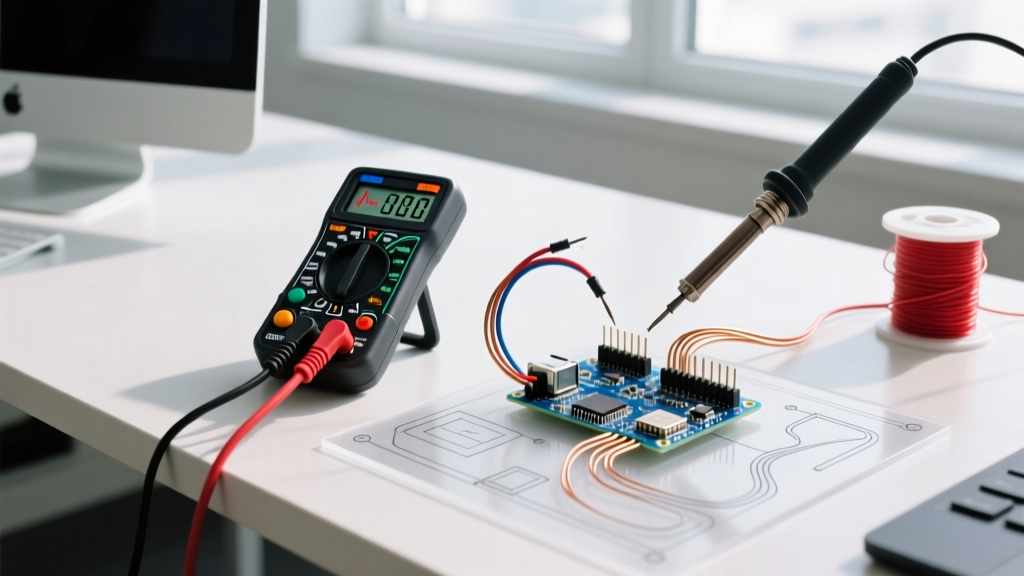
The Golden Rule: Never trust a single test point. Always use the Live-Dead-Live testing method with a CAT III or CAT IV rated multimeter.
- Live: Test your meter (e.g., Fluke T6-1000 or Klein Tools MM700) on a known live source to verify the meter is functioning.
- Dead: Test the target wires (hot to neutral, hot to ground, neutral to ground) to confirm zero voltage.
- Live: Test the known live source again to ensure the meter did not blow a fuse or fail during the second step.
For added safety, apply a physical Lockout/Tagout (LOTO) device to the breaker panel to prevent another household member from accidentally re-energizing the panel while you are terminating receptacles.
Step 2: Conductor Sizing and Voltage Drop Mitigation
Selecting the correct Non-Metallic (NM-B) cable is foundational. While 14 AWG is permitted for 15-amp lighting circuits, professional installers almost exclusively use 12 AWG (like Southwire Romex SIMpull 12/2 NM-B) for all 20-amp receptacle circuits to provide a thermal buffer and reduce voltage drop.
Standard Residential Wire Sizing Matrix
| Wire Gauge (Copper) | Max Breaker Size | Max Continuous Wattage (120V) | Recommended Max Run (3% Drop) | Common Application |
|---|---|---|---|---|
| 14 AWG | 15 Amp | 1,440W | 50 feet | General Lighting, Smoke Detectors |
| 12 AWG | 20 Amp | 1,920W | 60 feet | Kitchen/Dining Receptacles, Bathroom GFCI |
| 10 AWG | 30 Amp | 2,880W | 65 feet | Electric Dryers, Water Heaters (240V) |
| 8 AWG | 40 Amp | 3,840W | 75 feet | EV Chargers, Electric Ranges |
Note: NEC 210.19(A)(1) Informational Note recommends sizing conductors to prevent a voltage drop exceeding 3% at the furthest outlet. If your run from the panel to the final receptacle exceeds the distances above, you must upsize the wire gauge.
Step 3: The NEC 110.14(D) Torque Mandate
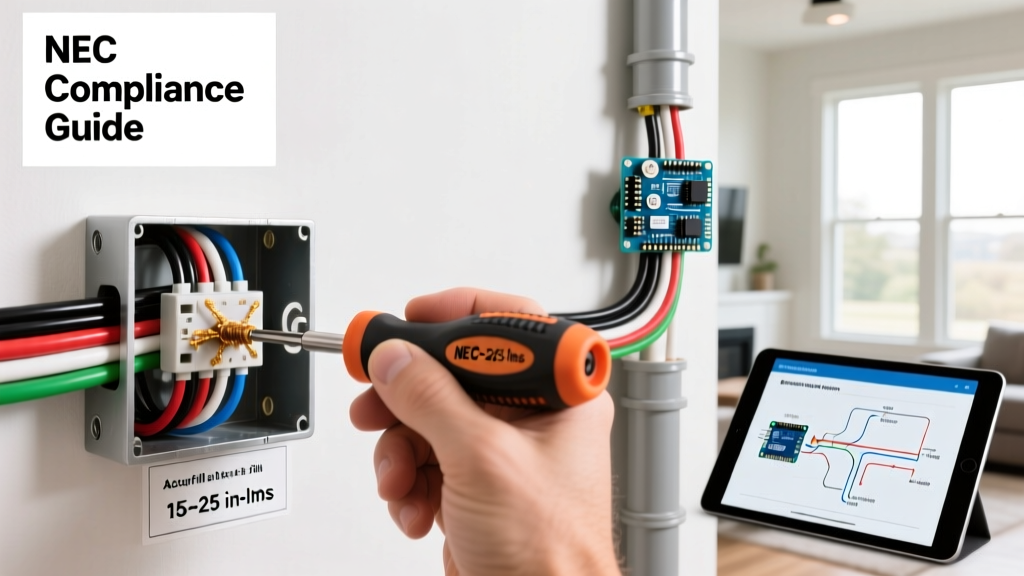
One of the most critical, yet frequently ignored, safety updates in modern electrical codes is NEC 110.14(D). This section mandates the use of calibrated torque tools for all electrical connections rated 100 amps or less. Hand-tightening screws by 'feel' is no longer acceptable or safe.
Why does this matter? Aluminum and copper conductors expand and contract at different rates under thermal load. A connection that feels tight in January can loosen by August due to thermal cycling, leading to high-resistance arcing and catastrophic fires.
- Tool Requirement: Use a calibrated torque screwdriver, such as the Milwaukee 48-22-4020 or Klein Tools 32500.
- Standard Torque Specs: Most standard 15A and 20A residential receptacles (e.g., Leviton T5262) require between 35 to 45 inch-pounds of torque. Always read the manufacturer's stamp on the device yoke.
- Breaker Terminals: Square D Homeline and Eaton BR series breakers typically require 40-50 inch-pounds for the main lug screws.
Step 4: AFCI and GFCI Protection Topologies
The Consumer Product Safety Commission (CPSC) heavily advocates for advanced circuit protection to prevent both shocks and fires. Modern electrical wiring installation in house environments requires dual protection in almost every room.
- GFCI (Ground Fault Circuit Interrupter): Protects against electrical shock by detecting current imbalances as small as 4-6 milliamps. Mandatory within 6 feet of water sources (kitchens, bathrooms, garages, outdoors).
- AFCI (Arc Fault Circuit Interrupter): Protects against fires by detecting the unique high-frequency signatures of arcing electricity. Mandatory in all living areas, bedrooms, hallways, and closets.
Pro-Tip: Instead of using expensive and bulky Dual Function (DF) receptacles, install Dual Function circuit breakers at the panel, such as the Eaton BR220CAF or Siemens Q220AFCI. This provides whole-branch protection, is easier to troubleshoot, and eliminates the need to crawl under cabinets to reset a tripped GFCI outlet.
Step 5: Box Fill Calculations (Preventing Overheating)
Cramming too many wires into a standard junction box compresses the conductors, damages insulation, and traps heat. NEC 314.16 dictates strict box fill calculations based on the volume of the box and the gauge of the wires.
Volume Allowance Per Conductor
- 14 AWG: 2.0 cubic inches per wire
- 12 AWG: 2.25 cubic inches per wire
- 10 AWG: 2.5 cubic inches per wire
Calculation Example: You are wiring a standard 12 AWG circuit through a single-gang plastic nail-on box. The box contains two 12/2 cables (4 current-carrying conductors), one ground wire bundle (counts as 1), and one receptacle device (counts as 2). Total count = 7. Multiply 7 by 2.25 cu in = 15.75 cubic inches required. A standard single-gang box is only 14 to 18 cubic inches. If you are using the 14 cu in box, you have violated code and created a fire hazard. Always use deep boxes (22+ cubic inches) for smart switches and dimmers, which have large internal heatsinks.
Top 3 Fatal Failure Modes in DIY Wiring
When inspecting residential wiring, master electricians consistently find the same dangerous shortcuts. Avoid these at all costs:
- Backstabbing (Push-In Connectors): Pushing stripped wires into the back of a receptacle relies on a tiny internal spring clip. These clips routinely fail under heavy loads (like vacuums or space heaters), causing arcing inside the wall. Solution: Always use the side-screw terminals or pigtail wires using Wago 221 lever-nuts.
- Bootleg Grounds: Connecting the ground screw of a receptacle to the neutral wire to trick a standard outlet tester into reading 'Correct'. This is incredibly lethal; if the neutral breaks upstream, the metal chassis of any plugged-in appliance becomes fully energized at 120V. Solution: If no ground wire exists, install a GFCI receptacle and label it 'No Equipment Ground' per NEC 406.4(D).
- Shared Neutrals (Multi-Wire Branch Circuits done wrong): Sharing a single neutral wire between two hot legs without tying the handles of the two breakers together. If an electrician turns off only one breaker to work on the circuit, the shared neutral will carry the return current from the other active leg, risking severe shock. Solution: Use a 2-pole breaker (e.g., Square D HOM220) with a common internal trip and tied handles.
Frequently Asked Questions
Can I mix 14 AWG and 12 AWG wire on the same 20-amp circuit?
No. While physically possible, NEC 240.4(D) strictly prohibits using 14 AWG wire on a 20-amp breaker. If any portion of the circuit utilizes 14 AWG wire, the entire circuit must be protected by a 15-amp breaker. The best practice is to maintain uniform wire gauges throughout a branch circuit to prevent future confusion.
Do I need a permit for an electrical wiring installation in house interiors?
Yes. According to the NFPA 70 (National Electrical Code) administrative guidelines adopted by most municipalities, any new circuit, panel upgrade, or substantial rewiring requires a permit and a rough-in/final inspection. Changing a single existing receptacle or switch usually does not require a permit, but adding new wiring always does.
What is the safest way to splice wires inside a junction box?
Traditional wire nuts (like Ideal 34 Yellow) are acceptable if twisted correctly, but modern push-in lever connectors, specifically the Wago 221 Series, are vastly superior for safety and reliability. They provide a gas-tight connection, allow for easy verification via the built-in test ports, and eliminate the risk of a wire nut vibrating loose over time.