
When planning a residential or commercial lighting layout, understanding the nuances of recessed lighting electrical wiring is the difference between a safe, code-compliant installation and a severe fire hazard. As of 2026, modern LED recessed luminaires draw significantly less power than legacy halogen or incandescent cans, but the National Electrical Code (NEC) still strictly governs the physical wiring methods, junction box fill capacities, and thermal protection requirements. This guide breaks down the critical code standards every electrician and advanced DIYer must follow when routing power to can lights.
Core NEC Articles Governing Recessed Lighting
The foundation of all recessed lighting electrical wiring falls under NFPA 70 (The National Electrical Code). Specifically, installers must navigate Article 410 (Luminaires, Lampholders, and Lamps) and Article 314 (Outlet, Device, Pull, and Junction Boxes). While the industry-wide shift to high-efficiency LED retrofit modules (drawing a mere 9W to 14W per unit in 2026) has drastically reduced circuit loading, the physical heat generated by the internal LED driver and the mechanical stress on wiring connections remain critical code focal points. Ignoring these articles frequently leads to failed municipal inspections and voided manufacturer warranties.
IC-Rated vs. Non-IC Rated: The Thermal Protection Mandate
One of the most misunderstood aspects of recessed lighting electrical wiring is the distinction between Insulation Contact (IC) rated and Non-IC rated housings. According to NEC Section 410.116, recessed luminaires installed in insulated ceilings must either be listed as IC-rated or maintain a strict 3-inch clearance from all combustible materials and insulation on all sides, except at the support points.
Thermal Protectors and Real-World Failure Modes
If you install a Non-IC housing (such as a legacy Halo H7T) and accidentally bury it in blown-in cellulose or fiberglass batts, the internal thermal protector will trigger. This bimetallic strip monitors the housing temperature; once it hits roughly 194°F (90°C), it cuts power to prevent a fire. The real-world symptom is a recessed light that randomly turns off, waits 15 minutes to cool down, and turns back on. To avoid this callback nightmare, always specify IC-AT (Insulation Contact, Air-Tight) rated housings for new construction, such as the Lithonia WF6 or Halo H5ICT series, which safely allow direct insulation contact and are rated for continuous operation up to 104°F ambient ceiling temperatures.
Junction Box Rules and Box Fill Calculations
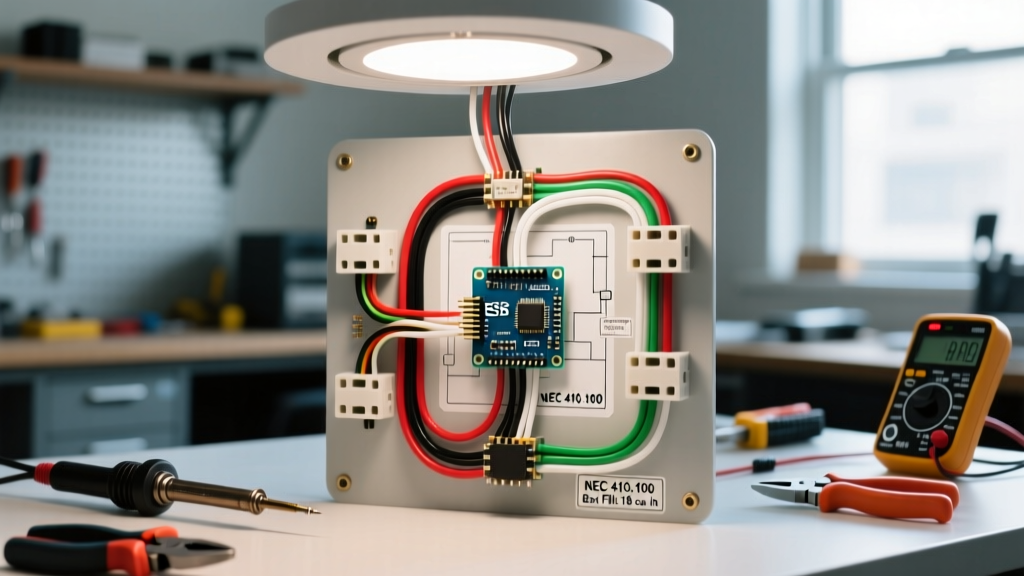
Recessed lighting fixtures feature an attached or remote junction box where the branch circuit wiring meets the fixture leads. NEC Article 314.16 dictates strict box fill capacities to prevent wire crushing, insulation damage, and subsequent short circuits. Every conductor entering and leaving the box counts toward the fill capacity, as do internal clamps and support fittings.
Below is the standard NEC 314.16(B) volume allowance chart used for calculating box fill in standard recessed lighting junction boxes:
| Wire Gauge | Volume Allowance per Conductor | Max Conductors in Standard 18 cu in Box |
|---|---|---|
| 14 AWG | 2.0 cubic inches | 9 conductors |
| 12 AWG | 2.25 cubic inches | 8 conductors |
| 10 AWG | 2.5 cubic inches | 7 conductors |
Note: Equipment grounding conductors count as a single conductor volume allowance based on the largest ground wire present in the box. Cable clamps also count as one conductor allowance.
Wiring Methods, Conductor Sizing, and Daisy-Chaining
For standard 120V residential recessed lighting electrical wiring, 14/2 NM-B (Romex) cable on a 15-amp breaker is the baseline. However, many professional electricians prefer pulling 12/2 NM-B on a 20-amp circuit to mitigate voltage drop on long daisy-chained runs. When daisy-chaining multiple recessed lights, the wiring enters the fixture's junction box, connects to the fixture leads, and a separate cable exits to the next light.
The Daisy-Chain Limit and Inrush Current
With modern 2026 LED recessed lights consuming only ~11W each, a 15-amp circuit (1,800W max, or 1,440W for continuous loads) could theoretically support over 130 fixtures. However, practical wiring limits this. Standard industry practice caps daisy-chains at 12 to 14 fixtures per run. This limitation is not based on steady-state wattage, but on inrush current. When you flip the switch, the capacitors inside 14 LED drivers charge simultaneously, creating a momentary current spike that can trip standard thermal-magnetic breakers or cause severe voltage sag, resulting in noticeable flickering at the farthest fixture in the chain.
Securing the Cable (NEC 334.30)
NEC 334.30 requires that NM-B cable be secured within 12 inches of the recessed light's junction box. Failing to staple or secure the cable within this distance is an immediate inspection failure. When routing cable into the knockout, you must use a listed cable connector (such as a Halex 3/8-inch plastic push-in connector) to protect the wire sheath from the sharp metal edges of the junction box.
Air-Tight (AT) Ratings and Energy Codes
Beyond the NEC, recessed lighting electrical wiring must comply with local energy codes, which increasingly adopt the International Energy Conservation Code (IECC). The U.S. Department of Energy's Building Energy Codes program highlights that unsealed recessed lights act as thermal chimneys, pulling conditioned air from the living space into the attic. As of 2026, most jurisdictions mandate that all recessed lights installed in ceilings bordering unconditioned spaces (like attics) must carry an Air-Tight (AT) rating. AT-rated fixtures feature sealed gaskets between the housing and the drywall, as well as sealed internal junction boxes, limiting air leakage to less than 2.0 CFM at 75 Pascals.
Top 5 Code Violations in Recessed Lighting Installations
Even experienced installers make mistakes when rushing through rough-in phases. Avoid these common NEC violations:
- Missing Cable Connectors: Pushing raw NM-B cable directly through a metal knockout without a clamp violates NEC 314.17(C) and risks severing the wire insulation over time due to vibration or thermal expansion.
- Over-Stripping Conductors: Exposing more than 1/2 inch of bare copper wire when using standard wire nuts or Wago 221 lever connectors. Bare copper should never be visible outside the connector, especially in the confined, warm space of a ceiling junction box.
- Improper Grounding Pigtails: Failing to bond the incoming equipment grounding conductor to the metal junction box using a green grounding screw or approved grounding clip. The box itself must be grounded, not just the fixture leads.
- Mixing Wire Gauges Improperly: Using 14 AWG pigtails inside a junction box that is fed by a 12 AWG 20-amp branch circuit. The entire circuit, including pigtails, must be rated for the breaker size.
- Burying Non-IC Transformers: If using low-voltage MR16 recessed lights, the magnetic or electronic transformer must remain accessible and cannot be buried in insulation unless specifically listed for such use.
Final Thoughts on Compliance and Safety
Proper recessed lighting electrical wiring requires a holistic understanding of both electrical safety and building science. By strictly adhering to NEC box fill calculations, respecting IC and AT ratings, and managing daisy-chain lengths to account for LED inrush currents, you ensure a lighting system that is safe, efficient, and fully compliant with 2026 building standards. Always verify local municipal amendments to the NEC, as local inspectors may have stricter interpretations regarding junction box accessibility and insulation clearances.