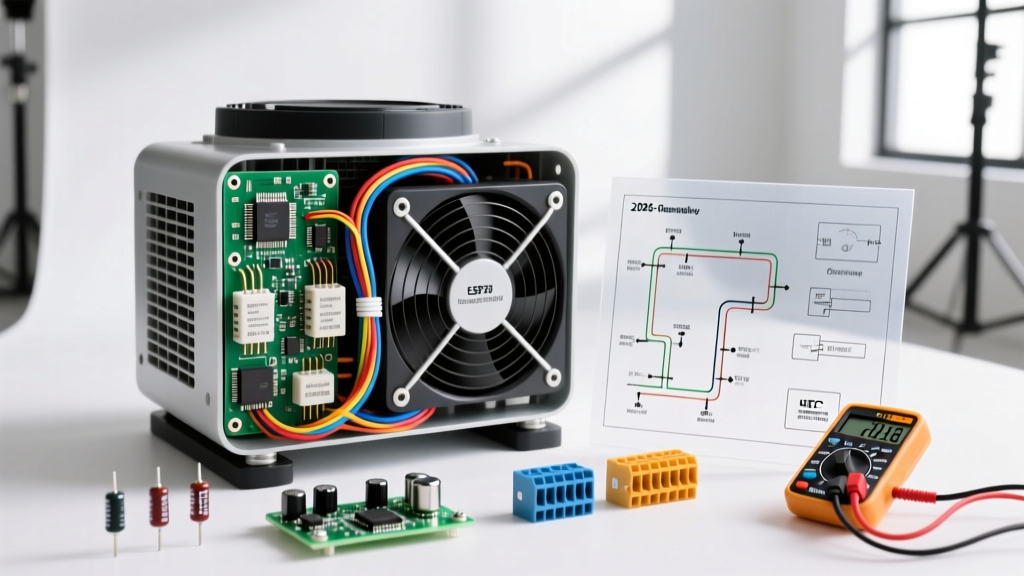

The True Cost of Wiring a Swamp Cooler in 2026
Evaporative coolers, commonly known as swamp coolers, remain one of the most energy-efficient cooling solutions for dry climates. However, transitioning from a portable unit to a hardwired, roof-mounted or side-draft whole-house system requires professional-grade electrical work. If you are planning an installation in 2026, understanding the nuances of swamp cooler electrical wiring is critical for both safety and budgeting.
With copper wire prices stabilizing but skilled electrician labor rates climbing to an average of $115 to $165 per hour in 2026, accurate cost estimation requires a granular breakdown. This guide details the exact materials, labor variables, and National Electrical Code (NEC) requirements you need to budget for a compliant and reliable evaporative cooler circuit.
120V vs. 240V Swamp Cooler Circuits: Which Do You Need?
The voltage requirement dictates your breaker size, wire gauge, and overall material costs. Most residential swamp coolers (like the popular MasterCool ADA55 5500 CFM) feature 1/2 HP to 1 HP motors that can be wired for either 120V or 240V. While 120V is convenient for short runs, 240V is vastly superior for roof-mounted units due to reduced voltage drop and smaller wire gauge requirements over long distances.
| Feature | 120V Dedicated Circuit | 240V Dedicated Circuit |
|---|---|---|
| Best Application | Side-draft / Window units (under 50 ft run) | Roof-mounted / Whole-house (over 50 ft run) |
| Typical Motor Size | 1/2 HP to 3/4 HP | 3/4 HP to 1.5 HP |
| Breaker Requirement | 1-Pole 20A | 2-Pole 15A or 20A |
| Wire Gauge (Copper) | 12 AWG THWN-2 | 14 AWG or 12 AWG THWN-2 |
| Avg. Material Cost | $140 - $210 | $165 - $260 |
| Total Installed Cost (2026) | $650 - $1,100 | $800 - $1,450 |
Material Cost Breakdown: What You Are Actually Buying
To estimate your swamp cooler electrical wiring costs accurately, you must account for outdoor-rated materials. Standard indoor NM-B (Romex) cable is strictly prohibited by the NEC for outdoor and wet location runs. You must use individual THWN-2 stranded conductors pulled through conduit.
1. Conduit and Fittings
For exterior wall runs to the roof, 3/4-inch Schedule 40 PVC or 3/4-inch EMT (Electrical Metallic Tubing) is standard. In 2026, a 10-foot stick of 3/4" PVC costs approximately $8.50, while EMT is around $11.00. You will also need weatherproof conduit bodies (LB fittings), PVC sweeps, and liquidtight flexible metal conduit for the final connection to the cooler's junction box to absorb motor vibration.
- 3/4" PVC Conduit (100 ft): ~$85.00
- 3/4" EMT Conduit (100 ft): ~$110.00
- Liquidtight Flex Metal (15 ft roll): ~$32.00
2. Wire and Breakers
For a standard 240V, 1/2 HP motor circuit, 14 AWG THWN-2 copper is technically permissible, but most electricians standardize on 12 AWG to allow for future motor upgrades and to mitigate voltage drop. A 250-foot spool of 12 AWG stranded THWN-2 costs roughly $45.00 in 2026. You will need four conductors for a 120V setup (Hot, Neutral, Ground, and a spare) or three for a 240V setup (Hot 1, Hot 2, Ground).
- 12 AWG THWN-2 Copper (250 ft spool): $45.00
- 2-Pole 20A Standard Breaker: $16.00
- 2-Pole 20A GFCI Breaker (if required by AHJ): $58.00
3. The Disconnect Switch
A critical component in swamp cooler wiring is the outdoor disconnect. The Square D D221NRB (30A, 240V, non-fused) is an industry standard for this application, featuring a NEMA 3R weatherproof enclosure. Expect to pay between $38 and $45 for a reliable disconnect switch.
Labor Rates and Installation Variables
Labor will comprise 60% to 75% of your total swamp cooler electrical wiring cost. In 2026, licensed electricians charge between $115 and $165 per hour, depending on your regional market. A standard roof-mounted cooler wiring job takes between 5 and 8 hours.
Pro Tip: If your electrical panel is located on the opposite side of the house from the cooler, expect labor costs to increase by $300 to $500. Electricians will need to dig a shallow trench (18 inches deep) to run underground PVC conduit, or spend hours fishing wire through attic spaces and interior walls.
Common Labor Scenarios:
- Direct Exterior Run (4-5 Hours): The panel is near the exterior wall where the cooler is mounted. Conduit is strapped directly to the outside wall. Estimated Labor: $460 - $825.
- Attic-to-Roof Penetration (6-7 Hours): Wire is run through the attic to avoid exterior conduit, requiring roof flashing and a weatherproof roof jack. Estimated Labor: $690 - $1,155.
- Underground Trenching (8-10 Hours): Required for detached structures or complex rooflines. Includes digging, laying Schedule 80 PVC, and backfilling. Estimated Labor: $920 - $1,650.
NEC Code Requirements You Cannot Ignore
Failing to adhere to the National Electrical Code (NEC) can result in failed inspections, voided equipment warranties, and severe fire hazards. When wiring an evaporative cooler, your electrician must comply with several specific articles:
Article 430: Motors, Motor Circuits, and Controllers
Swamp cooler motors are inductive loads. Under NEC Article 430.52, the branch-circuit short-circuit and ground-fault protective device (the breaker) must be sized to handle the motor's starting surge, which can be up to 250% of the full-load amperage (FLA). This is why a 1/2 HP motor drawing only 6 amps at 240V still requires a 15A or 20A breaker.
Article 430.102: Disconnecting Means
You cannot simply rely on the breaker in the main panel to serve as the disconnect. The NEC mandates that an individual disconnect switch must be located within sight of the motor controller. This is why the weatherproof disconnect switch mounted on the roof or side wall next to the cooler is a non-negotiable code requirement.
Article 425 & 440 Considerations
While evaporative coolers are not vapor-compression air conditioners (which fall strictly under Article 440), local Authorities Having Jurisdiction (AHJ) often apply similar outdoor equipment grounding rules. Ensure your equipment grounding conductor (EGC) is sized correctly and bonded to both the disconnect enclosure and the cooler's chassis.
Hidden Costs: Permits, Upgrades, and Edge Cases
When budgeting for your swamp cooler electrical wiring, set aside a contingency fund for these frequently overlooked expenses:
- Electrical Permits: Most municipalities require a permit for running a new dedicated 240V circuit. Permit fees typically range from $75 to $150 in 2026.
- Panel Capacity Upgrades: If your main service panel is maxed out, you may need to install a subpanel or upgrade to a 200A service, which can add $1,500 to $3,500 to the project.
- Roof Flashing Repair: If the old cooler mount compromised the roof's integrity, an electrician or roofer may need to install new flashing and sealant around the conduit penetration ($150 - $300).
- Smart Thermostat Integration: Upgrading to a smart thermostat that controls the cooler's pump and blower independently requires running a low-voltage 24V control wire alongside the high-voltage conduit, adding about $120 in labor and materials.
Troubleshooting Common Wiring Failures
Even after installation, swamp coolers present unique electrical challenges. The most common failure mode in DIY or poorly executed installs is thermal overload tripping. This occurs when voltage drop on a long 120V run causes the motor to draw excess amperage to maintain torque, eventually tripping the motor's internal thermal protector. According to the U.S. Department of Energy, proper sizing and maintenance of evaporative coolers are essential for efficiency; this extends directly to the electrical supply. Always calculate voltage drop for runs exceeding 50 feet, and upsize your wire from 12 AWG to 10 AWG if the drop exceeds 3%.
Final Thoughts on Your 2026 Installation
Investing in proper swamp cooler electrical wiring ensures your unit operates safely, quietly, and efficiently for decades. While the upfront cost of pulling 240V THWN-2 through EMT conduit and installing a Square D disconnect may seem steep, it prevents the catastrophic motor failures and fire risks associated with undersized, code-violating shortcuts. Always hire a licensed electrician familiar with NEC Article 430 motor requirements to guarantee your home stays cool and compliant.