
The Unique Challenges of Emmaus Electrical Systems
Undertaking an electrical wiring installation in Emmaus, Pennsylvania, presents a distinct set of challenges that generic wiring guides simply do not cover. Known for its charming historic district, tree-lined streets, and a mix of pre-1940s plaster-and-lathe homes alongside mid-century ranch builds, Emmaus requires electricians and advanced DIYers to navigate aging infrastructure, strict local amendments, and specific utility provider mandates. As of 2026, Pennsylvania’s enforcement of the Uniform Construction Code (UCC) and updated National Electrical Code (NEC) standards means that legacy wiring methods are no longer permissible for remodels or new branch circuits.
Whether you are upgrading a service panel on Chestnut Street or running new AFCI-protected circuits in a 1960s home near Macungie Road, troubleshooting failures during or after installation requires local expertise. This guide breaks down the most common failure modes, inspection red flags, and technical solutions specific to electrical wiring installations in the Emmaus borough.
PPL Electric Meter Base & Panel Upgrade Bottlenecks
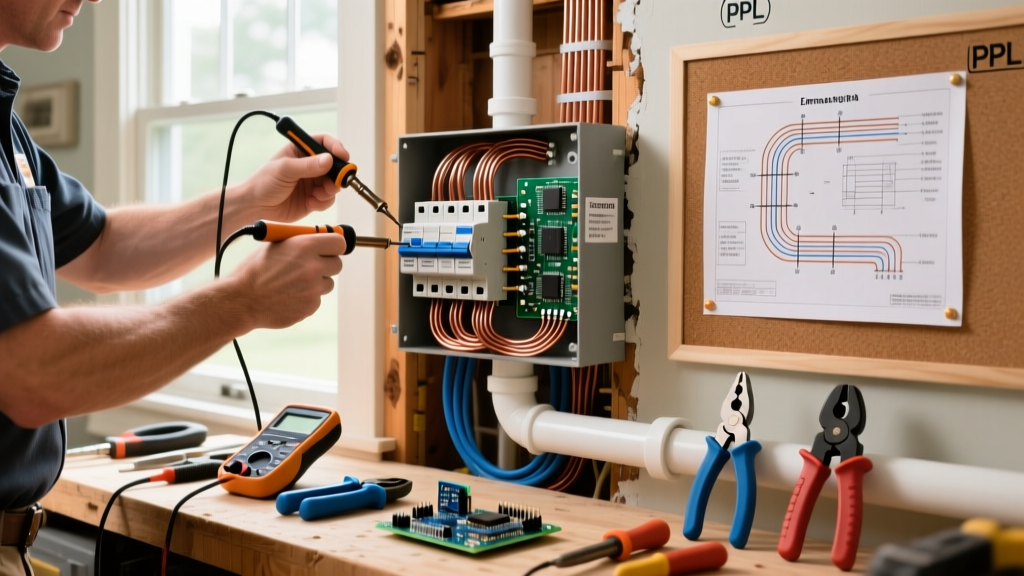
The most frequent point of failure during a heavy-up (upgrading from 100A to 200A service) in Lehigh County involves the utility provider’s specific equipment requirements. PPL Electric Utilities has strict standards for meter sockets and service entrance cables. If your installation fails the PPL inspection, they will not set the meter, leaving the home without power.
Common PPL Inspection Failures and Fixes
- Incorrect Meter Socket Model: PPL requires a 200A, ringless, 4-jaw meter socket with a bypass lever. The Milbank M9196-XS-AD-FC or Siemens WP4221 are the standard approved models in the Emmaus area. Using a 5-jaw or ring-type socket will result in an immediate rejection.
- Improper Lug Torque: The service entrance conductors (typically 4/0 AWG Aluminum or 2/0 AWG Copper) must be torqued to the manufacturer’s specifications, usually between 40 and 50 inch-pounds. PPL inspectors frequently use calibrated torque screwdrivers to verify this. Hand-tightening is no longer acceptable under 2026 NEC 110.14(D) requirements.
- Service Mast Weatherhead Clearance: If installing an exterior rigid metal conduit (RMC) service mast, PPL requires a minimum 12-foot clearance from the ground to the bottom of the drip loop, and the mast must be supported within 24 inches of the weatherhead.
2026 Service Upgrade Cost & Material Matrix
| Component | 100A Legacy System | 200A Modern Upgrade (2026 Specs) | Estimated Lehigh Valley Cost |
|---|---|---|---|
| Main Panel | Federal Pacific / Zinsco (Hazardous) | Square D QO 200A (QOM2200VH) Main Breaker | $450 - $650 |
| Meter Socket | Ring-type, 100A continuous | Milbank M9196-XS-AD-FC (Ringless, 200A) | $220 - $300 |
| Service Conductors | #2 AWG Aluminum (Degraded) | 4/0 AWG Aluminum SER Cable | $4.50 - $6.00 per linear ft |
| Total Project Avg. | N/A | Full 200A Heavy-Up | $3,200 - $4,800 |
Troubleshooting AFCI/GFCI Nuisance Tripping in Pre-1980s Homes
Under current NFPA National Electrical Code standards enforced via the Pennsylvania UCC, virtually all 15A and 20A, 120V branch circuits in living spaces require Arc-Fault Circuit Interrupter (AFCI) protection, while kitchens, bathrooms, and exteriors require Ground-Fault Circuit Interrupter (GFCI) protection. When retrofitting these breakers into older Emmaus homes, nuisance tripping is the number one troubleshooting headache.
The Shared Neutral (MWBC) Problem
Homes built in Emmaus between 1965 and 1985 frequently utilized Multi-Wire Branch Circuits (MWBCs) to save copper. These circuits share a single neutral wire between two hot legs (usually on a 240V double-pole breaker). If you replace a standard breaker with a single-pole AFCI or GFCI breaker on an MWBC, the breaker will trip immediately upon applying a load because the returning neutral current does not match the outgoing hot current.
The Fix: You must use a Double-Pole AFCI/GFCI breaker (e.g., Square D QO220AFCI) specifically designed to monitor the net vector sum of both hot legs and the shared neutral. Alternatively, you must pull new dedicated 12/2 NM-B Romex cables for each circuit, abandoning the shared neutral—a costly endeavor in plaster-and-lathe walls.
Degraded Wire Insulation and Micro-Arcing
Older rubber-insulated or early PVC Romex cables found in the borough's historic district can develop micro-fractures in the insulation. Standard breakers ignore this, but modern combination-type AFCI breakers (like the Siemens QA115AFCI) detect the high-frequency signatures of series arcing and trip the circuit.
Troubleshooting Step: Use a digital insulation resistance tester (Megger) set to 500V DC. Test the hot-to-ground and neutral-to-ground resistance. A reading below 2 Megohms indicates degraded insulation that will cause persistent AFCI tripping, necessitating a complete circuit rewire.
Grounding Failures: The PEX Pipe Epidemic in Lehigh County
One of the most dangerous and frequently missed issues during an electrical wiring installation in Emmaus involves the grounding electrode system. Homes built prior to 1980 relied heavily on the underground metallic copper water pipe as the primary grounding electrode. Over the last decade, thousands of Lehigh County homeowners have replaced their failing copper water lines with PEX (cross-linked polyethylene) plumbing.
CRITICAL WARNING: PEX is non-conductive. If a home's copper water service line was replaced with PEX from the street to the house, the electrical panel has likely lost its primary grounding electrode. This creates a severe shock hazard and prevents surge protective devices (SPDs) from functioning correctly.
How to Verify and Restore the Ground
- Inspect the Water Main: Check where the water service enters the basement or crawlspace. If it is plastic or PEX, the metallic water pipe ground is invalid.
- Install Supplementary Ground Rods: Drive two 5/8-inch by 8-foot copper-clad steel ground rods into the earth, spaced at least 6 feet apart, near the exterior wall closest to the panel.
- Run a New GEC: Install a continuous, unspliced 4 AWG bare copper Grounding Electrode Conductor (GEC) from the panel's neutral/ground bar to the ground rods using acorn clamps.
- Test Resistance: Use a 3-point fall-of-potential ground tester. The NEC requires a resistance to ground of 25 ohms or less. If the first rod reads higher than 25 ohms, the second rod is mandatory to bring the resistance down.
Navigating Emmaus Borough Permits and Historic District (HARB) Rules
Troubleshooting an electrical installation isn't just about physics; it's about bureaucracy. The Emmaus Borough Code Enforcement office (located at 58 S 10th St) requires electrical permits for all panel upgrades, new circuits, and service alterations. Furthermore, if the property is located within the Emmaus Historic District Overlay (HDO), exterior wiring modifications trigger an additional layer of review.
Exterior Conduit and the HARB
If your troubleshooting requires rerouting the exterior service entrance conduit (such as moving a meter base to comply with PPL's new height requirements), you cannot simply run bare silver EMT (Electrical Metallic Tubing) on the exterior of a historic facade. The Emmaus Historic Architectural Review Board (HARB) requires that all exterior surface-mounted raceways be painted to match the existing trim or masonry color. Failing to do so will result in a code violation and a stop-work order, even if the electrical installation itself is perfectly safe and NEC-compliant.
Summary Checklist for Emmaus Inspections
Before calling the borough for a rough-in or final inspection, verify the following site-specific requirements:
- Panel Labeling: All breakers must be labeled with specific room descriptions (e.g., 'Master Bed North Receptacles', not just 'Bedroom').
- AFCI/GFCI Documentation: Ensure all combination-type AFCI breakers are used for living spaces, and dual-function (CAFCI/GFCI) breakers are used for kitchens and laundry areas as per the latest UCC adoption.
- PPL Coordination: Confirm the temporary power release or meter set appointment with PPL Electric Utilities via their official builder portal at least 48 hours before the final borough inspection.
- Smoke/CO Interconnection: Verify that all hardwired smoke and carbon monoxide detectors are on a dedicated, AFCI-protected circuit and feature a red traveler wire for interconnection, ensuring all units sound when one detects a hazard.
By understanding the intersection of modern NEC mandates, PPL utility requirements, and Emmaus's unique architectural landscape, you can troubleshoot and resolve electrical wiring issues efficiently, ensuring a safe, code-compliant, and fully energized home.