
Navigating the Electrical Code for Garage Outlets
The garage is arguably the most demanding environment in a modern home. Unlike climate-controlled living spaces, garages are subjected to extreme temperature fluctuations, high humidity, combustible dust, and the heavy, continuous draw of power tools and electric vehicles. Because of these unique hazards, the electrical code for garage outlets is stringent, prioritizing shock prevention and fire mitigation above all else. Whether you are finishing a new build or upgrading a legacy workspace in 2026, understanding and exceeding the National Electrical Code (NEC) requirements is non-negotiable for safety and compliance.
Core NEC Mandates for Garage Receptacles
The NEC (specifically Article 210) outlines precise rules for garage wiring. Ignoring these can lead to failed inspections, voided home insurance policies, and severe shock hazards.
The 20-Amp Dedicated Circuit Rule (NEC 210.11(C)(4))
Modern electrical codes require that garages be supplied by at least one dedicated 120-volt, 20-ampere branch circuit. This circuit must serve only the garage and any outdoor receptacles accessible from the garage. You cannot daisy-chain garage outlets with interior bedroom or living room circuits. This dedicated 20A circuit ensures that running a heavy-draw tool (like a 15-amp table saw) alongside a dust collector or space heater will not immediately trip the breaker or overheat the wiring.
GFCI Protection: Your First Line of Defense (NEC 210.8(A)(2))
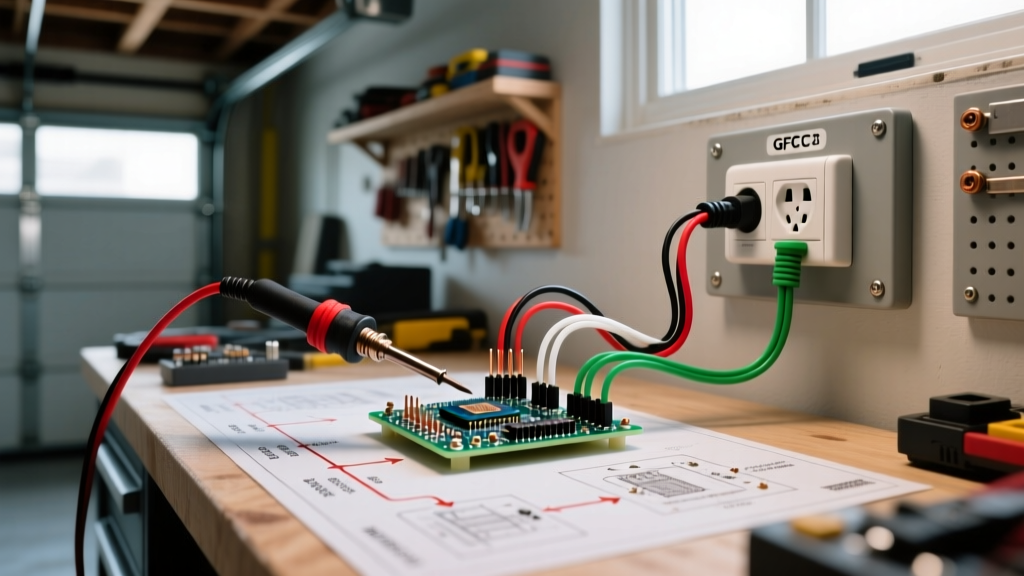
Every 125-volt, single-phase, 15- and 20-ampere receptacle installed in a garage must have Ground-Fault Circuit Interrupter (GFCI) protection. Concrete garage floors act as a massive, grounded heat sink. If a faulty power tool leaks current and you are standing on damp concrete, the shock can be fatal. GFCIs detect ground faults as small as 4 to 6 milliamps and cut power in a fraction of a second. According to the U.S. Consumer Product Safety Commission (CPSC), GFCIs prevent thousands of electrical shocks annually.
Inspector's Pro-Tip: While point-of-use GFCI receptacles (like the Leviton GFNT2-W) are common, many 2026 electrical panels now utilize Dual Function (DF) circuit breakers that combine both Arc Fault (AFCI) and Ground Fault (GFCI) protection in a single breaker, satisfying code while freeing up neutral pigtails in crowded junction boxes.
Strategic Placement and Spacing Guidelines
The NEC does not enforce the strict '6-foot wall spacing' rule in unfinished garages that it does in living rooms, but it does mandate specific placements to prevent the use of dangerous extension cords across concrete floors.
- Vehicle Bays (NEC 210.52(G)): You must install at least one receptacle in each designated car bay. This is intended for block heaters, EV chargers, and basic maintenance tools.
- Workbenches: While not strictly codified by exact measurements in the base NEC, local amendments almost universally require a dedicated receptacle within 24 inches of any fixed workbench surface.
- Height Requirements: The ADA and general best practices dictate mounting standard garage receptacles between 18 and 24 inches from the finished floor. However, for workbench outlets, mounting them 48 inches high (above the backsplash) prevents cord strain and keeps plugs away from spilled liquids.
Garage Wiring Compliance Matrix
Selecting the right wire gauge, breaker size, and receptacle type is critical. The table below outlines the standard configurations for various garage applications based on current NEC guidelines.
| Application | Receptacle Type | Breaker Size | Wire Gauge (Copper) | GFCI Required? |
|---|---|---|---|---|
| General Purpose / Workbench | 15A or 20A Duplex (NEMA 5-15R / 5-20R) | 20 Amp | 12 AWG | Yes |
| Heavy Air Compressor | 20A Twist-Lock (NEMA L6-20R) or 30A | 20A or 30 Amp | 12 AWG or 10 AWG | No (if >125V or >20A)* |
| Level 2 EV Charger | 50A Range (NEMA 14-50R) | 50 Amp | 6 AWG (or 4 AWG for long runs) | No (EVSE handles GFCI) |
| Welder (240V) | 50A Range (NEMA 6-50R) | 40A or 50 Amp | 8 AWG or 6 AWG | No |
*Note: The 2023/2026 NEC expanded GFCI requirements to include 250V and up to 50A receptacles in garages (NEC 210.8(F)). However, hardwired EV chargers and specific 240V welder setups have distinct exception pathways. Always consult your local Authority Having Jurisdiction (AHJ).
Specialized Circuits: EV Chargers and Heavy Machinery
As electric vehicle adoption accelerates in 2026, the Department of Energy strongly recommends installing dedicated Level 2 charging infrastructure. A standard NEMA 14-50R receptacle is the gold standard for plug-in EV chargers like the ChargePoint Home Flex or Emporia Vue.
Wiring a NEMA 14-50R Safely
Do not use cheap, residential-grade 14-50 receptacles for EV charging. Continuous loads (defined as running for 3+ hours) generate immense heat. Standard $15 receptacles often suffer from loose internal busbars, leading to melting and fires. You must use an industrial-grade receptacle like the Hubbell HBL9450A (typically priced between $90 and $120) or the Bryant 9450FR. These feature heavy-duty phenolic bodies and robust terminal clamps designed to handle continuous 40-amp draws without thermal degradation.
Avoiding Critical Failure Modes in Garage Wiring
Even when you follow the electrical code for garage outlets, poor installation techniques can compromise the entire system. Watch out for these common failure modes:
- The 'Backstab' Push-In Connection: Never use the push-in holes on the back of a 15A or 20A receptacle. These rely on a small spring clip that can loosen over time due to thermal expansion and contraction. Under a heavy 16A continuous load, a loose backstabbed connection will arc, melt the plastic housing, and cause a fire. Always use the side terminal screws, or buy 'back-wire' receptacles that feature internal screw-tightened clamps.
- Undersized Wiring for Long Runs: Garages are often located at the far end of the main panel. If your cable run from the breaker to the first garage outlet exceeds 75 feet, voltage drop becomes a severe issue. A 12 AWG wire on a 75+ foot run will experience significant voltage sag when a motorized tool starts up, potentially burning out the tool's capacitor. Solution: Upsize to 10 AWG NM-B or THHN wire for long runs to keep voltage drop under the recommended 3% threshold.
- Exposed NM-B (Romex) Cable: In unfinished garages with exposed wall studs, you cannot simply staple Romex to the face of the studs where it is vulnerable to physical damage (NEC 330.15). You must either bore holes through the center of the studs, run the wire behind a drywall barrier, or protect the exposed cable using 1/2-inch EMT (Electrical Metallic Tubing) conduit or rigid wood guards.
Step-by-Step: Wiring a Compliant 20A GFCI Receptacle
Follow this procedure to install a code-compliant Leviton GFNT2-W 20A Tamper-Resistant GFCI in your garage workbench zone.
- Prep the Wire: Using a precision wire stripper (like the Klein 11055), strip exactly 3/4 inch of insulation from the 12 AWG black and white wires. Stripping too little results in insulation under the screw washer; stripping too much leaves exposed bare copper outside the terminal, creating a shock hazard.
- Form the J-Hook: Bend the bare copper ground wire and the stripped conductors into a tight 'J' hook using needle-nose pliers.
- Connect to Terminals: Hook the black (hot) wire onto the brass 'LINE' terminal, the white (neutral) onto the silver 'LINE' terminal, and the bare ground to the green screw. Ensure the hook wraps clockwise around the screw so that tightening the screw pulls the hook tighter.
- Torque to Spec: Using a calibrated torque screwdriver, tighten the terminal screws to 14 in-lbs (or the manufacturer's specified torque). This ensures optimal contact pressure without stripping the brass threads.
- Pigtail Downstream: If feeding additional standard outlets down the line, connect them to the 'LOAD' terminals on the GFCI. This extends the ground-fault protection to the entire downstream circuit, a highly recommended safety practice in damp garage environments.
Final Thoughts on Code Compliance
Adhering to the electrical code for garage outlets is not just about passing a municipal inspection; it is about engineering a resilient, fire-safe environment. By utilizing 20A dedicated circuits, mandating GFCI protection, investing in industrial-grade EV receptacles, and executing precision terminations, you future-proof your garage against the heavy electrical demands of the modern era. Always reference the latest edition of the NFPA 70 National Electrical Code and consult with a licensed electrician or your local building department before energizing new circuits.