
The Core Mandate: Navigating NEC Article 210.52(C)
When planning a kitchen remodel or new construction, the electrical code for kitchen counter outlets is one of the most heavily scrutinized areas by local inspectors. The National Electrical Code (NEC), specifically Article 210.52(C), dictates exactly how, where, and what type of receptacles must be installed to prevent the use of dangerous extension cords across hot stovetops and wet sinks. As of the current 2026 landscape, adhering to the latest NEC iterations (2023 and upcoming 2026 drafts) is critical for both safety and passing final inspections.
The fundamental rule is simple: no point along the wall line behind a countertop can be more than 24 inches from a receptacle. However, the nuances regarding islands, peninsulas, and specific appliance clearances separate a professional-grade installation from a failed inspection.
The 24-Inch and 12-Inch Spacing Rules Explained
NEC 210.52(C)(1) outlines the spacing requirements for wall-mounted countertops. To be code-compliant, you must measure the continuous horizontal space along the wall.
- The 12-Inch Trigger: Any countertop space that is 12 inches or wider requires at least one receptacle outlet.
- The 24-Inch Maximum: Receptacles must be placed so that no point along the wall line is more than 24 inches (measured horizontally) from a receptacle outlet.
- Breaks in the Counter: Sinks, ranges, and cooktops divide the countertop into separate spaces. Each resulting space must be measured independently to determine if it meets the 12-inch minimum width.
Countertop Spacing Matrix
| Continuous Counter Width | Minimum Receptacles Required | Maximum Distance Between Outlets |
|---|---|---|
| Less than 12 inches | 0 (Not required, but permitted) | N/A |
| 12" to 28" | 1 | 24" from any point to outlet |
| 29" to 52" | 2 | 48" between outlets (24" radius) |
| 53" to 76" | 3 | 48" between outlets |
Small-Appliance Branch Circuits (SABCs): Powering the Kitchen
You cannot simply extend an existing living room circuit into the kitchen. NEC 210.11(C)(1) mandates that all kitchen countertop receptacles must be supplied by at least two 20-ampere small-appliance branch circuits (SABCs).
Wiring and Breaker Specifications
- Wire Gauge: You must use a minimum of 12 AWG copper wire (e.g., Southwire 12/2 NM-B for standard runs, or 12 AWG THHN in EMT conduit for commercial or exposed finishes). 14 AWG wire is strictly prohibited on 20A circuits.
- Breaker Sizing: Each circuit requires a dedicated 20A breaker (e.g., Eaton BR220 or Square D HOM220). Depending on your local jurisdiction's adoption of AFCI mandates, you may need a Dual Function (AFCI/GFCI) breaker, which costs approximately $45–$65 per pole compared to $8 for a standard breaker.
- No Lighting or Fixed Appliances: These two circuits must serve only countertop receptacles, wall-mounted ovens, and refrigeration equipment. You cannot wire under-cabinet LED lighting or a hardwired dishwasher to a SABC.
Pro-Tip for Remodels: While the code requires a minimum of two SABCs, high-end kitchens with heavy plug-in loads (multiple air fryers, stand mixers, espresso machines) benefit vastly from running a third or even fourth 20A circuit. The marginal cost of an extra $60 for 12/2 wire and a $15 breaker prevents nuisance tripping during holiday cooking.
GFCI and Tamper-Resistant Mandates
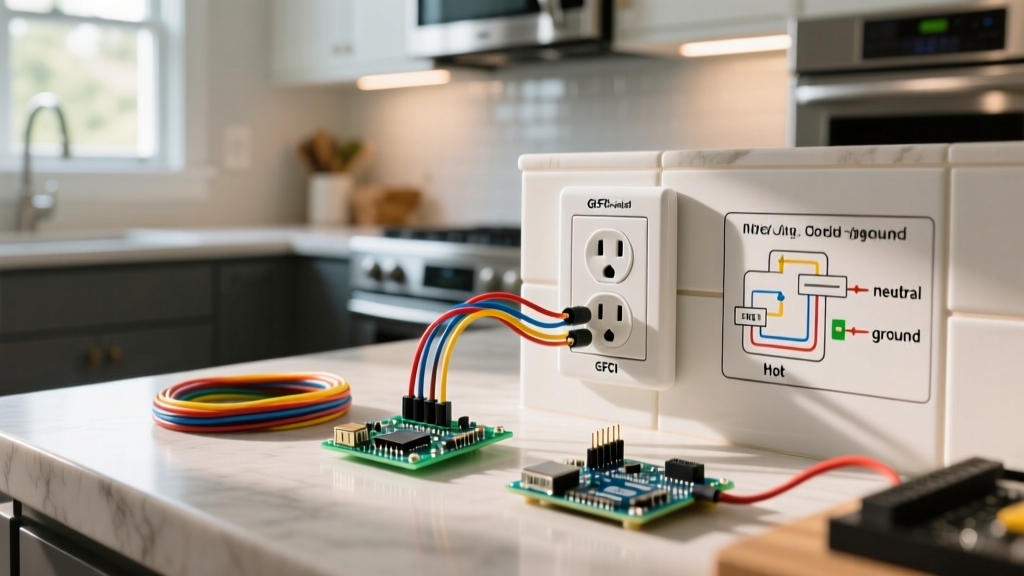
Water and electricity are a lethal combination. Under NEC 210.8(A)(6), all 125-volt through 250-volt, single-phase, 15- and 20-ampere receptacles installed in kitchens must have Ground-Fault Circuit Interrupter (GFCI) protection. Furthermore, NEC 406.12 requires all residential kitchen receptacles to be Tamper-Resistant (TR).
Equipment Selection: Receptacle vs. Breaker Protection
You have two code-compliant paths to achieve GFCI protection:
- GFCI Receptacles: Using devices like the Leviton Decora 20A TR GFCI (Model R52-GFTNL-00W), which retails for $18–$25. You can wire downstream standard TR receptacles to the "LOAD" terminals of the GFCI to protect multiple outlets on the same run.
- GFCI Circuit Breakers: Installing a 20A GFCI breaker in the main panel and using standard 20A TR receptacles (like the Leviton T5262-W, ~$6 each) at the counter. This is often preferred in kitchens with limited backsplash space where bulky GFCI bodies crowd the junction box.
For comprehensive safety standards regarding ground faults, the U.S. Consumer Product Safety Commission (CPSC) strongly advocates for GFCI testing monthly, a task made easier when using breaker-level protection or easily accessible backsplash devices.
The Massive Code Shift: Islands and Peninsulas
If you are reading older DIY guides, you will find outdated information regarding kitchen islands. For decades, the NEC required at least one receptacle on every island and peninsula. This changed drastically in the 2023 NEC (Section 210.52(C)(2)) and carries forward into 2026 code adoptions.
Why the Rule Changed
Fire departments and safety advocates noted a severe hazard: cords from slow cookers or blenders plugged into island outlets would drape across the edge. Children or adults could snag the cord, pulling boiling contents directly onto themselves. Consequently, the NEC removed the requirement to install outlets on islands and peninsulas.
Current Rules for Island Installations
- Not Mandatory: You are no longer forced to install an outlet on an island.
- If You Choose to Install: If the homeowner or designer requests an island outlet, it must still be GFCI protected.
- Prohibited Mounting: Receptacles cannot be installed facing upward on the countertop surface (where spills can enter the slots). They must be mounted on the side of the cabinet, provided they are not more than 12 inches below the countertop, and the cabinet must have a lip or edge to prevent cords from sliding off.
Prohibited Locations and Edge Cases
Knowing where not to place an outlet is just as critical as knowing the spacing rules. The electrical code for kitchen counter outlets explicitly forbids certain placements to prevent fire and shock hazards.
- Behind the Sink: Receptacles cannot be installed directly behind a kitchen sink. The cord of an appliance plugged in behind the sink would have to cross the water basin to reach the counter, creating an extreme shock hazard.
- Behind the Range/Cooktop: Similarly, outlets cannot be placed behind a range or cooktop. Heat from the burners can degrade wire insulation, and reaching behind a hot stove to unplug a device is a severe burn risk.
- Face-Up Surfaces: NEC 406.5(E) prohibits receptacles from being installed in a face-up position on countertops, as liquid spills will pool directly into the electrical contacts. (Note: Specialized, UL-listed pop-up assemblies with spill ratings exist, but standard wall receptacles turned flat are illegal).
Material Cost Breakdown for a Standard Kitchen Rough-In
To help you budget for a code-compliant kitchen wiring project, here is a realistic 2026 material estimate for a standard 12-foot L-shaped kitchen run requiring 6 countertop receptacles across two SABCs:
| Material | Specification | Estimated Cost |
|---|---|---|
| 12/2 NM-B Wire | 150 ft. roll (Southwire or Cerro) | $85.00 |
| 20A TR GFCI Receptacles | 2x Leviton R52-GFTNL (Line/Load) | $42.00 |
| 20A TR Standard Receptacles | 4x Leviton T5262-W (Downstream) | $24.00 |
| 20A Breakers | 2x Eaton BR220 (Standard) | $16.00 |
| Deep Junction Boxes | 6x 22-cu-in Old Work / Nail-on | $18.00 |
| Total Materials | Excluding conduit, trim plates, and labor | ~$185.00 |
Frequently Asked Questions (FAQ)
Can I use a 15-amp receptacle on a 20-amp kitchen circuit?
Yes. NEC 210.21(B)(3) allows 15-ampere receptacles to be installed on a 20-ampere circuit, provided there is more than one receptacle on the circuit (a duplex outlet counts as two). However, the receptacle itself must still be rated for the circuit, and most electricians prefer using 20A-rated receptacles (which feature the T-slot neutral) in kitchens to accommodate heavy-duty commercial-style appliance plugs.
Do under-cabinet lighting circuits count as SABCs?
No. NEC 210.23 and 210.11(C)(1) clearly separate lighting loads from small-appliance branch circuits. You must run a separate, dedicated 15A or 20A lighting circuit for your under-cabinet LEDs, puck lights, and overhead kitchen lighting. Tapping into the countertop GFCI circuit for lighting will result in an immediate inspection failure.
What is the maximum height for a kitchen counter outlet?
The NEC does not specify a strict maximum height above the countertop for receptacles, but it does state they must be located "above but not more than 20 inches above the countertop surface" (NEC 210.52(C)(5) exception for accessibility). In standard practice, electricians place the center of the junction box 18 to 24 inches above the finished floor, which typically lands the outlet 2 to 6 inches above the standard 36-inch countertop, keeping it safely away from baseboard trim and backsplash tile lines.
For the most authoritative and up-to-date code adoptions in your specific municipality, always consult the National Fire Protection Association (NFPA) NEC resources and your local Authority Having Jurisdiction (AHJ) before pulling wire.