
The Blueprint for Safe Exterior Illumination
Designing a landscape lighting system or wiring exterior architectural sconces goes far beyond simply connecting a fixture to a power source. When executing electrical wiring for outdoor lights, electricians and advanced DIYers must navigate a complex matrix of National Electrical Code (NEC) standards designed to mitigate shock hazards, prevent moisture intrusion, and ensure long-term circuit integrity. As local jurisdictions continue to adopt the 2023 NEC and look toward 2026 code cycles, the requirements for exterior wiring have become increasingly stringent, particularly regarding Ground Fault Circuit Interrupter (GFCI) protection and underground burial depths.
This comprehensive guide decodes the critical NEC articles governing exterior lighting circuits, providing actionable specifications, material recommendations, and installation parameters to ensure your project passes inspection and withstands the elements.
Decoding Wet vs. Damp Locations (NEC Article 100)
The foundation of outdoor electrical compliance begins with correctly classifying the installation environment. NEC Article 100 strictly defines the difference between wet and damp locations, which directly dictates the UL listing required for your fixtures and junction boxes.
- Damp Locations: Areas protected from direct weather exposure but still subject to moderate moisture and condensation. Examples include covered porches, deep eaves, and interior spaces of unheated garages. Fixtures here must carry a UL Damp rating.
- Wet Locations: Areas exposed to direct weather, rain, snow, and soil contact. This includes open yard landscaping, uncovered decks, and exterior walls subject to wind-driven rain. Fixtures and enclosures must carry a UL Wet rating and typically feature IP65 or IP67 ingress protection.
Code Note: Installing a damp-rated fixture under a shallow eave where wind-blown rain can reach the socket is a frequent code violation. Always default to Wet-rated (IP65+) fixtures for any exterior wall mount to eliminate inspector callbacks.
Approved Cable Types for Exterior Runs
Selecting the correct conductor for outdoor environments is critical. Standard NM-B (Romex) is strictly prohibited in wet/damp locations and underground runs. Below is a comparison matrix of the approved wiring methods for exterior lighting circuits.
| Cable / Conductor Type | NEC Article | Primary Use Case | Est. Material Cost (per ft) |
|---|---|---|---|
| UF-B (12/2 or 14/2) | 339 | Direct burial landscape runs, underground feeder to detached post lights. | $0.85 - $1.10 |
| THWN-2 in PVC Conduit | 310 / 352 | Long runs, high-traffic areas, commercial exterior lighting, under driveways. | $0.45 (wire) + $1.20 (conduit) |
| Direct Burial MC (Metal Clad) | 330 | Commercial landscape, areas requiring physical crush protection without PVC. | $2.50 - $3.10 |
| SJOOW / SOOW (Flexible Cord) | 400 | Prohibited for permanent fixed outdoor lighting wiring (temporary use only). | N/A |
For most residential landscape lighting, Southwire 12/2 UF-B is the industry standard. While 14 AWG is permissible for 15-amp lighting circuits, upgrading to 12 AWG mitigates voltage drop over long trench runs (exceeding 50 feet) and future-proofs the circuit for LED expansion.
Trenching and Burial Depth Requirements (NEC Table 300.5)
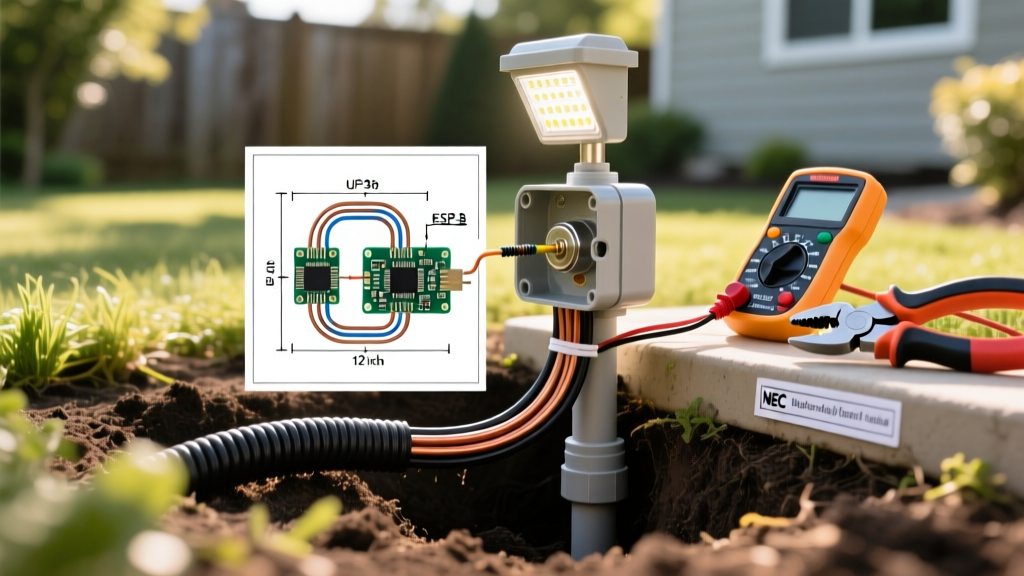
One of the most heavily scrutinized aspects of electrical wiring for outdoor lights is the underground trench depth. NEC Table 300.5 outlines the minimum cover requirements to protect conductors from accidental excavation and frost heave.
Minimum Cover Depths for 120V Residential Lighting:
- 24 Inches: Direct burial UF-B cable without conduit protection.
- 18 Inches: THWN-2 conductors inside Schedule 40 PVC conduit.
- 12 Inches: Direct burial UF-B cable only if the circuit is limited to 120V, 20A or less, AND is protected by a GFCI breaker at the panel.
- 6 Inches: Rigid Metal Conduit (RMC) or Intermediate Metal Conduit (IMC).
Pro-Tip for Rocky Soil: If you cannot achieve 24 inches of depth due to bedrock, you must transition the UF-B cable into Schedule 80 PVC conduit where it rises from the trench, and encase the shallow horizontal run in at least 2 inches of concrete to satisfy the physical protection requirements of NEC 300.5(D).
GFCI Protection and Receptacle Mandates
The evolution of NEC Article 210.8 has drastically expanded GFCI requirements. Under current and upcoming 2026 code adoptions, all 125-volt to 250-volt, single-phase, 15- and 20-ampere receptacles installed outdoors must have GFCI protection. Furthermore, if your outdoor hardwired lighting is daisy-chained from or supplied through an outdoor receptacle, the entire circuit requires GFCI protection.
For dedicated hardwired lighting panels, GFCI protection is not strictly mandated by NEC 210.8 unless the circuit also feeds an exterior outlet. However, many local jurisdictions and landscape lighting manufacturers strongly recommend GFCI protection for low-voltage transformers (120V primary side) to prevent shock hazards from moisture ingress in the transformer housing.
Recommended Hardware: Use a Square D QO120GFI or Eaton BR120GFT GFCI breaker at the main panel rather than a GFCI receptacle in a weatherproof box. Panel-level GFCIs are less prone to nuisance tripping from ambient moisture and eliminate the need to maintain a weatherproof receptacle enclosure solely for circuit protection.
Junction Boxes and Splicing in the Elements
Splicing wires in the dirt is a guaranteed way to fail an inspection and cause a ground fault within six months. NEC 300.5(E) requires all underground splices to be accessible or made with listed kits. For exterior lighting, proper splicing techniques are non-negotiable.
- Above-Ground Splices: Must be housed in a NEMA 3R (rain-tight) or NEMA 4 (watertight) junction box. The Bell 1-Gang Die-Cast Weatherproof Box is a staple for mounting architectural sconces where the wall junction cannot be perfectly sealed.
- Underground Splices: Standard wire nuts will corrode and fail. You must use silicone-filled, moisture-sealing wire connectors like the King Innovation DryConn series or 3M Direct Bury splice kits. These encapsulate the copper connection in a waterproof resin.
- Conduit Bodies: When pulling THWN-2 through PVC, use PVC conduit bodies (LB, LL, or C-types) with neoprene gaskets to maintain the watertight seal of the raceway system.
Common Code Violations to Avoid
Electrical inspectors frequently flag the same exterior wiring mistakes. Avoid these critical failures to ensure a smooth sign-off:
- Missing Warning Ribbons: NEC 300.5(D)(3) requires a continuous warning ribbon (usually bright yellow or red) placed 12 inches above any direct-buried UF-B cable or conduit. Failing to lay this ribbon before backfilling is an automatic red tag.
- Exposed NM-B at Transitions: Running interior Romex (NM-B) directly into an exterior wall cavity and splicing it without a proper junction box, or allowing the NM-B jacket to extend outside the building envelope where it is exposed to UV and moisture.
- Conduit Filled with Water: While PVC conduit underground is considered a "wet location" by the NEC, failing to use duct seal (sealing putty) where the conduit enters the house or a light post allows water to wick via capillary action directly into your interior breaker panel or fixture housing.
- Improper Fixture Support: Mounting heavy architectural lanterns directly to drywall or siding without anchoring to a structural stud or using a listed fan-rated/fixture-rated exterior box (NEC 314.27).
Frequently Asked Questions
Can I use standard indoor LED recessed cans under an outdoor soffit?
No. Standard indoor IC-rated recessed housings are not listed for damp or wet locations. Moisture will condense inside the housing, destroying the LED driver and creating a shock hazard. You must use housings specifically marked "Suitable for Damp Locations" (for covered soffits) or "Wet Locations" (for exposed eaves).
Do low-voltage (12V) landscape lights require a permit?
Generally, the Class 2 low-voltage wiring on the secondary side of the transformer does not require an electrical permit or fall under strict NEC Article 300 burial depths (though 6 inches is recommended). However, the 120V primary wiring feeding the transformer does require a permit, GFCI protection, and must meet all standard outdoor wiring codes.
Authoritative References
To ensure your electrical wiring for outdoor lights complies with the highest safety standards, always consult the most recent code publications and safety organizations: