
Decoding the Secondary Hot: What Is the Red Wire in Electrical Wiring?
When peeling back the gray PVC sheathing of a standard NM-B (Romex) cable or pulling conductors through EMT conduit, the black wire typically claims the spotlight as the primary ungrounded (hot) conductor. However, professional electricians and advanced DIYers frequently encounter a secondary colored conductor. So, what is the red wire in electrical wiring? In North American AC power systems, the red wire serves as a secondary hot wire, a switched leg, or a traveler wire, carrying the exact same lethal voltage potential as the black wire.
Understanding the material properties, National Electrical Code (NEC) applications, and specific tooling required for red conductors is critical for safe installation. This material and tool guide breaks down the exact specifications, failure modes, and code-compliant practices for working with red electrical wires in 2026.
NEC Code Note: The National Fire Protection Association (NFPA 70) does not strictly mandate specific colors for ungrounded conductors in residential single-phase systems, but industry standard and NEC 215.12(C) dictate that red is universally recognized as a secondary hot or Phase B conductor. Treat it as live at all times.
Core Applications: Where Red Wires Are Deployed
The red wire is not a generic spare; it is engineered for specific circuit topologies where a single neutral must be shared, or where multiple switching points are required.
1. Multi-Wire Branch Circuits (MWBC)
In an MWBC, a 3-wire cable (e.g., 12/3 NM-B) contains a black hot, a red hot, and a white neutral. The black and red wires are connected to opposite phases (Line 1 and Line 2) of a 240V split-phase panel. Because the AC waveforms are 180 degrees out of phase, the currents cancel each other out on the shared neutral. If the red and black wires are mistakenly placed on the same phase, the neutral wire will carry the combined amperage (e.g., 20A + 20A = 40A), overheating the 12 AWG neutral and causing a catastrophic fire.
2. 3-Way and 4-Way Switch Travelers
When wiring a staircase or hallway to control a single light from two locations, the red wire acts as a 'traveler' alongside the black wire, carrying the switched current between the two 3-way switches. In 4-way switch setups, the red and black wires form the traveler pairs entering and exiting the intermediate switch.
3. Interconnected Smoke and CO Detectors
Modern building codes require hardwired smoke detectors to be interconnected. In a 14/3 NM-B cable, the black wire provides 120V power, the white is the neutral, and the red wire serves as the interconnect signal line. When one detector senses smoke, it sends a 120V signal down the red wire, triggering all alarms in the daisy chain simultaneously.
4. Ceiling Fan Motor and Light Separation
For independent wall control of a ceiling fan's motor and its integrated light kit, a 12/3 or 14/3 cable is run from a dual-switch wall box. The black wire powers the fan motor, while the red wire powers the light fixture, allowing users to toggle them independently without relying on pull chains.
Material Specifications and Insulation Types
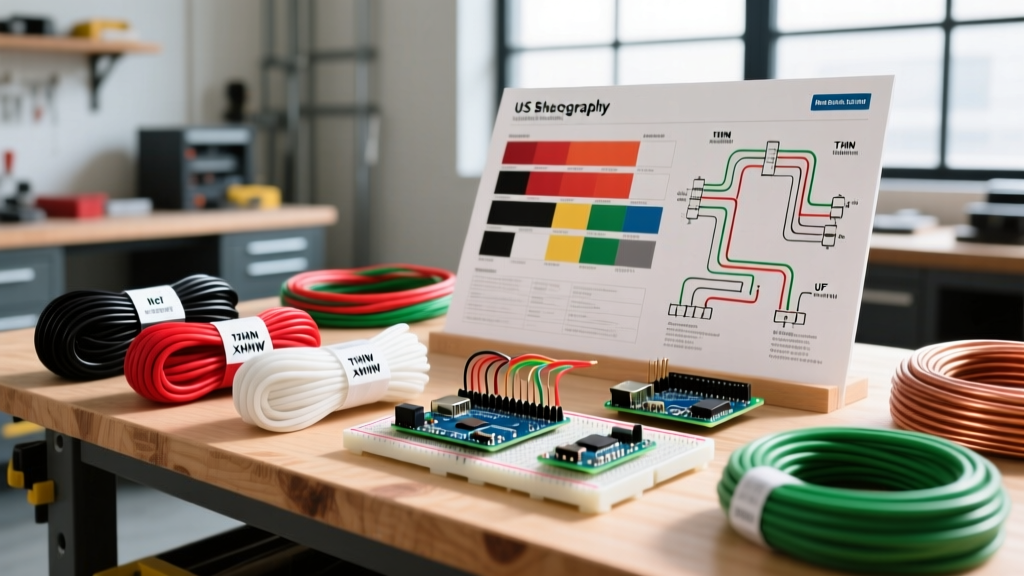
The physical construction of the red wire dictates its ampacity, thermal tolerance, and installation environment. Below is a comparison of the most common red conductor materials available on the market today.
| Wire Type | Gauge (AWG) | Insulation Material | Max Temp Rating | NEC Ampacity (60°C Column) | 2026 Avg. Cost |
|---|---|---|---|---|---|
| Southwire SIMpull NM-B | 14 AWG | PVC with Nylon Jacket | 90°C (Rated at 60°C) | 15 Amps | $0.48 / ft |
| Southwire THHN | 12 AWG | PVC with Nylon Jacket | 90°C | 20 Amps | $0.39 / ft |
| Cerro XHHW-2 | 10 AWG | XLPE (Cross-Linked) | 90°C (Wet/Dry) | 30 Amps | $0.65 / ft |
| Southwire UF-B | 12 AWG | Solid PVC (Moisture Res.) | 90°C (Rated at 60°C) | 20 Amps | $0.85 / ft |
Material Insight: While THHN and NM-B conductors feature a 90°C insulation rating, NEC Table 310.16 requires that ampacity for standard residential terminations (like standard 15A or 20A receptacles) be calculated using the 60°C column. XHHW-2 is superior for commercial conduit pulls because its cross-linked polyethylene (XLPE) insulation is thinner, reducing pulling friction, and it is rated for wet locations, unlike standard THHN which is only THWN-2 rated for specific wet conditions.
Essential Tools for Working with Secondary Hots
Working with red wires in complex topologies like MWBCs or 3-way switches requires precision tools to prevent nicking the copper, which creates high-resistance hot spots.
- Wire Strippers: The Klein Tools 11063W (14-10 AWG) is the industry standard for solid copper NM-B conductors. It features a compound-lever action that scores the PVC without biting into the copper. Priced around $28, it prevents the micro-fractures that cheap automatic strippers often cause on 12 AWG wire.
- Voltage Testing: Because red wires are often travelers or switched legs, they can be 'dead' when a switch is off. Always verify with a Fluke 117 True RMS Multimeter (~$215). Non-contact testers like the Fluke 2AC VoltAlert (~$35) are excellent for initial sweeps but can yield false positives due to capacitive coupling from adjacent live black wires in the same sheath.
- Pigtail Connectors: When landing multiple red traveler wires or MWBC pigtails, use IDEAL INDUSTRIES PowerPlug or standard Wago 221 Series lever nuts. The Wago 221-413 (3-conductor lever nut, ~$0.75 each) allows for secure, vibration-proof connections without the risk of tape unraveling inside a crowded 3-gang switch box.
Critical Safety and Code Compliance
The Occupational Safety and Health Administration (OSHA) and the NEC enforce strict rules regarding the handling of secondary ungrounded conductors to prevent arc flashes and electrocution.
The Handle-Tie Mandate (NEC 210.4)
If you are wiring an MWBC using a red and black wire on a split-phase system, NEC 210.4(B) mandates a simultaneous disconnect. This means you must use a double-pole breaker or apply an approved handle tie (such as the Bryant BRHT for Eaton panels, ~$6) to two adjacent single-pole breakers. This ensures that if a homeowner turns off the black wire's breaker to replace a receptacle, the red wire's breaker is also killed, preventing a lethal shock from the shared neutral return path.
Phase Identification in Conduit
In commercial 120/208V 3-phase systems, red is typically designated as Phase B. If you are pulling individual THHN conductors, NEC 215.12(C) requires that if you use a color other than the standard orange/brown/yellow for 208V, you must permanently identify the phase at every termination point using colored phase tape (e.g., 3M Scotch 35 Series vinyl tape, ~$4/roll).
Troubleshooting Common Red Wire Failures
When a circuit involving a red wire malfunctions, the issue usually stems from one of three specific failure modes:
- Open Neutral on an MWBC: If devices on the black wire work, but devices on the red wire are experiencing severe voltage drop or over-voltage (e.g., reading 145V or 90V instead of 120V), the shared white neutral has likely disconnected at a wire nut upstream. The red and black circuits are now forming a series 240V circuit, destroying 120V appliances.
- Traveler Miswiring in 3-Way Switches: If a 3-way switch only works when the other switch is in the 'up' position, the red traveler and the black 'common' wire have been swapped on the switch terminals. The red wire must always be paired with the black traveler on the brass screws, while the line/load hot goes to the black (common) screw.
- Induced Voltage on Switched Legs: When testing a red wire acting as a switched leg to a light fixture with a high-impedance digital multimeter, you may read 40V-60V even when the switch is off. This is 'ghost voltage' caused by capacitive coupling from the parallel live black wire in the 14/3 cable. Use a low-impedance (LoZ) tester to confirm it is truly dead.
Frequently Asked Questions
Can I use a red wire as a neutral?
No. NEC 200.6 strictly requires grounded (neutral) conductors to be white or gray. Using a red wire as a neutral, even if wrapped in white tape, is a severe code violation and poses a massive shock hazard to future electricians who will assume it is a hot wire.
Is the red wire always hot?
In standard AC wiring, yes, the red wire is an ungrounded (hot) conductor. However, in low-voltage DC applications (like thermostat wiring or USB power), red is universally used as the positive voltage supply, while black or blue serves as the ground or common.
What gauge should I use for a red wire on a 20A circuit?
For any 20-amp breaker, the red conductor must be a minimum of 12 AWG copper. If you are running a 12/3 NM-B cable for an MWBC on a 20A double-pole breaker, both the black and the red wires inside that sheath are 12 AWG and properly rated for the load.