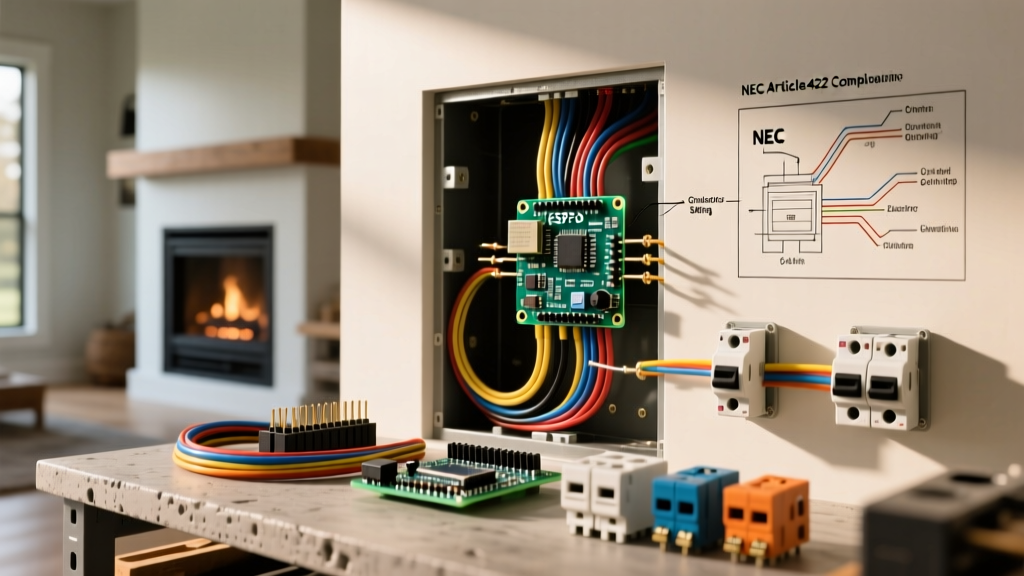

The Intersection of Gas and Electricity: A 2026 Code Perspective
Installing a modern gas fireplace is no longer just about routing a gas line and venting exhaust. Today’s high-efficiency models, such as the Heatilator Novus series or the Napoleon Ascent™ X, rely heavily on electrical integration for intermittent pilot ignition (IPI), variable-speed blowers, and LED accent lighting. As an electrical professional or advanced DIYer, understanding the precise gas fireplace electrical wiring requirements is critical for both safety and compliance. The National Electrical Code (NEC) treats these units as appliances, subjecting them to specific overcurrent, grounding, and accessibility rules. This guide breaks down the exact NEC articles, wire gauges, and installation parameters you need to execute a flawless, code-compliant installation in 2026.
Core NEC Articles Governing Gas Fireplace Wiring
When pulling wire for a gas hearth appliance, you must navigate several intersecting NEC articles. According to the National Fire Protection Association (NFPA 70), the following sections are your primary guardrails:
- Article 422 (Appliances): Gas fireplaces with electrical blowers or electronic ignition are classified as appliances. Section 422.10 dictates branch-circuit sizing, while 422.13 covers storage-type water heaters (often confused, but distinct from hearth products).
- Article 110.3(B) (Installation and Use): This is the golden rule of electrical inspections. Listed equipment must be installed in accordance with the manufacturer’s instructions. If the Napoleon or Majestic installation manual specifies a dedicated circuit, the NEC mandates you provide one, even if the amperage draw technically allows sharing.
- Article 250 (Grounding and Bonding): The metal chassis of the fireplace and the electrical junction box must be bonded to the equipment grounding conductor (EGC). Relying on the gas pipe for grounding is a severe violation and a massive shock hazard.
- Article 314 (Outlet, Device, Pull, and Junction Boxes): Dictates the accessibility and sizing of the junction box where the 120V branch circuit terminates inside the fireplace’s lower control cavity.
Ignition Systems: Millivolt vs. Electronic (IPI)
Before sizing your circuit, you must identify the ignition system. The electrical demands of a standing pilot millivolt system are vastly different from a modern electronic ignition system.
| Feature | Millivolt (Standing Pilot) | Electronic Ignition (IPI) |
|---|---|---|
| Ignition Power Source | Thermopile (generates ~750mV DC) | 120V AC stepped down to 24V AC |
| 120V AC Requirement | Optional (only for blower/lights) | Mandatory (for spark and gas valve) |
| Battery Backup | Not required (pilot stays lit) | Required (usually 4x AA batteries) |
| Typical Max Amperage | 2.5A (Blower only) | 3.5A (Ignition module + Blower) |
Circuit Sizing, Wire Gauge, and Voltage Drop
Most residential gas fireplaces draw between 1.5A and 3.5A at 120V. While this low amperage might tempt you to tap into an existing living room receptacle circuit, doing so often violates the manufacturer’s requirement for a dedicated line. Furthermore, shared circuits introduce the risk of a tripped breaker plunging the room into darkness and killing the heat source simultaneously.
Selecting the Right NM-B Cable
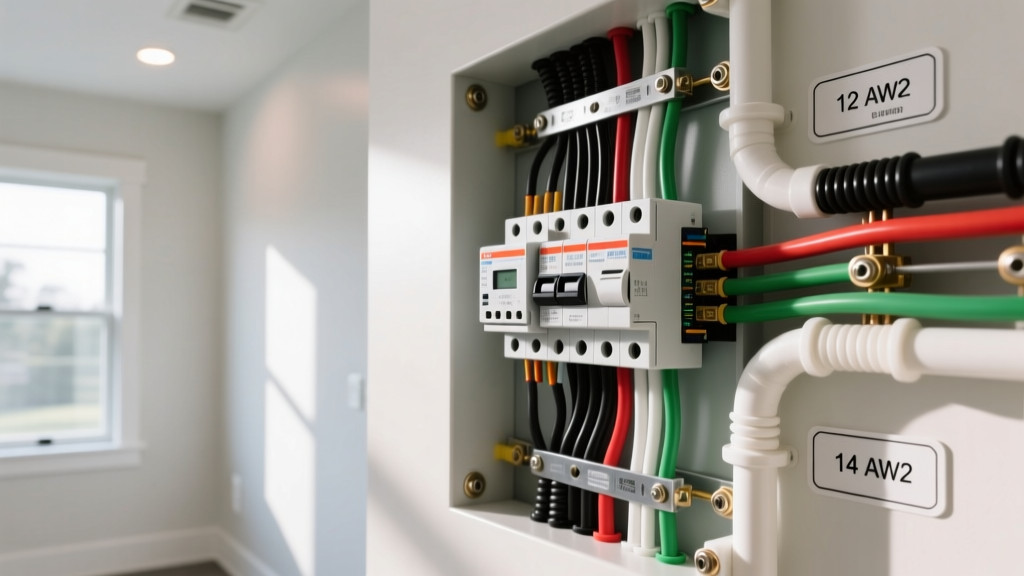
For runs under 50 feet from the main panel, 14/2 NM-B (Romex) on a 15-amp single-pole breaker is the legal minimum and perfectly adequate for a 3A load. However, in 2026, with copper prices stabilizing around $1.60 per linear foot for 14/2 and $2.30 for 12/2, the industry best practice is to pull 12/2 NM-B on a 20-amp breaker. This provides a robust margin for voltage drop, especially in large custom homes where the fireplace might be 80 feet from the subpanel. Voltage drop below 114V can cause IPI control modules to fail to spark, resulting in lockout codes.
The GFCI Conundrum: To Protect or Not to Protect?
One of the most heavily debated topics in hearth electrical wiring is Ground Fault Circuit Interrupter (GFCI) protection. Does a gas fireplace require a GFCI breaker or receptacle?
Expert Insight: The NEC does not explicitly mandate GFCI protection for a dedicated fireplace receptacle unless it is located within 6 feet of a wet bar sink (Article 210.8) or the junction box is situated in a crawlspace or unfinished basement. However, most hearth manufacturers explicitly forbid GFCI protection in their manuals. Why? Because the high-frequency noise generated by the IPI spark igniter can cause nuisance tripping on sensitive GFCI devices. If a GFCI trips in the dead of winter, the fireplace shuts down. Always defer to Article 110.3(B) and the manufacturer’s manual: if they say no GFCI, the inspector will fail you if you install one.
Step-by-Step Junction Box and Grounding Standards
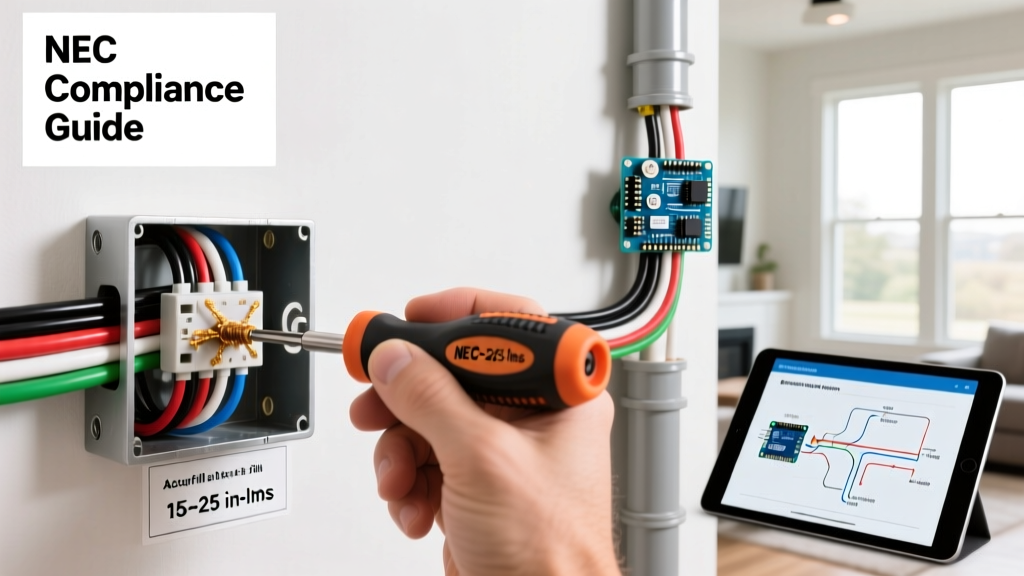
The physical termination of the wiring inside the fireplace surround is where most code violations occur. Follow this sequence to ensure compliance with UL 127 and ANSI Z21.50 standards:
- Locate the Knockout: Identify the factory-installed junction box or the designated cable knockout in the lower control cavity. Never drill your own hole into the firebox or outer wrapper without using a listed cable clamp.
- Secure the Cable: Strip the NM-B jacket and secure the cable to the junction box using a standard 3/8-inch NM cable connector. The cable must be stapled within 8 inches of the box (per NEC 334.30).
- Maintain Clearances: Ensure the wiring remains at least 1/2 inch away from the actual firebox metal and any hot flue pipes. If the wire must cross a hot zone, it must be protected by a fiberglass heat shield or routed through rigid metal conduit (RMC).
- Ground the Chassis: Terminate the bare copper EGC to the green grounding screw inside the junction box. Additionally, run a bonding jumper from the junction box to the fireplace’s main chassis grounding lug to ensure the outer metal louvers cannot become energized.
- Leave Service Slack: Leave exactly 6 inches of wire slack inside the box. Too much slack crowds the cavity and blocks airflow to the control module; too little makes future module replacement impossible without pulling new wire.
Common Code Violations and Failure Modes
According to data from the U.S. Fire Administration (USFA), improper installation of heating equipment remains a leading cause of residential fires. When it comes to gas fireplaces, electrical faults rarely cause massive structural fires, but they do cause catastrophic component failure. Watch out for these specific failure modes:
- Shared Neutrals (Multi-Wire Branch Circuits): If you use a 14/3 cable to feed a fireplace and an adjacent outlet on different phases, a lost neutral can send 240V through the fireplace’s 120V control board, instantly vaporizing the IPI module. Always use a dedicated 2-wire circuit.
- Buried Junction Boxes: Framers and drywallers frequently bury the fireplace junction box behind the cement board or stone veneer. NEC Article 314.29 requires all junction boxes to be accessible without removing any part of the building structure. Always use the manufacturer’s provided access panel.
- Thermopile Wire Melting: On millivolt systems, the low-voltage wires connecting the thermopile to the gas valve are often routed too close to the pilot flame. The PVC insulation melts, shorting the millivolt signal and causing the main burner to drop out unexpectedly.
- Missing Equipment Ground: Using the metal gas flex line as a grounding path. This is a lethal violation. The gas line must be bonded separately per NFPA 54, but the appliance must have a dedicated copper EGC back to the panel.
Frequently Asked Questions
Can I plug a gas fireplace into a standard wall outlet?
Only if the manufacturer’s installation manual explicitly permits it and the cord is provided by the factory. Most built-in, zero-clearance gas fireplaces require hardwiring into an internal junction box to maintain the unit’s UL listing and fire-clearance ratings. Freestanding gas stoves, however, often come with a standard 3-prong plug.
Do I need an AFCI breaker for the fireplace circuit?
Under NEC Article 210.12, Arc Fault Circuit Interrupter (AFCI) protection is required for all 120V, 15A and 20A branch circuits supplying outlets in living rooms, family rooms, and bedrooms. Since most gas fireplaces are installed in these areas, the circuit breaker in the main panel must be a Combination Type AFCI, unless the junction box is classified as a non-outlet hardwired appliance connection by your local AHJ (Authority Having Jurisdiction).
What happens if the power goes out?
If you have a modern IPI system wired with a battery backup module (usually installed in the lower cavity), the fireplace will continue to ignite and provide radiant heat during a power outage, though the blower will not function. Millivolt systems will continue to operate perfectly without any grid power or batteries, as the pilot flame generates its own electricity.
For further reading on safe home heating installations and electrical standards, always consult the Consumer Product Safety Commission (CPSC) fire safety guidelines and your local municipal building department before closing up any walls.