
The Hidden Dangers of Sensor Light Wiring
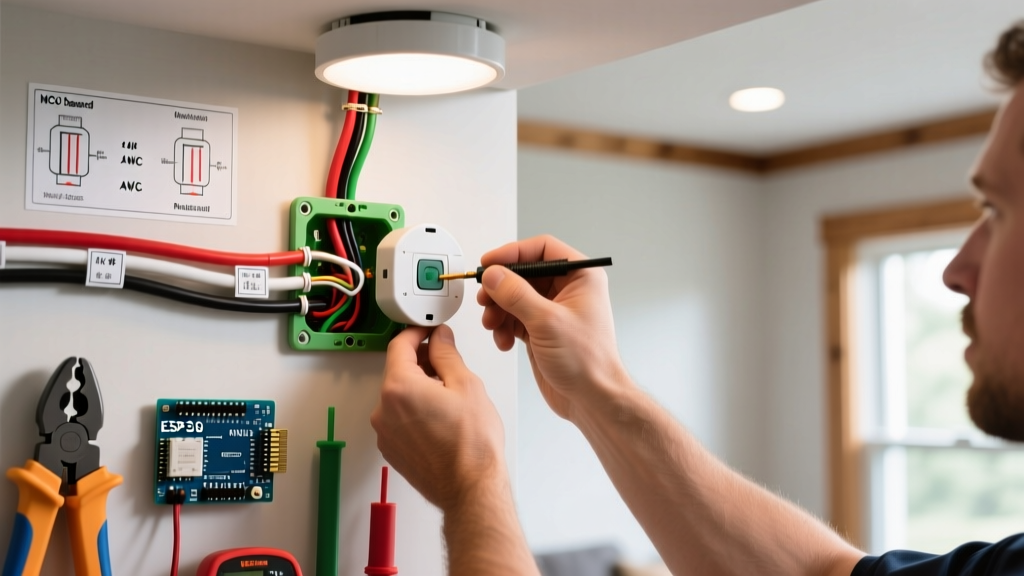
Upgrading a standard toggle switch to an automated sensor is one of the most popular home improvement projects, but it introduces unique electrical complexities. When tackling an electrical wiring motion sensor light project, DIYers often focus on the convenience of hands-free illumination while overlooking critical safety protocols. Modern motion sensors contain solid-state electronics that interact differently with household wiring than traditional mechanical switches. According to the National Fire Protection Association (NFPA), electrical failures or malfunctions are a leading cause of home structure fires, many of which stem from improper junction box modifications and overloaded circuits.
This guide provides a deep-dive into the safety best practices, National Electrical Code (NEC) requirements, and advanced troubleshooting techniques required for a flawless and fire-safe motion sensor installation in 2026.
Pre-Installation Safety: Beyond Flipping the Breaker
The most common and fatal mistake in residential wiring is assuming that turning off the wall switch or a single breaker has completely de-energized the junction box. Multi-wire branch circuits (MWBCs) or backfed outlets can leave 'hot' wires sitting right next to the ones you are handling.
Non-Contact Voltage Tester Verification
Before removing the existing faceplate, you must verify the absence of voltage. Invest in a dual-range non-contact voltage tester (NCVT) like the Klein Tools NCVT-4IR (typically priced around $35). This tool detects standard 12V-1000V AC and features an infrared thermometer to check for loose, heat-generating connections. Always test the NCVT on a known live circuit first to verify the battery and sensor are functioning, then test the target switch box, and finally test the known live circuit again.
Implementing Residential Lockout/Tagout (LOTO)
The Occupational Safety and Health Administration (OSHA) mandates Lockout/Tagout procedures in commercial environments, but the principle is equally vital for home DIYers. Use a breaker lockout device, such as the Schneider Electric HOM1LOCK (approx. $8), to physically secure the breaker in the 'OFF' position. This prevents a family member from accidentally resetting the panel while your hands are inside the junction box.
Understanding Junction Box Constraints and Box Fill
Motion sensor switches are significantly deeper than standard single-pole toggles. The Leviton DOS05, for example, requires roughly 1.75 inches of depth, while a standard toggle requires less than an inch. This creates a severe box fill issue in older homes equipped with shallow 12-cubic-inch plaster rings.
Calculating NEC Article 314.16 Box Fill
The NEC strictly limits how many wires and devices can occupy a junction box to prevent overheating and wire insulation damage. Here is the exact math for a standard motion sensor installation using 14 AWG wire on a 15-amp circuit:
- Current-Carrying Wires: 4 wires (2 line/load hots, 2 neutrals) × 2.0 cubic inches = 8.0 cu in.
- Device Yoke (The Switch): Counts as 2 wire volumes × 2.0 cubic inches = 4.0 cu in.
- Ground Wires: All grounds combined count as 1 wire volume × 2.0 cubic inches = 2.0 cu in.
- Internal Clamps: Count as 1 wire volume × 2.0 cubic inches = 2.0 cu in.
Total Required Volume: 16.0 cubic inches. If your existing single-gang old-work box is only 14 cubic inches, you are violating code and creating a fire hazard. You must upgrade to an 18 or 20-cubic-inch deep single-gang box, or use a surface-mounted wiremold extension box.
Core Wiring Protocols and The Neutral Dilemma
Unlike a dumb switch that simply breaks the hot leg, a motion sensor requires constant power to run its internal PIR (Passive Infrared) sensor and relay. This dictates the wiring topology.
| Model (2026 Standard) | Neutral Required? | Max LED Load | Price Range | Best Application |
|---|---|---|---|---|
| Leviton DOS05 | Yes (White wire) | 600W (approx 60 bulbs) | $25 - $30 | New construction, deep boxes |
| Lutron Maestro MS-OPS2H | No (Ground referenced) | 150W (approx 15 bulbs) | $40 - $48 | Retrofits, older homes w/o neutrals |
| Hubbell HOS06W | Yes (White wire) | 800W | $35 - $42 | Commercial, high-traffic corridors |
What If You Don't Have a Neutral Wire?
In homes built before the 1980s, switch boxes often only contain the hot and switched-hot (load) wires; the neutral bundle is capped off in the ceiling fixture box, not brought down to the switch. If you attempt to wire a neutral-requiring sensor (like the Leviton DOS05) by bootlegging a ground wire as a neutral, you will create a severe shock hazard and cause ground-fault circuit interrupters (GFCIs) upstream to trip immediately. In these scenarios, you must use a ground-referenced switch like the Lutron MS-OPS2H, or pull a new 14/2 or 12/2 NM-B cable from the nearest junction box.
Outdoor Installations: Weatherproofing and IP Ratings
Wiring an exterior floodlight with an integrated motion sensor exposes your connections to UV radiation, thermal expansion, and moisture intrusion. The Consumer Product Safety Commission (CPSC) frequently flags outdoor electrical shorts caused by degraded wire nuts.
Sealing the Connections
Never use standard vinyl electrical tape to seal outdoor wire connections; the adhesive melts in summer heat and freezes/cracks in winter. Instead, follow this protocol:
- Strip wires to exactly 3/4 inch using a precision stripper to avoid nicking the copper.
- Twist the wires together and apply a silicone-filled wire nut (such as the IDEAL PowerGrip WeatherProof series). The silicone completely encapsulates the copper, preventing oxidation.
- For added security in high-vibration areas (like a floodlight mounted near a slamming door), use In-Sure push-in connectors rated for outdoor damp locations, followed by a wrap of self-fusing silicone rescue tape.
Expert Tip: Always mount outdoor motion sensors with the cable entry pointing downward. If the housing requires a horizontal mount, apply a bead of exterior-grade polyurethane sealant (like Loctite PL Premium) along the top edge of the mounting plate to prevent water from tracking behind the fixture into the soffit.
Troubleshooting Common Failure Modes and Ghosting
When wiring an electrical motion sensor light, the most frequent post-installation complaint is 'LED ghosting'—where the lightbulbs emit a faint, eerie glow even when the sensor has timed out and switched off.
The Science of Ghosting
Ground-referenced motion sensors (those that do not require a neutral wire) complete their internal control circuit by leaking a microscopic amount of current (usually under 0.5mA) through the lightbulb and back to the panel via the ground wire. With old 60W incandescent bulbs, this micro-current was imperceptible. However, modern 9W LED bulbs contain internal capacitors and driver circuitry that store this micro-current until it reaches a threshold, then discharge it as a brief flash or continuous dim glow.
The Hardware Fix
Do not attempt to fix ghosting by changing the wiring topology. Instead, install a bypass capacitor. The Lutron LUT-MLC Minimum Load Capacitor (approx. $15) is designed specifically for this. Wire it in parallel with the load (connect one wire to the load hot, the other to the neutral) up at the light fixture canopy, not at the switch box. This provides the micro-current a path to bypass the LED driver, eliminating the glow instantly.
Final NEC Code Compliance Checklist
Before restoring power and closing up the wall, run through this mandatory safety checklist to ensure your installation meets current code standards:
- Grounding Continuity: Verify the bare copper ground is securely pigtailed to both the metal junction box (if applicable) and the green ground screw on the motion sensor. Use a green 10-32 hex screw for metal boxes.
- Wire Gauge Matching: Ensure 14 AWG wire is used on 15-amp breakers, and 12 AWG wire is used on 20-amp breakers. Never mix 14 AWG wire on a 20-amp circuit.
- Box Fill Verification: Confirm the cubic inch capacity of the junction box exceeds the calculated fill volume.
- Sensor Placement Clearance: Ensure the PIR lens is not pointed directly at HVAC vents or heat sources, which will cause false thermal triggers and premature relay failure.
By treating the electrical wiring of your motion sensor light with the same rigor as a main panel upgrade, you guarantee a system that is not only convenient but fundamentally safe for decades to come.