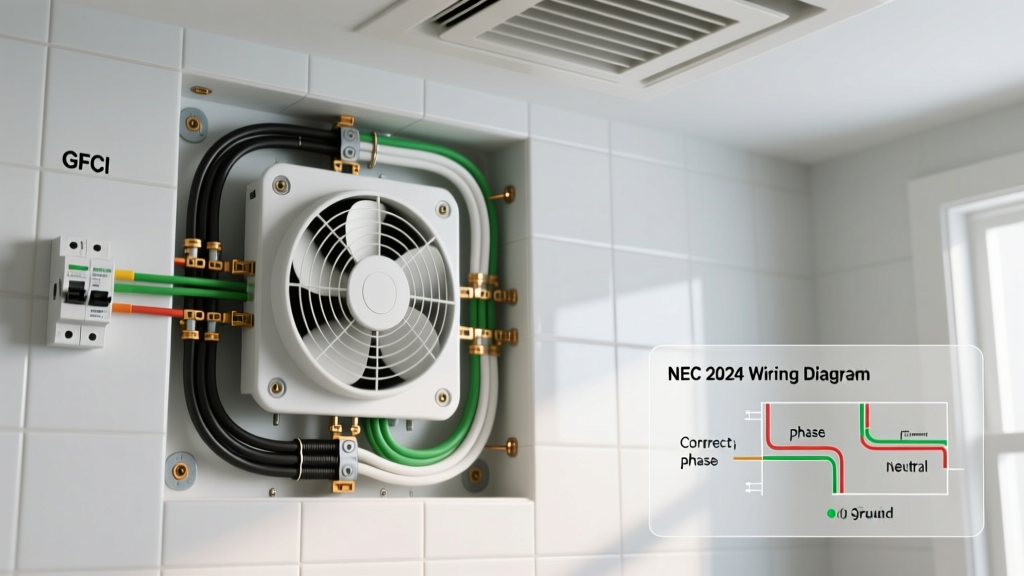

The Core NEC Requirements for Bathroom Fan Electrical Wiring
Bathroom fan electrical wiring is a frequent point of failure during both rough-in and final electrical inspections. Unlike standard room ventilation, bathroom environments introduce high humidity, condensation, and complex multi-function appliance loads (heaters, lights, and motors). Navigating the National Electrical Code (NEC) requirements for these installations is critical for passing inspection and ensuring long-term safety. According to the National Fire Protection Association (NFPA) NEC guidelines, bathroom circuits are subject to strict branch circuit sizing, ground-fault protection, and box-fill regulations that general living spaces do not require.
For 2026, local jurisdictions are heavily enforcing the 2023 NEC updates, particularly regarding Arc-Fault Circuit Interrupter (AFCI) and Ground-Fault Circuit Interrupter (GFCI) protections. This guide breaks down the exact compliance metrics, wire gauges, and physical installation standards you need to pass your bathroom fan inspection on the first attempt.
Circuit Sizing and Branch Circuit Rules (NEC Article 210)
One of the most common inspection red flags is improper circuit sizing. Under NEC Article 210.11(C)(3), at least one 20-ampere branch circuit must be provided to supply bathroom receptacle outlets. This 20A circuit has strict rules regarding what else it can power:
- Single-Bathroom Rule: If the 20A circuit supplies only that specific bathroom, it can also power the bathroom's lighting and exhaust fan.
- Multi-Bathroom Rule: If the 20A circuit supplies receptacles in multiple bathrooms, it cannot supply any lighting or fan loads in any of those bathrooms.
Wire Gauge and Cable Selection
Because the baseline requirement is a 20A circuit, you must use 12 AWG copper wire (typically 12/2 NM-B or 12/3 NM-B). Using 14 AWG wire on a 20A breaker is an immediate code violation and will result in a failed inspection. If your local municipality allows a dedicated 15A lighting circuit that does not serve receptacles, 14/2 NM-B is permissible for the fan, but standardizing on 12 AWG for all bathroom wiring eliminates inspector confusion and future-proofs the circuit for upgrades.
Multi-Function Fans (Heater/Fan/Light): If you are installing a combination unit like the Panasonic WhisperWarm FV-0511VQ1, the built-in 1500W heater draws approximately 12.5 amps. When combined with the motor and LED lighting, the total load approaches the continuous limit of a standard 15A circuit. These units require a dedicated 20A circuit wired with 12/3 NM-B cable to separate the heater (red wire) from the fan/light (black wire), allowing independent wall switch control.
GFCI vs. AFCI Protection: Clearing the Confusion
Inspectors pay close attention to how bathroom fan electrical wiring is protected at the breaker panel. The distinction between GFCI (shock protection) and AFCI (fire/arcing protection) is heavily tested.
NEC 210.8(A) Exception Note: GFCI protection is required for all 125V, 15A and 20A receptacles in bathrooms. However, a bathroom exhaust fan itself does not require GFCI protection unless it is installed directly over a shower or bathtub enclosure, or if the manufacturer's installation instructions explicitly mandate it.
Compliance Matrix: Protection Requirements
| Installation Scenario | Wire Gauge | Breaker Size | GFCI Required? | AFCI Required? |
|---|---|---|---|---|
| Fan over vanity/dry area | 12/2 NM-B | 20A | No (unless mfr requires) | Yes (NEC 210.12) |
| Fan over shower/tub (Wet Location) | 12/2 NM-B | 20A | Yes | Yes (NEC 210.12) |
| Heater/Fan/Light Combo Unit | 12/3 NM-B | 20A (Dedicated) | No (unless over tub) | Yes (NEC 210.12) |
Note: AFCI requirements for bathrooms vary by local adoption of the 2020/2023 NEC. Always verify with your local Authority Having Jurisdiction (AHJ), but installing a Dual-Function (AFCI/GFCI) breaker or using an AFCI breaker with a GFCI receptacle downstream satisfies the strictest interpretations.
Damp vs. Wet Location Ratings
According to ENERGY STAR ventilating fan specifications and UL safety listings, the physical location of the fan dictates its required rating. Installing a damp-rated fan in a wet location is a severe code violation that poses an electrocution hazard.
- Damp-Rated Fans: Suitable for general bathroom ceiling installation where condensation occurs, but no direct water spray is present. Most standard exhaust fans fall into this category.
- Wet-Rated Fans: Required if the fan is mounted directly inside the shower enclosure or above a bathtub. These units feature sealed motors, specialized gaskets, and must be connected to a GFCI-protected circuit.
Junction Box Selection and Box Fill Calculations
NEC Article 314 governs junction box sizing. Bathroom fans typically terminate their wiring inside the fan housing's integrated junction box. Inspectors will open the fan canopy during the final inspection to verify 'box fill' calculations.
Calculating Box Fill for a Standard Fan
Every wire, clamp, and device strap takes up physical volume inside the box, measured in cubic inches. For 12 AWG wire, the NEC mandates 2.25 cubic inches per conductor.
- Conductors: 12/2 NM-B brings in a black (hot), white (neutral), and bare (ground). That is 3 conductors. (3 x 2.25 = 6.75 cu in.)
- Internal Clamps: If the fan housing has built-in cable clamps, count 1 conductor volume. (1 x 2.25 = 2.25 cu in.)
- Total Minimum Volume: 6.75 + 2.25 = 9.0 cubic inches.
Most modern Panasonic and Broan fan housings provide 12 to 15 cubic inches of wiring space, which is compliant. However, if you are retrofitting an older, shallow 'pancake' junction box (often only 6.0 cubic inches) to mount a separate inline fan, you will fail inspection due to overfilling. Always verify the stamped cubic-inch rating on the metal or plastic housing before rough-in.
Top 5 Reasons Bathroom Fan Wiring Fails Inspection
Based on data and field reports from the International Association of Electrical Inspectors (IAEI), here are the most common edge cases and failure modes during bathroom fan inspections:
1. Missing or Improper Cable Clamps
NM-B cable entering a metal fan junction box must be secured by a listed cable connector (e.g., a 1/2-inch internal NM-B clamp). Simply pushing the Romex through a knockout hole without a clamp damages the wire sheathing and is an automatic fail.
2. Over-Torqued Wire Nuts
When pigtailing the fan's 18 AWG stranded fixture wire to the branch circuit's 12 AWG solid wire, electricians often over-tighten the wire nut. This can shear the thin strands of the fixture wire, creating a high-resistance connection that causes heat buildup. Use purple or yellow winged wire nuts specifically rated for stranded-to-solid connections.
3. Grounding the Metal Box Incorrectly
If the fan's junction box is metal, the bare copper ground wire must be pigtailed to both the metal box (via a green grounding screw) and the fan's internal ground wire. Failing to bond the metal box to the equipment grounding conductor is a major shock hazard.
4. Exceeding the 80% Continuous Load Rule
If a bathroom heater/fan combo is classified as a continuous load (running for 3 hours or more, common in timer-switch applications), the 1500W heater (12.5A) exceeds the 80% rule for a 15A circuit (12A max). It must be on a dedicated 20A circuit.
5. Venting into the Attic (Mechanical/Electrical Overlap)
While primarily a mechanical code issue, electrical inspectors frequently flag bathroom fans that vent directly into the attic space. The resulting condensation rots the roof decking and drips back onto the fan's electrical junction box, creating a severe short-circuit hazard. The duct must terminate at a roof or soffit vent cap.
Final Inspection Readiness Checklist
Before calling your local AHJ for the final electrical inspection, run through this compliance checklist to ensure your bathroom fan electrical wiring is up to code:
- [ ] Breaker Verification: Confirm the fan is on a 20A circuit (if sharing with receptacles) or a properly sized dedicated circuit (if a heater combo).
- [ ] Wire Gauge Check: Verify 12 AWG wire is used on all 20A circuits; no 14 AWG wire is present in the fan junction box.
- [ ] Clamp Security: Ensure all NM-B cables entering the fan housing are secured with listed internal or external cable clamps.
- [ ] Ground Bonding: Confirm the metal junction box is bonded to the ground wire, and the fan chassis is grounded.
- [ ] GFCI/AFCI Testing: Press the 'Test' button on the AFCI breaker and the GFCI receptacle (if the fan is downstream or over a shower) to verify trip functionality.
- [ ] Manufacturer Instructions: Leave the installation manual inside the cabinet or taped to the attic side of the drywall near the fan; inspectors frequently ask for it to verify specific GFCI or dedicated circuit mandates.
By adhering strictly to these NEC guidelines and paying attention to the physical details of box fill and wire termination, your bathroom fan installation will not only pass inspection effortlessly but will also provide decades of safe, moisture-free operation.