
The Unique Challenges of Milwaukee's Housing Stock
Milwaukee is renowned for its architectural charm, from the iconic Cream City brick duplexes to the sprawling American Foursquares and classic Milwaukee Bungalows. However, for the DIY enthusiast or homeowner tackling electrical wiring in Milwaukee, WI, this historic housing stock presents a unique set of challenges. The majority of residential properties in neighborhoods like Sherman Park, Bay View, and Washington Heights were constructed between 1890 and 1950. This means the original electrical infrastructure was designed for a fraction of the electrical load demanded by modern 2026 appliances, HVAC systems, and EV chargers.
Before pulling any wire or swapping a breaker, it is critical to understand what is hiding behind your plaster and lath walls. Many of these homes have undergone decades of piecemeal renovations, resulting in a dangerous patchwork of outdated wiring methods.
⚠️ Homeowner Safety Warning: If your home was built before 1950, assume the presence of ungrounded circuits, degraded cloth-sheathed wiring, or active knob-and-tube systems. Many Wisconsin home insurance providers will not underwrite a policy, or will charge severe premiums, if knob-and-tube wiring is detected in accessible areas like the attic or basement.
Identifying Your Home's Wiring Era
To plan your electrical wiring project, you must first identify the generation of wiring currently in your home. Use the matrix below to determine your baseline upgrade priorities.
| Construction Era | Common Wiring Type | 2026 Upgrade Priority | Common Milwaukee Neighborhoods |
|---|---|---|---|
| 1890 - 1920 | Knob-and-Tube (K&T) | Critical: Complete remediation required for insurance and safety. | Walker's Point, Brady Street, Lower East Side |
| 1920 - 1945 | Cloth-Sheathed NM (Rubber) | High: Insulation flakes off, exposing bare copper. Replace entirely. | South Milwaukee, Bay View, Lincoln Village |
| 1945 - 1965 | Early PVC NM-B (No Ground) | Medium: Safe if undamaged, but lacks equipment ground. Add GFCI. | Wauwatosa, West Allis, Sherman Park |
| 1965 - Present | Modern NM-B (With Ground) | Low: Update to current AFCI/GFCI code requirements. | Menomonee Falls, Oak Creek, Franklin |
Navigating Wisconsin SPS 316 vs. National Electrical Code
When executing any electrical wiring in Milwaukee, WI, you are not just following the National Electrical Code (NEC). Wisconsin operates under its own administrative code, specifically Wisconsin SPS 316 (Electrical), which adopts the NFPA 70 National Electrical Code but includes state-specific amendments.
Key Wisconsin Amendments to Watch
- Ufer Ground (Concrete-Encased Electrode): Wisconsin strictly enforces the use of a Ufer ground for new services and major upgrades. If you are upgrading your panel, the inspector will likely require a #4 bare copper wire embedded in the concrete footing, connected to the rebar.
- AFCI Expansion: While the NEC requires Arc-Fault Circuit Interrupter (AFCI) protection in most living areas, Wisconsin inspectors are notoriously strict about retrofitting AFCI protection when you extend or modify an existing circuit in a bedroom, living room, or hallway.
- Working Space Clearances: SPS 316 mandates a strict 30-inch wide, 36-inch deep clear working space in front of your main panel. In narrow Milwaukee bungalow basements, this often requires relocating the panel or framing out a dedicated closet.
Project Guide: Rewiring a 1930s Bungalow Kitchen
The kitchen is the most demanding room in any home. A classic 1930s Milwaukee bungalow kitchen was originally wired for a single 15-amp circuit to power a toaster and a radio. Today, it must support a microwave, dishwasher, disposal, and multiple countertop appliances. Here is how to execute a code-compliant kitchen rewire.
Step 1: Assess the Main Panel
Locate your main service panel. Many older Milwaukee homes still have original Cutler-Hammer Type CH panels or Murray load centers. Verify you have at least 200 amps of service capacity. If you have a 60-amp or 100-amp service, you must upgrade the mast and panel before adding new kitchen circuits. A 200-amp service upgrade in the City of Milwaukee typically costs between $2,400 and $3,800 in 2026, depending on whether the utility mast needs rebuilding.
Step 2: Pulling New 12/2 NM-B Wire
You must install a minimum of two 20-amp small-appliance branch circuits (SABCs) for the countertop receptacles. Additionally, the dishwasher and garbage disposal require dedicated circuits.
- Drilling the Joists: In a bungalow with an unfinished basement, drill 3/4-inch holes through the floor joists. Keep holes at least 2 inches from the edge of the joist to maintain structural integrity, a rule heavily enforced by Milwaukee building inspectors.
- Running the Cable: Use 12/2 NM-B (Romex) with a bare copper ground. Secure the cable with metal nail plates where it passes through studs to prevent drywall screws from piercing the wire later.
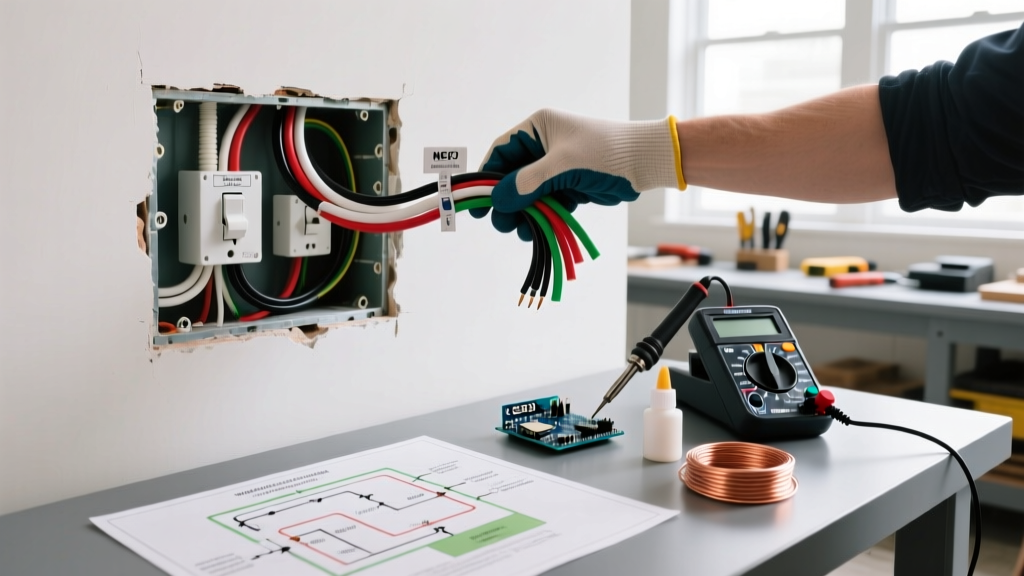
- Fishing Plaster Walls: Milwaukee homes feature thick plaster and wood lath. Use a flexible fiberglass fish tape and a rotary tool with a dust-extraction attachment to cut precise openings for your new old-work boxes.
Step 3: Installing AFCI/GFCI Dual-Function Breakers
Kitchen countertop circuits require Ground-Fault (GFCI) protection, while the wiring running through the walls requires Arc-Fault (AFCI) protection. Instead of using bulky GFCI receptacles that struggle to fit into shallow plaster-wall boxes, install a Dual-Function (DF) breaker at the panel. For a Cutler-Hammer panel, use the Eaton BR120CAF2 20-Amp Dual Function breaker. This provides both AFCI and GFCI protection directly at the source, freeing up space in your wall boxes.
Permitting with the City of Milwaukee DNS
A common mistake DIYers make is skipping the permitting process. The City of Milwaukee Department of Neighborhood Services (DNS) requires permits for almost all electrical alterations. As a homeowner, you are legally permitted to do your own electrical work provided it is your primary residence and you pass a basic homeowner electrical exam administered by the city.
The Permitting Workflow:
- Submit a Homeowner Electrical Permit application via the city's online portal or in person at the DNS office on N. 7th Street.
- Pay the permit fee (typically $45 to $85 for minor residential alterations in 2026).
- Complete the rough-in wiring and call DNS for the rough inspection. Do not close up your drywall or plaster until the rough inspection is passed.
- Install devices and cover plates, then schedule the final inspection.
2026 Material & Labor Cost Matrix for Milwaukee Projects
Budgeting accurately is vital for older home renovations. Below is a breakdown of average costs for common electrical wiring projects in the Milwaukee metro area, reflecting 2026 supply chain realities and local union/non-union labor rates.
| Project Scope | Material Cost (DIY) | Pro Installation Cost | Timeline |
|---|---|---|---|
| 200-Amp Panel Upgrade | $850 - $1,200 | $2,400 - $3,800 | 1 - 2 Days |
| Kitchen Rewire (2 SABCs + Appliances) | $250 - $400 | $1,800 - $2,600 | 2 - 3 Days |
| Knob-and-Tube Remediation (Whole House) | $3,500 - $5,000 | $14,000 - $22,000 | 2 - 4 Weeks |
| EV Charger Circuit (50-Amp, 240V) | $150 - $300 | $800 - $1,400 | 1 Day |
Frequently Asked Questions: Milwaukee Wiring Nuances
Can I replace 2-prong outlets in my plaster walls without rewiring?
Yes, but with strict limitations. If your home has ungrounded 2-prong receptacles and you do not want to tear open the plaster to run new grounded wire, you can replace them with 3-prong receptacles only if they are protected by a GFCI. You must install a GFCI breaker at the panel or a GFCI receptacle at the first outlet in the circuit, and label all downstream 3-prong outlets with the 'GFCI Protected / No Equipment Ground' stickers provided in the box. This satisfies NEC 406.4(D) and Wisconsin SPS 316.
Does Milwaukee require AFCI breakers for older homes?
If you are simply replacing a broken receptacle on an existing, unmodified circuit, you are generally not required to upgrade to AFCI. However, the moment you extend the circuit, add a new outlet, or modify the wiring in a bedroom, living room, or hallway, SPS 316 requires the entire circuit to be brought up to current code, which mandates AFCI protection.
How do I handle the service mast on a Milwaukee duplex?
Milwaukee duplexes often feature shared service masts or masts that are pulled away from the Cream City brick facade due to decades of ice loading and weather. If your service mast conduit (typically 2-inch rigid galvanized steel) is compromised, We Energies will not reconnect power after a panel upgrade until the mast is rebuilt to their specific service entrance standards, which require a minimum 12-foot clearance over driveways and specialized weatherheads.
Final Thoughts on Local Wiring Projects
Tackling electrical wiring in Milwaukee, WI requires a blend of historical preservation awareness and strict adherence to modern safety codes. By respecting the unique construction of local bungalows, understanding the nuances of Wisconsin SPS 316, and properly engaging with the DNS permitting office, you can safely modernize your home's electrical infrastructure. Always prioritize safety over speed, and when in doubt, consult a licensed Wisconsin Master Electrician to verify your project scope.