
The Hidden Costs of Solar: Why Wiring Matters in 2026
When homeowners and commercial developers budget for a photovoltaic (PV) installation, the solar modules and hybrid inverters typically dominate the financial conversation. However, the electrical wiring for solar panels represents the central nervous system of your entire energy array. In 2026, with copper prices experiencing market volatility and the National Electrical Code (NEC) enforcing stricter rapid-shutdown mandates, accurately estimating wiring costs is no longer optional—it is critical for project viability.
According to the U.S. Department of Energy, the 'Balance of System' (BOS) components, which heavily feature wiring, conduit, and combiner hardware, account for roughly 10% to 15% of total residential solar installation costs. Underestimating this segment leads to mid-project budget overruns, while overestimating can render a bid uncompetitive. This comprehensive cost estimation guide breaks down the exact material prices, labor rates, and code-compliance expenses you need to budget for electrical wiring for solar panels in 2026.
Core Conductors: PV Wire vs. THWN-2 vs. USE-2
Selecting the correct conductor type is the first major cost variable. You cannot use standard indoor Romex (NM-B) for outdoor solar arrays. The National Fire Protection Association (NFPA) mandates specific insulation ratings for UV exposure, moisture resistance, and high-temperature tolerances.
| Wire Type | Primary Use Case | Temp Rating (Wet/Dry) | 2026 Avg. Cost (10 AWG) | UV & Moisture Resistant? |
|---|---|---|---|---|
| PV Wire | Module-level string connections (exposed) | 90°C / 105°C | $0.55 - $0.75 / ft | Yes (Superior) |
| THWN-2 | Runs inside conduit (DC & AC) | 75°C / 90°C | $0.30 - $0.45 / ft | No (Requires Conduit) |
| USE-2 | Underground / Buried array runs | 75°C / 75°C | $0.45 - $0.60 / ft | Yes (Moisture focus) |
Gauge Sizing and Voltage Drop Economics
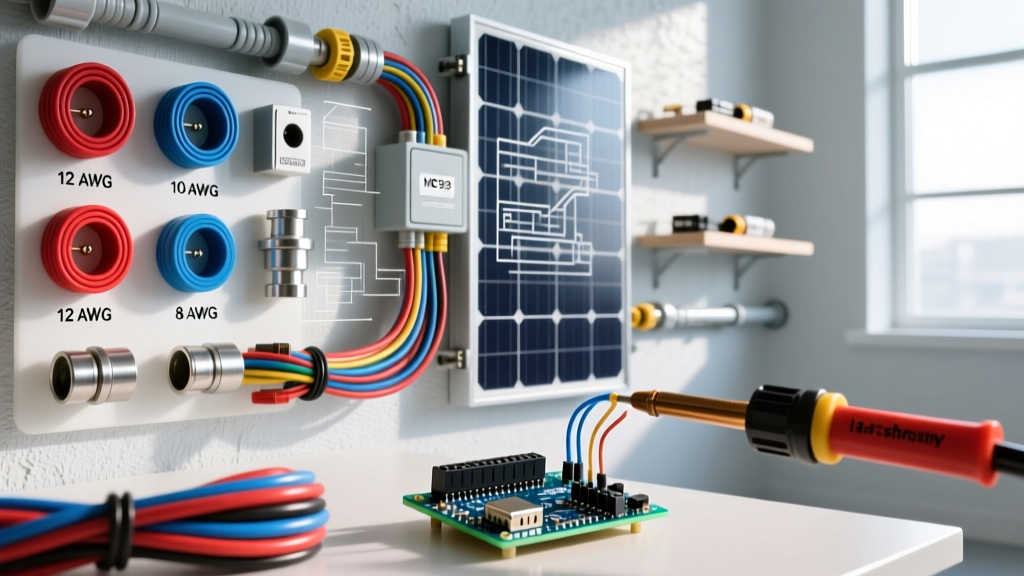
While 10 AWG is the industry standard for module-level string wiring (handling up to 30 amps and 600V-1000V DC), long roof runs require upsizing to 8 AWG or 6 AWG to prevent voltage drop. The NEC recommends keeping voltage drop under 3% for maximum efficiency. Upsizing from 10 AWG to 6 AWG THWN-2 increases your copper material cost by approximately 65%, adding roughly $120 to $180 to a standard 10kW residential array. However, this upfront cost prevents an estimated 2-4% annual energy loss, paying for itself within 3 to 5 years.
Balance of System (BOS) Wiring Components
The wire itself is only a fraction of the electrical wiring for solar panels budget. You must account for the hardware that terminates, protects, and routes those conductors.
- MC4 Connectors: The universal standard for solar module connections. In 2026, high-quality, UL-listed MC4 pairs (male/female) cost between $1.50 and $2.50 per pair. Avoid cheap, unbranded alternatives; mismatched MC4 connectors are a leading cause of DC arc faults.
- DC Combiner Boxes: For larger string inverter systems, combiner boxes merge multiple DC strings before they hit the inverter. A 4-string, 1000V rated outdoor combiner box with integrated surge protection devices (SPD) and fuses costs $180 to $350.
- DC & AC Disconnects: Required by local utilities and the NEC for emergency shutoff. A 600V DC pull-out disconnect costs roughly $85 to $120, while a 240V AC fused disconnect runs $110 to $160.
- Grounding Lugs and Buss Bars: Essential for bonding the array to the earth ground. Budget $40 to $90 for heavy-duty, tin-plated copper lugs and mounting hardware.
Conduit and Raceway Systems
Once the DC wires leave the immediate vicinity of the solar modules, they must be protected by a raceway. Your two primary options are Electrical Metallic Tubing (EMT) and PVC Schedule 80.
Expert Insight: While PVC Schedule 80 is cheaper and easier to bend, many 2026 municipal inspectors heavily favor EMT (thin-wall steel conduit) for rooftop solar runs. EMT provides superior physical protection against hail and debris, and per NEC Article 250.118, it can double as your Equipment Grounding Conductor (EGC), saving you the cost of pulling a separate bare copper ground wire.
Cost Comparison:
- 1/2-inch EMT Conduit: ~$1.35 per foot (plus $1.50 per coupling/fitting).
- 1/2-inch PVC Sch 80: ~$0.95 per foot (plus $1.10 per fitting).
- Conduit Fill Capacity: Remember that NEC Chapter 9, Table 1 limits conduit fill to 40%. If you are pulling three strings of 10 AWG THWN-2 plus a ground wire, 1/2-inch conduit is sufficient. If you add communications cables for optimizers, you must upsize to 3/4-inch conduit, increasing material costs by 25%.
NEC Code Compliance: Rapid Shutdown & Grounding
The most significant cost driver in modern solar wiring is compliance with NEC Article 690.12 (Rapid Shutdown). This code requires that conductors outside the array boundary be reduced to 30 volts or less within 30 seconds of grid disconnection. To achieve this, installers must integrate Module-Level Power Electronics (MLPE), such as power optimizers or microinverters.
While MLPEs are technically power electronics, they drastically alter the wiring topology. Instead of running high-voltage DC strings down the roof, you are often running a single, heavy-gauge AC trunk line (like 8 AWG or 6 AWG THWN-2) that daisy-chains from microinverter to microinverter. This requires specialized AC Q-cables or harnessed trunk cables.
- Microinverter Trunk Cable (Q-Cable): Costs approximately $2.50 to $3.50 per foot. A 20-panel array requires roughly 100 feet of trunk cable, adding $250 to $350 to the wiring budget.
- Optimizer Communication Cables: If using DC optimizers, the communication loop requires specialized shielded twisted-pair cables, costing roughly $0.80 per foot.
Grounding and Bonding Expenses
Proper grounding is non-negotiable. You will need bare copper wire (typically 8 AWG or 6 AWG) to bond the module frames, racking system, and conduit to the main grounding electrode. Bare copper wire costs roughly $0.60 to $0.90 per foot. Additionally, you must purchase specialized grounding clips or bonding jumpers for the solar racking (e.g., IronRidge or Unirac), which cost about $2.00 per module.
Labor Rates and Trenching in 2026
Material costs only tell half the story. The Solar Energy Industries Association (SEIA) notes that skilled electrical labor remains in high demand. In 2026, expect the following labor rates for solar wiring:
- Licensed Electrician (Master/Journeyman): $85 to $150 per hour, depending on regional cost-of-living indices.
- Solar Installer (Wire Pulling & Termination): $45 to $75 per hour.
- Trenching for Underground Runs: If your array is ground-mounted or requires a lateral run to a detached garage, trenching costs average $8 to $15 per linear foot for a 24-inch deep trench (required for PVC conduit housing direct burial wire).
A standard 10kW rooftop system typically requires 16 to 24 man-hours dedicated strictly to wiring, conduit bending, pulling, and terminations, translating to $1,200 to $2,400 in wiring-specific labor.
Total Wiring Cost Estimation Matrix
The table below provides a realistic 2026 budget matrix for the electrical wiring for solar panels, encompassing DC/AC conductors, conduit, MLPE trunk cables, grounding, and connectors (excluding the cost of the inverters/optimizers themselves and main service panel upgrades).
| System Size | Estimated Material Cost | Estimated Wiring Labor | Total Wiring Budget Range | Cost per Watt (Wiring Only) |
|---|---|---|---|---|
| 5 kW Residential (String Inverter) | $450 - $650 | $800 - $1,200 | $1,250 - $1,850 | $0.25 - $0.37 / W |
| 10 kW Residential (Microinverters) | $900 - $1,300 | $1,400 - $2,100 | $2,300 - $3,400 | $0.23 - $0.34 / W |
| 15 kW Commercial (Optimizers) | $1,400 - $1,900 | $2,200 - $3,500 | $3,600 - $5,400 | $0.24 - $0.36 / W |
| 25 kW Ground Mount (Includes Trenching) | $2,500 - $3,800 | $4,000 - $6,000 | $6,500 - $9,800 | $0.26 - $0.39 / W |
Expert Strategies to Optimize Your Wiring Budget
As a senior electrical designer, I recommend the following strategies to keep your solar wiring costs under control without compromising safety or code compliance:
- Optimize String Lengths: Design your array to keep DC string runs as short as possible. Place the DC combiner box or string inverter centrally relative to the solar modules to minimize expensive 10 AWG PV wire and reduce voltage drop.
- Use Aluminum for Long AC Runs: If you have a long AC run from the inverter to the main service panel (over 100 feet), consider using XHHW-2 aluminum wire instead of copper. Aluminum is roughly 50% to 60% cheaper than copper. Just remember to upsize the gauge by one step (e.g., use 4 AWG aluminum instead of 6 AWG copper) and use anti-oxidant paste (Noalox) at all terminations.
- Pre-Assembled Harnesses: For microinverter systems, purchase factory-terminated trunk cables rather than buying raw cable and crimping connectors on the roof. The labor saved (roughly 3-4 hours) far outweighs the 15% premium on pre-assembled harnesses.
Frequently Asked Questions
Can I use standard THHN wire for exposed solar panel connections?
No. Standard THHN wire is not rated for continuous UV exposure or outdoor wet locations. Using it outside of a conduit will result in insulation degradation within a few years, leading to ground faults and potential fires. You must use PV Wire or USE-2 for any exposed module-level connections.
Does the electrical wiring for solar panels degrade over time?
High-quality, UL-listed PV wire is designed to last 25 to 30 years, matching the warranty period of the solar modules themselves. The insulation is cross-linked (XLPE) to withstand extreme thermal cycling and UV radiation. However, improper clipping or resting wires directly on abrasive roofing materials can cause mechanical wear long before chemical degradation occurs.
Do I need a permit specifically for the solar wiring?
Yes. The electrical wiring for solar panels falls under local building and electrical codes. Your local Authority Having Jurisdiction (AHJ) will require an electrical permit, and an inspector will verify your wire sizing, conduit fill, grounding electrode connections, and rapid shutdown compliance before granting Permission to Operate (PTO) from the utility.