
Core Materials for Boiler Electrical Wiring
Boiler electrical wiring is a unique discipline that bridges high-voltage power distribution (120V/240V) and low-voltage control logic (24V). A single miswired connection can result in a fried control board, a tripped main breaker, or a severe fire hazard. Whether you are wiring a new high-efficiency condensing gas boiler or retrofitting an older oil-fired system, selecting the correct materials is non-negotiable. As of 2026, modern boilers feature advanced ECM (Electronically Commutated Motor) pumps and variable-speed draft inducers, making precise wiring and high-quality terminations more critical than ever.
High-Voltage vs. Low-Voltage Conductors
The backbone of any boiler installation relies on keeping line voltage and control voltage strictly separated. For the primary power feed, 12 AWG THHN/THWN stranded wire pulled through EMT conduit, or 12/2 NM-B (Romex) for concealed residential runs, is the standard for 20-amp dedicated circuits. For the low-voltage side (thermostats, zone valves, and aquastats), 18 AWG solid thermostat wire is required. Use 18/2 for simple single-zone heat calls, and 18/5 or 18/8 when wiring multi-zone systems with complex pumping modules.
Control Components & Relays
Modern boiler systems rely on switching relays to isolate the 24V thermostat calls from the 120V circulator pumps. The Taco SR506-EXP (approximately $160 in 2026) remains an industry standard for managing up to six zones, featuring built-in priority settings for indirect water heaters. For primary limit control, the Honeywell L8148E Aquastat (around $185) provides reliable high-limit and circulator switching for single-zone systems.
| Material | Specification / Model | Application | Est. Cost |
|---|---|---|---|
| Line Voltage Wire | 12/2 NM-B (Southwire) | Main 20A power feed to boiler | $0.75 / ft |
| Control Wire | 18/5 Solid Thermostat (Cerro) | Zone valves, thermostats, relays | $0.35 / ft |
| Switching Relay | Taco SR506-EXP | Multi-zone circulator control | $160.00 |
| Wire Connectors | Wago 221-412 Lever Nuts | Secure low/high voltage terminations | $0.45 / ea |
| Disconnect Switch | Leviton 30A Fused Pullout | NEC required local shutoff | $28.00 |
Essential Tools for the Job
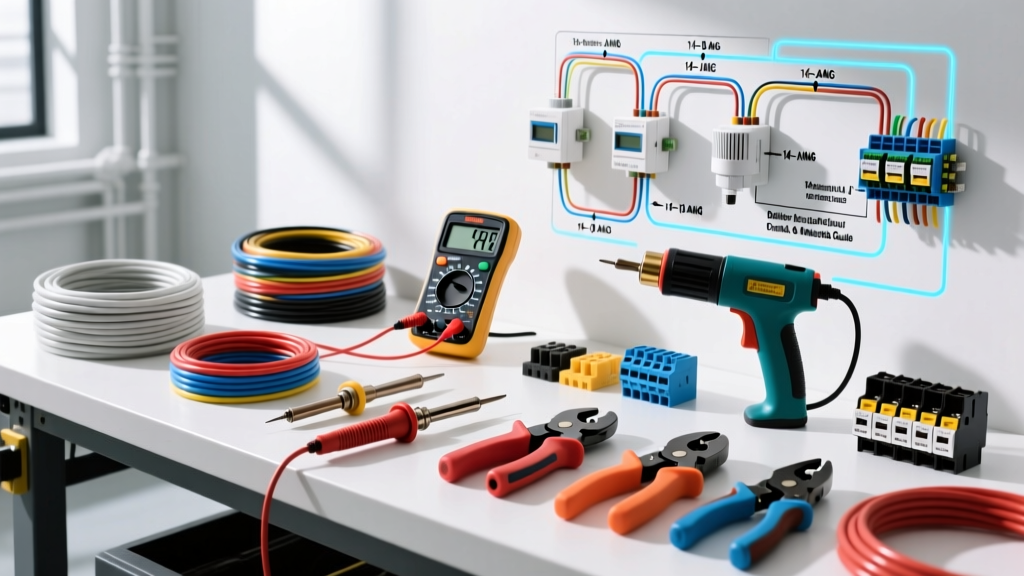
Standard residential electrical tools will get you through the rough-in, but boiler wiring requires specialized diagnostic equipment to handle the inductive loads and sensitive control boards found in modern hydronic systems.
Testing & Diagnostics
A standard average-responding multimeter will give you false readings when testing the variable-speed motors in modern condensing boilers. You must use a True RMS Multimeter, such as the Fluke 117 ($220) or the Klein Tools MM600 ($75). True RMS accurately measures non-linear loads, ensuring your voltage drop calculations across long thermostat wire runs are accurate.
Stripping, Crimping & Termination
Stripping 18 AWG solid wire without nicking the copper core is vital; a nicked wire will snap when pulled through a tight knockout, causing a hidden open circuit. The Knipex ErgoStrip 16 95 ($55) allows for precise, depth-adjusted stripping of both NM-B jackets and delicate 18 AWG control wires. For terminations, abandon traditional twist-on wire nuts for low-voltage connections. Wago 221 Lever Nuts provide a gas-tight, vibration-proof connection that will not loosen due to the micro-vibrations of adjacent circulator pumps.
Step-by-Step Wiring Workflow
- Install the Local Disconnect: Per NEC Article 422, a dedicated disconnecting means must be within sight of the boiler. Mount a 30A fused pullout disconnect box within 6 feet of the unit.
- Run the Line Voltage: Pull 12/2 NM-B from the main panel (on a dedicated 20A AFCI/GFCI breaker, depending on local 2026 code adoptions) to the disconnect, and then via MC (Metal Clad) cable or EMT conduit to the boiler's primary junction box.
- Mount Control Relays: Secure switching relays (like the Taco SR series) to a dedicated backboard. Keep at least 4 inches of physical separation between the 120V relay terminals and the 24V thermostat terminals to prevent electromagnetic interference (EMI).
- Pull and Route Low-Voltage Wire: Run 18/5 thermostat wire to all zone valves and thermostats. Crucial: Do not run 18 AWG wire parallel to 120V line voltage for more than a few inches. Cross them at 90-degree angles to prevent induced ghost voltages.
- Terminate and Label: Use Wago lever nuts for all splices. Label every wire at both the relay and the zone valve using a Brady BMP21-PLUS label maker.
Code Compliance & Safety Standards
Boiler electrical wiring is strictly governed by the National Fire Protection Association (NFPA 70), commonly known as the National Electrical Code (NEC). Article 422 covers appliances, while Article 725 dictates the installation of Class 2 and Class 3 remote-control and signaling circuits (your 24V thermostat wiring). Furthermore, the U.S. Department of Energy emphasizes that proper electrical control integration is vital for maintaining the AFUE (Annual Fuel Utilization Efficiency) ratings of modern condensing boilers. Improper wiring that causes short-cycling will drastically reduce system efficiency and void manufacturer warranties.
Expert Insight: Never rely on the boiler's internal transformer to power more than the manufacturer's specified VA (Volt-Amp) rating. If you are adding multiple high-VA zone valves (like Honeywell V8043E, which draw roughly 7.5 VA each), calculate the total load. If it exceeds the internal transformer's 40 VA capacity, you must install a separate, dedicated 24V control transformer to prevent overheating and catastrophic control board failure.
Troubleshooting Common Boiler Wiring Failures
Even with the right tools, boiler systems present unique electrical edge cases. Here is how to diagnose the most common field failures:
- Inductive Kickback Frying the Transformer: When a zone valve motor closes, it generates a reverse voltage spike (inductive kickback). If your relay or transformer lacks internal suppression, this spike will degrade the components over time. Fix: Install a 0.47 µF, 250V AC suppression capacitor across the zone valve motor terminals.
- Ghost Voltages on Thermostat Wires: If a thermostat reads 12-15V when it should read 0V or 24V, you likely have capacitive coupling from running 18 AWG wire too close to 120V lines. Fix: Reroute the low-voltage wire or use a True RMS meter with a low-impedance (LoZ) setting to bleed off the ghost voltage and confirm the circuit is truly dead.
- Short-Cycling Due to Aquastat Placement: If the boiler fires for only 30 seconds before shutting off, the aquastat's heat-conductive grease may be missing, or the sensor well is corroded. Fix: Clean the copper sensor well with emery cloth and apply a liberal layer of silicone-based heat transfer compound before re-seating the aquastat probe.
By combining code-compliant materials, precision diagnostic tools, and a strict adherence to high/low voltage separation, your boiler electrical wiring will deliver decades of safe, efficient, and reliable hydronic heating.