
Why Electrical Wiring Terminology Matters for Home Projects
Walking into the electrical aisle of a hardware store or reading a local building permit application can feel like deciphering a foreign language. For DIY homeowners tackling renovations, understanding electrical wiring terminology is not just about passing an inspection—it is a critical safety baseline. Misinterpreting a single term, such as confusing "grounding" with "bonding," can result in energized appliance casings, failed rough-in inspections, or catastrophic arc faults.
As jurisdictions across the United States continue to enforce the 2023 National Electrical Code (NEC) and draft 2026 local amendments, the vocabulary of residential wiring has evolved. This guide decodes the essential jargon you need to know, translating inspector-speak and NEC definitions into actionable knowledge for your next home project.
The Core Circuit Lexicon: Beyond Basic Definitions
While most DIYers know that Volts represent pressure and Amps represent flow, applying these terms to real-world home circuits requires deeper context.
- Voltage (V): In North American homes, you will encounter 120V (single-pole circuits for lighting and standard receptacles) and 240V (double-pole circuits for dryers, ranges, and HVAC). Always measure with a non-contact voltage tester (like the Fluke 1AC-II) before touching any conductor.
- Amperage (A): The current-carrying capacity. A standard bedroom circuit is 15 Amps, while kitchen small-appliance circuits must be 20 Amps per NEC 210.52.
- Volt-Amps (VA): Often confused with Watts, VA is used in NEC Article 220 for load calculations. For purely resistive loads (like baseboard heaters), VA equals Watts. For inductive loads (like motors in refrigerators), VA accounts for the phase angle difference, ensuring your panel is not overloaded by startup surges.
- Continuous Load: Defined by NEC Article 100 as a load where maximum current is expected to continue for 3 hours or more. You must size branch circuit conductors and overcurrent devices at 125% of a continuous load. If your bathroom heater draws 12 Amps continuously, it requires a 15-Amp circuit minimum, but practically demands a 20-Amp circuit for safety margins.
Cable and Conductor Identification Matrix
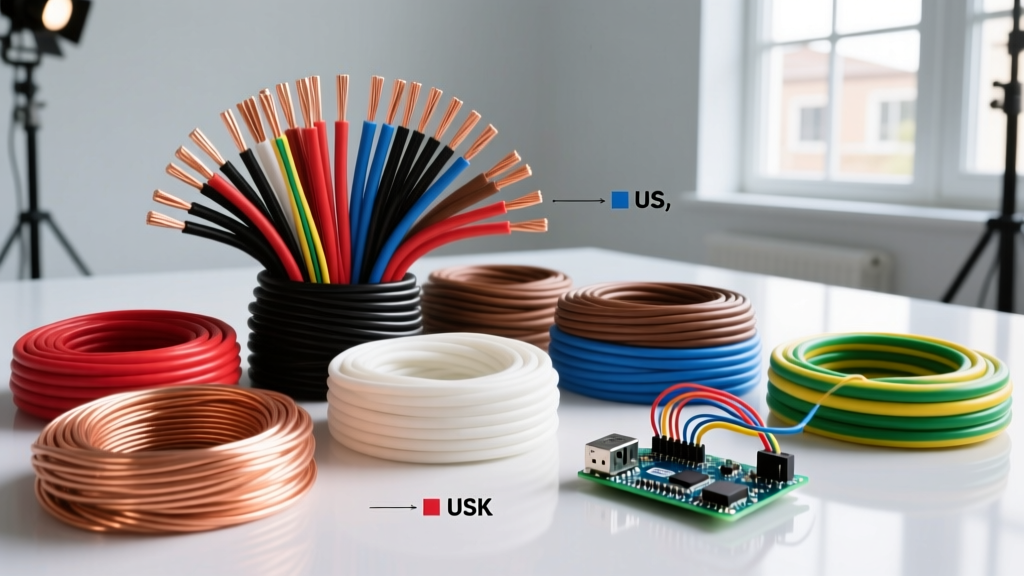
Referring to "Romex" is common on job sites, but "Romex" is a trademarked brand name owned by Southwire. The correct terminology is Nonmetallic-Sheathed Cable (Type NM-B). Understanding the jacket colors and gauge designations is mandatory for pulling the right wire from the lumber yard.
| Jacket Color | Wire Gauge (AWG) | Max Ampacity (60°C Column) | Typical Home Application |
|---|---|---|---|
| White | 14 AWG | 15 Amps | General lighting, bedroom/bathroom receptacles |
| Yellow | 12 AWG | 20 Amps | Kitchen small appliances, dining rooms, garage receptacles |
| Orange | 10 AWG | 30 Amps | Electric water heaters, central AC condensers, dryers (10/2) |
| Black | 8 AWG or 6 AWG | 40A / 55A | Electric ranges, subpanels, EV chargers (Level 2) |
Pro Tip for 2026 Remodels: If you are running wire underground to a detached garage or shed, NM-B is strictly prohibited. You must use Type UF-B (Underground Feeder) for direct burial, or pull individual THWN-2 conductors through Schedule 80 PVC conduit.
Panel and Box Terminology: Where the Inspector Looks First
Electrical panels and junction boxes are the most heavily scrutinized components during a rough-in inspection. Misusing the following terms or concepts will result in an immediate red tag.
The Service Panel Anatomy
- Main Lug vs. Main Breaker: A "Main Lug" panel has no single disconnect switch; the bus bars are fed directly from the meter. A "Main Breaker" panel includes a primary overcurrent protective device (OCPD) that shuts off all power to the branch circuits.
- Bus Bar: The metal strips that distribute power from the main breaker to the individual branch circuit breakers. Never remove the panel dead-front cover while the main breaker is ON; the bus bars remain energized and lethal even if all branch breakers are off.
- Neutral Bar (Grounded Conductor Bar): Where all white neutral wires terminate. In a main service panel, the neutral bar is bonded to the panel enclosure. In a subpanel, it must be isolated from the enclosure.
- Ground Bar (Equipment Grounding Conductor Bar): Where bare copper or green wires terminate. In a subpanel, this bar is bonded directly to the metal enclosure to provide a low-impedance fault path.
Box Fill Calculations (NEC Article 314.16)
Inspectors will check your "box fill." This terminology refers to the maximum number of conductors allowed inside a junction or device box to prevent overheating and wire crushing. For standard single-gang boxes, remember these volume requirements per conductor:
- 14 AWG: 2.0 cubic inches per wire.
- 12 AWG: 2.25 cubic inches per wire.
- 10 AWG: 2.5 cubic inches per wire.
Note: Pigtails count as zero, but each internal cable clamp counts as one conductor volume, and a duplex receptacle counts as two conductor volumes.
The Most Dangerous Confusion: Grounding vs. Bonding
Even seasoned DIYers frequently conflate grounding and bonding. According to the National Fire Protection Association (NFPA) definitions in NEC Article 100, these are distinct, critical functions:
- Grounding (Earthing): Connecting an electrical system or equipment to the earth via a grounding electrode (like a copper ground rod or ufer ground). This stabilizes voltage and protects against lightning strikes or utility line surges.
- Bonding: The permanent joining of metallic parts to form an electrically conductive path. Bonding ensures that if a hot wire touches a metal appliance casing, the fault current has a low-resistance path back to the panel, instantly tripping the breaker.
Failure Mode: If you replace a 3-prong dryer cord with a 4-prong cord but fail to remove the "bonding strap" on the dryer's terminal block, you will energize the dryer's chassis with 120V of neutral return current. This is a lethal shock hazard and a primary reason 4-prong dryer outlets were mandated.
Modern Protection: AFCI, GFCI, and Dual-Function Devices
As highlighted by the U.S. Consumer Product Safety Commission (CPSC), advanced circuit protection is vital for preventing residential fires and electrocutions. Understanding the terminology of these devices is required for modern upgrades.
- GFCI (Ground-Fault Circuit Interrupter): Protects against shock by detecting current leakage to ground (as low as 5 milliamps). Required in wet locations: kitchens, bathrooms, garages, and outdoors.
- AFCI (Arc-Fault Circuit Interrupter): Protects against fire by detecting dangerous electrical arcs (sparks) caused by damaged wires or loose connections. Required in almost all living spaces (bedrooms, living rooms, hallways).
- Combination-Type AFCI: Detects both parallel arcs (line-to-neutral) and series arcs (loose connections on a single wire).
- Dual-Function (DF) Receptacle: A device like the Leviton AGTR-15 that provides both AFCI and GFCI protection in a single outlet. This is the go-to solution when adding a bathroom receptacle to an older, un-upgraded panel that lacks AFCI breakers.
Multi-Wire Branch Circuits (MWBC): Handle Ties and Shared Neutrals
An MWBC uses a single 3-wire cable (e.g., 12/3 NM-B) to feed two separate 120V circuits sharing one neutral wire. The two hot wires (black and red) must be on opposite phases (legs) of the panel so the neutral only carries the unbalanced load, not the sum of both.
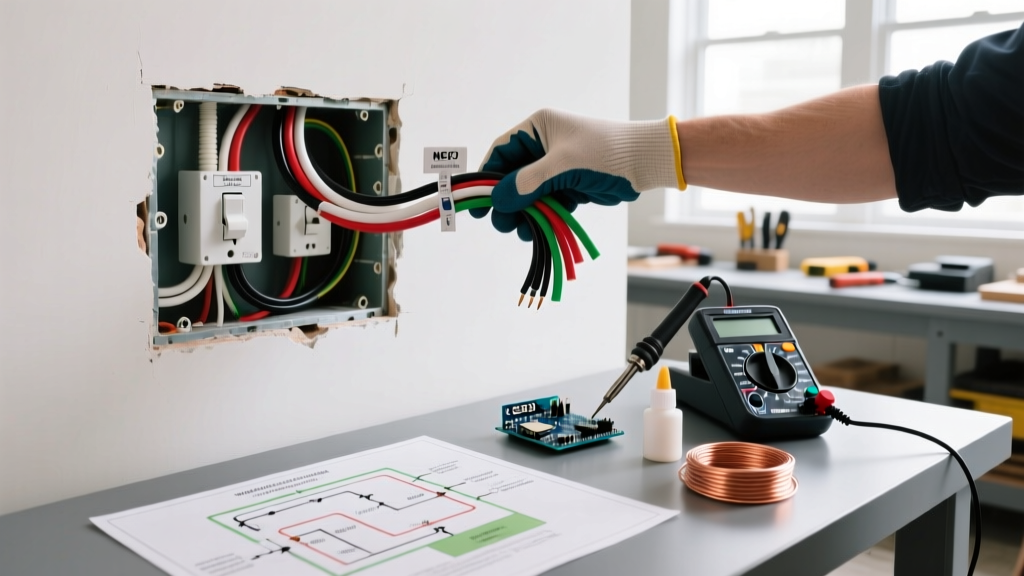
The Code Requirement: NEC 210.4 requires simultaneous disconnection. You must use a handle tie on two single-pole breakers, or a single double-pole breaker, so that turning off one circuit for maintenance doesn't leave the shared neutral energized by the other circuit. Failing to use handle ties is an instant inspection failure and a severe shock risk for anyone working on the downstream wiring.
Translating Inspector Feedback
When the city inspector reviews your work, they will use shorthand terminology. Here is a quick translation guide to help you pass your final walkthrough:
- "You have a bootleg ground." — You wired a 3-prong receptacle but connected the ground screw to the neutral wire to fake a ground. This is highly dangerous.
- "Your neutrals are crossed." — Wires from Circuit A and Circuit B are sharing a neutral bar lug or a neutral wire nut in a multi-gang box. Neutrals must not leave the enclosure they originate from unless part of a specific, code-compliant MWBC.
- "Box is overfilled." — You stuffed too many 12 AWG wires into a standard 18-cubic-inch single-gang box. Upgrade to a deep 22.5-cubic-inch box or use a 4-square plaster ring.
- "Need a TR receptacle here." — You installed standard receptacles in a living area. NEC 406.12 mandates Tamper-Resistant (TR) receptacles (marked with "TR" on the face) in all dwelling unit areas to prevent children from inserting objects into the slots.
Final Thoughts on Safe Wiring Practices
Mastering electrical wiring terminology transforms you from a guesswork DIYer into a capable, code-conscious home renovator. Always reference the latest NEC guidelines, consult your local Authority Having Jurisdiction (AHJ) for specific municipal amendments, and adhere to OSHA electrical safety standards regarding lockout/tagout procedures before beginning any panel work. When in doubt, hire a licensed master electrician to review your rough-in before closing up the drywall.