
The Commercial Stakes: Why Your Electrical Box Cut Out Tool Matters
In commercial rough-in and trim-out phases, time is the most expensive commodity on the job site. When hanging drywall over pre-wired commercial spaces, drywall subcontractors rely on electricians to mark boxes accurately, or they use specialized cutout tools to trace the boxes from the outside. However, when electricians are called upon to cut their own openings—especially in retrofit scenarios, acoustic ceiling grid perimeters, or when dealing with fire-rated assemblies—the right electrical box cut out tool is non-negotiable.
A blown drywall cutout doesn't just look unprofessional; it creates severe code and safety liabilities. According to the National Fire Protection Association (NFPA) NEC Guidelines, specifically NEC 314.20, boxes in non-combustible surfaces must be flush or project slightly. More critically, in commercial fire-rated assemblies (such as UL Design U419 for 1-hour walls), an oversized cutout compromises the firestop integrity. If a spiral saw bit wanders just 1/4-inch too far, the electrician must now apply intumescent firestop putty (like 3M Fire Barrier Putty, costing $4 to $8 per box) or pay the drywall crew to patch, mud, and sand the wall—delaying the trim-out phase by days.
Tool Technology Matrix: Rotary vs. Oscillating vs. Hole Saws
Commercial electricians typically rely on three categories of tools for box cutouts. Understanding the mechanical differences dictates which tool you deploy for specific wall types.
| Tool Category | Best Application | Speed / RPM | Commercial Pros | Commercial Cons |
|---|---|---|---|---|
| Dedicated Rotary Cutout (Spiral Saw) | High-volume new construction, standard 5/8" drywall | 25,000 - 35,000 RPM | Fastest method; clean shearing edges; excellent for tracing boxes. | High dust generation; risk of cutting hidden wires if not careful. |
| Oscillating Multi-Tool | Live panel retrofits, near fire-safing, precision trimming | 10,000 - 20,000 OPM | Zero risk of wire snagging; plunge-cut capable; low dust. | Slower; blades dull quickly on Type X (fire-rated) drywall. |
| Cordless Hole Saw (Dust Extracting) | Concrete walls, masonry, deep acoustic panels | 500 - 1,500 RPM | Perfect circles for round junction boxes; integrated dust shrouds. | Useless for standard rectangular single-gang or 4-square boxes. |
Top Commercial-Grade Cut Out Tools in 2026
The shift toward high-density battery ecosystems (like 20V/18V stacked lithium cells) has made cordless rotary cutout tools the standard on commercial sites, eliminating the trip hazards of extension cords. Here are the top performers currently dominating commercial trim-outs.
1. DeWalt 20V MAX XR Cutout Tool (DCE200B)
Priced around $159 (bare tool), the DCE200B is the undisputed workhorse for commercial electricians. It features a 30,000 RPM motor and accepts both 1/8-inch and 1/4-inch collets. The standout feature for commercial use is the integrated dust blower, which clears gypsum dust from the cut line, allowing the operator to see the box edge while routing. Its sealed switch housing prevents conductive drywall dust from infiltrating the motor, a common failure mode in cheaper alternatives.
2. Makita 18V LXT Compact Router/Trim (XTR01Z)
While technically marketed as a compact router, the XTR01Z ($199 bare tool) is heavily adopted by commercial sparkies due to its variable speed dial (10,000 to 30,000 RPM). This versatility allows an electrician to use a 1/4-inch carbide bit for cutting out plastic non-metallic boxes, then dial down the RPM to route wood blocking or trim laminates without burning the material. The electronic brake stops the bit instantly when released, reducing the risk of scoring adjacent finished walls.
3. Bosch Colt GKF125CE (Corded)
For high-volume daily production where battery management is a bottleneck, the corded Bosch Colt ($119) remains a staple. Delivering a consistent 35,000 RPM via a 5.6-amp motor, it never bogs down when plunging into dense 5/8-inch Type X fire-rated drywall. The fixed base provides superior stability compared to some cordless models, ensuring the baseplate remains perfectly flat against the wall during the critical plunge phase.
Bit Metallurgy and Failure Modes
The tool is only as effective as the bit driving it. Commercial electricians must abandon standard wood bits immediately. Drywall consists of a gypsum core sandwiched between heavy paper faces. Standard twist bits will tear the paper face, creating a ragged, oversized hole.
- Carbide Spiral Upcut Bits (1/8-inch): The industry standard for single-gang and duplex boxes. The "upcut" flute geometry pulls gypsum dust up and out of the kerf, preventing the bit from binding and snapping. Pro Tip: The DeWalt DW6631 or Bosch DC100 are top-tier choices.
- Carbide Spiral Upcut Bits (1/4-inch): Essential for 4-square steel boxes and large junction boxes. The thicker shank resists the lateral torque applied when routing the long, straight edges of a 4x4 box.
- Failure Mode - Bit Snapping: The most common cause of 1/8-inch bit breakage is plunging too aggressively at a 90-degree angle. Commercial pros always use an "angle entry" technique (detailed below) to distribute the lateral load.
- Failure Mode - Dulling on Type X: Type X drywall contains glass fibers for fire resistance. These fibers act like sandpaper on standard HSS (High-Speed Steel) bits. Always use solid carbide or carbide-tipped bits; expect to replace 1/8-inch bits every 40-50 cuts on Type X walls.
The Pro Routing Technique: Step-by-Step
Executing a flawless cutout requires muscle memory and an understanding of router physics. Follow this sequence for commercial trim-outs:
- Locate and Mark: Use a laser level or a physical stud finder to locate the box. Tap the wall to hear the hollow sound of the box cavity. Mark the center with a drywall rasp or a specialized marking tool (like the Blind Mark system) to avoid guessing.
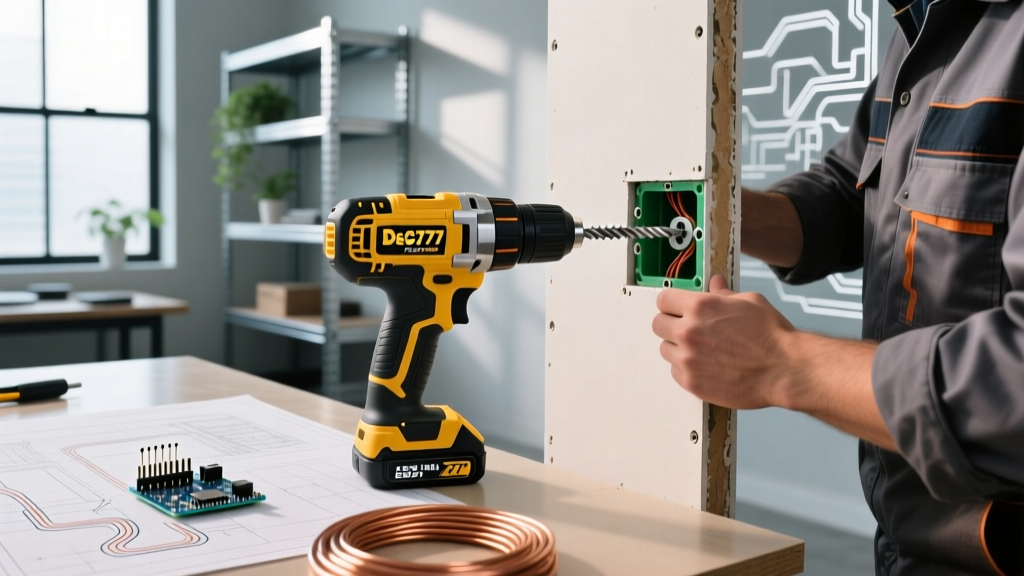
- The Angle Plunge: Do not plunge straight in. Tilt the running tool at a 45-degree angle, allowing the tip of the spiral bit to pierce the drywall paper cleanly. Once the tip is through, slowly lever the tool down to a flat, 90-degree position.
- Find the Edge: Move the bit laterally until you feel it "drop" off the edge of the electrical box and hit the drywall paper. You will hear a distinct change in pitch.
- Trace Clockwise: For an inside cutout (like an electrical box), you must route clockwise. This ensures the rotational force of the bit pushes the tool's baseplate tightly against the edge of the box, acting as a guide. Routing counter-clockwise will cause the bit to grab and pull away from the box, resulting in a massive, ruined hole.
- Lift and Exit: Once you complete the perimeter and meet your starting plunge hole, lift the tool straight out while it is still running to prevent scarring the drywall face.
Commercial Code Alert: When cutting out boxes in commercial plenum spaces or fire-rated shafts, always verify the box depth before plunging. Hitting the back of a shallow steel box with a 30,000 RPM carbide bit will shatter the bit, sending shrapnel into the operator's face. Always wear ANSI Z87.1 rated safety glasses and a face shield when routing near concealed metal.
Dust Management and OSHA Compliance
Commercial job sites are heavily regulated regarding airborne particulates. While standard gypsum dust is a nuisance, joint compound and certain fire-rated drywall materials can contain respirable crystalline silica. OSHA's Silica and Particulate Standards mandate strict Permissible Exposure Limits (PEL). Using an electrical box cut out tool without dust management can result in massive fines for the general contractor and the electrical sub.
To maintain compliance and keep the site clean:
- Use Dust Shrouds: Attach a vacuum-compatible dust shroud to your rotary tool, connected to a HEPA-filtered dust extractor (like a Festool CT SYS or Bosch VAC090A).
- Pre-Cut Vacuuming: If using an oscillating multi-tool for precision work, use a tool with integrated dust extraction ports.
- Site Communication: Coordinate cutout times with the drywall foreman. Cutting boxes before the final sanding phase prevents cross-contamination of dust layers.
Final Thoughts for the Commercial Electrician
Investing in a premium electrical box cut out tool and the correct carbide spiral bits pays for itself on the first commercial job. By avoiding drywall blowouts, maintaining fire-rating integrity, and adhering to OSHA dust protocols, you protect your company's bottom line and reputation. Whether you choose the cordless freedom of the DeWalt DCE200B or the variable-speed precision of the Makita XTR01Z, mastering the clockwise routing technique and angle-plunge method will elevate your trim-out crew from amateur to elite commercial status.