
Navigating Heat Pump Electrical Wiring Requirements in 2026
As the global push toward electrification accelerates, residential and commercial heat pump installations have surged. However, the transition from traditional gas furnaces to advanced, variable-speed electric heat pumps introduces complex electrical demands. Understanding heat pump electrical wiring requirements is not just about keeping the system running; it is about strict adherence to the National Electrical Code (NEC) to prevent catastrophic failures, voided warranties, and fire hazards.
This guide decodes the critical NEC standards—specifically Article 440 (Air-Conditioning and Refrigerating Equipment) and Article 430 (Motors)—providing master electricians and advanced DIYers with the precise data needed for code-compliant installations.
Code Update Note: The NEC 2023 and upcoming 2026 cycles place heightened emphasis on equipment-specific installation instructions. Per NEC 110.3(B), manufacturer installation manuals are now legally enforceable extensions of the code, particularly regarding inverter-driven heat pumps and electromagnetic interference (EMI) mitigation.
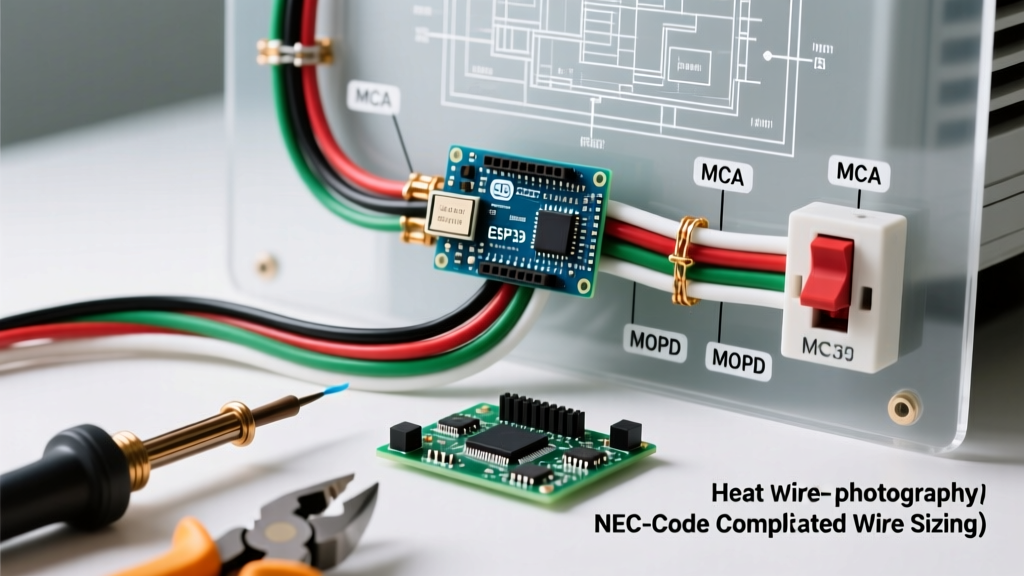
Decoding the Data Plate: MCA vs. MOPD
The most common point of failure in HVAC wiring is misinterpreting the outdoor condenser data plate. Electricians accustomed to standard branch circuit sizing often make the mistake of sizing both the wire and the breaker to the same amperage. Heat pumps operate under different rules.
Minimum Circuit Ampacity (MCA)
MCA dictates the minimum wire size required to safely carry the continuous and non-continuous loads of the compressor and fan motors. It is calculated by taking 125% of the largest motor load plus 100% of all other loads. You must size your conductors to meet or exceed the MCA.
Maximum Overcurrent Protection Device (MOPD)
MOPD dictates the maximum breaker size allowed to protect the equipment. This higher rating is designed to accommodate the massive, momentary inrush current (Locked Rotor Amps, or LRA) when the compressor starts, without nuisance tripping.
Typical Residential Heat Pump Specifications
| Unit Capacity (Tons) | Voltage Rating | MCA (Wire Sizing) | MOPD (Breaker Max) | Min. Copper Wire (75°C) |
|---|---|---|---|---|
| 2.0 Ton | 208/230V - 1 Phase | 15.2 A | 25 A | 14 AWG |
| 3.0 Ton | 208/230V - 1 Phase | 24.0 A | 40 A | 10 AWG |
| 4.0 Ton | 208/230V - 1 Phase | 31.5 A | 50 A | 8 AWG |
| 5.0 Ton | 208/230V - 1 Phase | 42.0 A | 60 A | 6 AWG |
Notice the 3-ton unit: The MCA is 24A, but the MOPD is 40A. Under NEC 440.22, it is entirely legal and code-compliant to use 10 AWG copper wire (rated 35A at 75°C) on a 40A breaker. The breaker protects the equipment's internal overloads during startup surges, while the wire handles the continuous operational load.
Branch Circuit Conductors: Sizing and Insulation
When selecting conductors for heat pump electrical wiring requirements, you must factor in terminal temperature limitations. According to NEC 110.14(C), equipment terminals rated 100 amps or less must be sized using the 75°C column of NEC Table 310.16, unless the equipment is explicitly marked for 90°C.
Conductor Types and Routing
- THHN/THWN-2 in Conduit: The standard for commercial and high-end residential runs. While THHN has a 90°C insulation rating (allowing for derating adjustments in hot attics), the final ampacity must not exceed the 75°C column for termination purposes.
- UF-B (Underground Feeder): Commonly used for direct burial to the outdoor disconnect. UF-B is strictly limited to the 60°C column in Table 310.16 per NEC 339.5, meaning a 10 AWG UF-B cable is only rated for 30A, not 35A.
- SER (Service Entrance Cable): Often used from the main panel to an indoor air handler. XHHW-2 insulation in SER cable is rated for 90°C in dry locations and 75°C in wet, but terminations still default to 75°C.
Overcurrent Protection: The HACR Requirement
Standard thermal-magnetic breakers are not always suitable for HVAC equipment. The NEC and equipment manufacturers require breakers to be marked as HACR (Heating, Air Conditioning, and Refrigeration) type. Modern breakers from major manufacturers like Square D, Eaton, and Siemens are universally HACR-rated, but older panels may require specific replacements. HACR breakers feature calibrated magnetic trip elements designed to withstand the high inrush currents of compressor motors without tripping prematurely.
The Disconnect Switch: NEC Article 440 Compliance
Every outdoor heat pump condenser requires a local disconnect switch. This is not optional; it is a critical life-safety requirement for maintenance personnel.
Location and Visibility
NEC 440.14 mandates that the disconnecting means must be within sight from and readily accessible from the equipment. "Within sight" is defined in NEC Article 100 as being visible and not more than 50 feet away. If the disconnect is blocked by landscaping, fencing, or stored items, it fails inspection.
Fused vs. Non-Fused Disconnects
While a non-fused (pull-out) disconnect is acceptable if the branch circuit breaker provides the exact overcurrent protection required, a fused disconnect is often preferred or required by local AHJs (Authorities Having Jurisdiction) when the branch circuit breaker exceeds the equipment's MOPD. If using fuses, they must be dual-element, time-delay fuses (like Bussmann Fusetron) sized to the MOPD to handle motor starting surges.
Control and Communication Wiring for Inverter Systems
The landscape of heat pumps has shifted dramatically toward variable-speed, inverter-driven models (e.g., Mitsubishi Hyper-Heat, Bosch IDS). These systems do not use traditional 24V AC thermostat wiring for the outdoor unit. Instead, they use high-speed digital communication buses.
Shielding and EMI Mitigation
Inverter compressors switch DC power at high frequencies, generating significant Electromagnetic Interference (EMI). If communication wires are run parallel to high-voltage lines without shielding, the EMI will corrupt the data signal, resulting in erratic fault codes (e.g., Mitsubishi U-series communication errors).
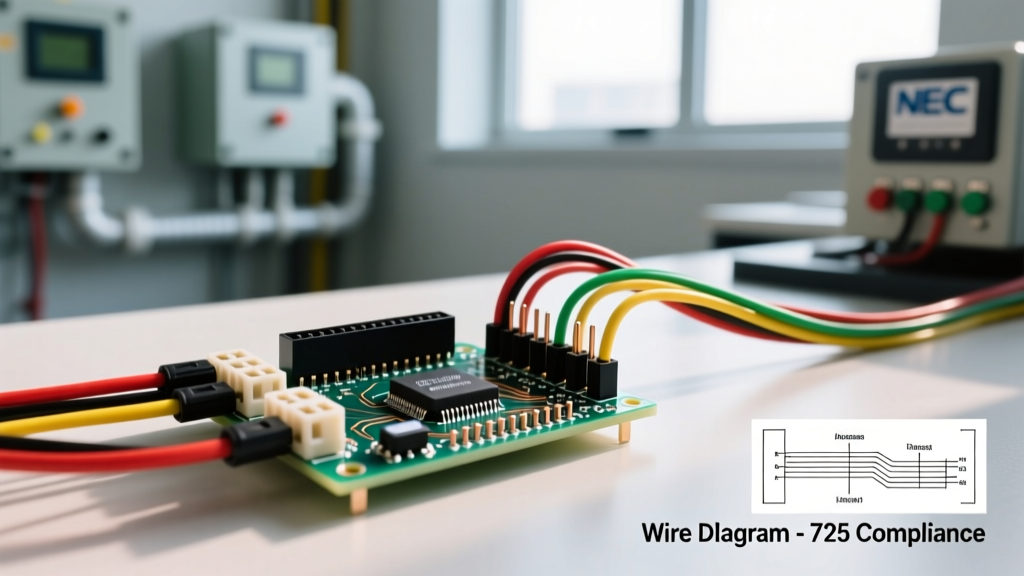
- Wire Type: Use 14 AWG or 16 AWG, 2-conductor or 4-conductor shielded stranded copper cable, as explicitly mandated by the manufacturer.
- Separation Distance: Maintain a minimum 2-inch separation between line-voltage conductors and low-voltage communication cables. If crossing is unavoidable, cross at a strict 90-degree angle.
- Shield Grounding: The drain wire (shield) must typically be grounded at one end only (usually the indoor unit) to prevent ground loops, which can destroy the control board.
Grounding and Bonding Standards
Proper grounding is non-negotiable. The outdoor condenser must be grounded via an Equipment Grounding Conductor (EGC) run with the circuit conductors. Relying solely on a grounding rod at the disconnect switch is a severe code violation. The EGC provides the low-impedance fault current path necessary to trip the breaker instantly in the event of a short circuit.
Additionally, the disconnect switch enclosure and the condenser chassis must be bonded together. If using metallic conduit (like EMT or Liquidtight Flexible Metal) between the disconnect and the unit, the conduit can serve as the EGC per NEC 250.118, provided all fittings are tightly secured. However, running a dedicated copper EGC inside the conduit is considered best practice in the HVAC industry to prevent vibration-induced loosening from compromising the ground path.
Common Code Violations to Avoid
- Undersizing Wire to MOPD: Pulling 10 AWG wire on a 50A breaker because "the breaker is 50A." Always size wire to MCA, breaker to MOPD.
- Missing Duct Seal: When running thermostat or communication wires through the exterior wall into the indoor air handler, NEC 300.7 requires sealing the conduit or wall penetration to prevent condensation and air leakage.
- Improper Whip Connections: Using standard Romex (NM-B) outside the building envelope or inside liquid-tight flexible conduit exposed to UV and weather. NM-B is strictly for indoor, dry locations. Use WHIP (pre-assembled liquid-tight with THHN) or UF-B.
Summary and Authoritative Resources
Meeting heat pump electrical wiring requirements demands a synthesis of NEC code knowledge and strict adherence to manufacturer data plates. As heat pump technology evolves toward higher efficiency and complex inverter topologies, the margin for electrical error shrinks. Always consult the latest Energy Star specifications and local AHJ amendments before roughing in your branch circuits.