
Navigating the Wiring Electrical Code for Home Inspections
Passing an electrical inspection requires far more than simply ensuring the lights turn on and the outlets have power. It demands strict, uncompromising adherence to the National Electrical Code (NEC). For DIYers, remodelers, and even seasoned electricians, keeping up with the evolving wiring electrical code standards is the single biggest hurdle in residential and commercial projects. As jurisdictions across the country continue to adopt the 2023 NEC and prepare for the 2026 NEC cycle, inspectors are cracking down on legacy habits and outdated installation methods.
Whether you are finishing a basement, wiring a new addition, or upgrading a service panel, understanding the core compliance requirements will save you from failed rough-ins, costly rework, and potential fire hazards. This comprehensive guide breaks down the most frequent inspection failures, provides exact NEC article references, and delivers a field-tested checklist to ensure your wiring electrical code compliance is flawless.
The Foundation: Understanding the NEC Framework
The NEC, published by the National Fire Protection Association (NFPA), is not a federal law but a model code adopted by state and local jurisdictions. Its primary directive is the practical safeguarding of persons and property from hazards arising from the use of electricity. When an inspector evaluates your work, they are not looking for the most efficient route or the cheapest materials; they are verifying that every splice, staple, and breaker aligns with the specific articles outlined in the NEC.
According to data analyzed by the International Association of Electrical Inspectors (IAEI), the majority of residential inspection failures stem from a misunderstanding of box fill calculations, improper grounding in subpanels, and missed Arc-Fault Circuit Interrupter (AFCI) requirements. Let us dissect these critical failure points.
Top 5 Wiring Electrical Code Violations (and How to Fix Them)
1. Box Fill Violations (NEC Article 314.16)
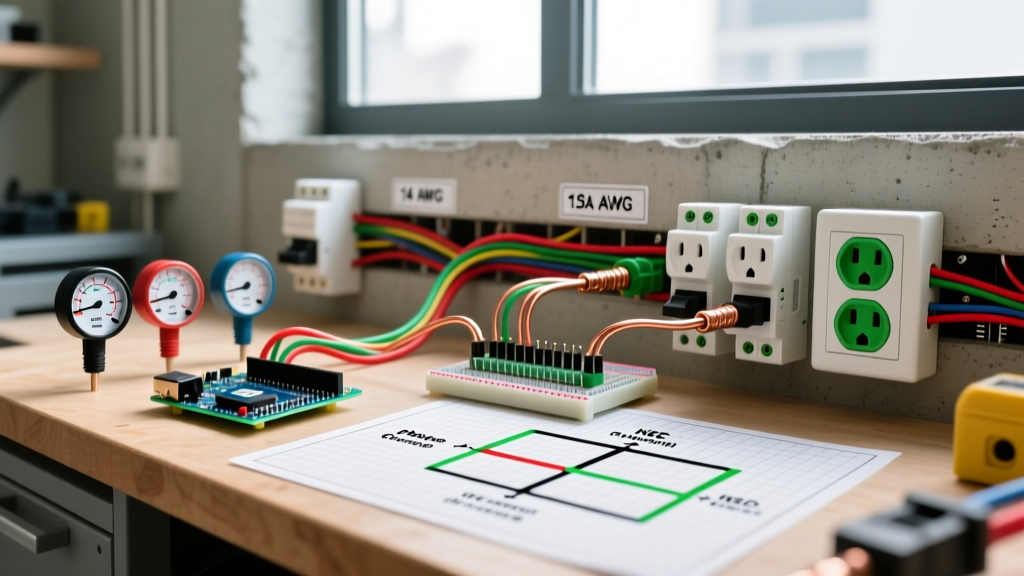
Overcrowding a junction box or receptacle box is one of the most common reasons for a failed rough-in inspection. When too many wires are crammed into a confined space, heat cannot dissipate, and wire insulation can be damaged during device installation. The wiring electrical code mandates specific cubic-inch allowances based on the wire gauge.
- #14 AWG: Requires 2.0 cubic inches per conductor.
- #12 AWG: Requires 2.25 cubic inches per conductor.
- #10 AWG: Requires 2.5 cubic inches per conductor.
Pro-Tip: Equipment grounding conductors (EGCs) count as a single allowance based on the largest ground wire in the box. Internal cable clamps count as one allowance. Each device (switch or receptacle) counts as two allowances based on the largest wire connected to it.
2. Missing AFCI and GFCI Protection (NEC Articles 210.8 & 210.12)
The expansion of AFCI and GFCI requirements has been a major focus in recent code cycles. GFCI (Ground-Fault Circuit Interrupter) protection is strictly required in areas where water and electricity may mix. This includes bathrooms, garages, outdoor receptacles, crawl spaces, unfinished basements, and any receptacle within 6 feet of a sink.
AFCI (Arc-Fault Circuit Interrupter) protection, designed to prevent electrical fires caused by arcing faults, is now required in almost all living spaces. This includes bedrooms, family rooms, dining rooms, living rooms, parlors, libraries, dens, sunrooms, recreation rooms, closets, hallways, and laundry areas. Using standard breakers in these circuits will result in an immediate inspection failure.
3. Improper Securing and Supporting of NM Cable (NEC Article 334.30)
Nonmetallic-sheeled cable (Romex) cannot simply be laid across joists or left dangling. The wiring electrical code dictates that NM cable must be secured within 8 inches of a single-gang box without internal clamps, or within 12 inches of a box with clamps. Furthermore, the cable must be stapled or secured at intervals not exceeding 4.5 feet. Using the wrong type of staple (e.g., using standard office staples instead of UL-listed cable staples) or driving the staple too tightly and crushing the cable sheath are frequent red flags for inspectors.
4. Subpanel Grounding and Bonding Errors (NEC Article 250.32)
In a main service panel, the neutral and ground bars are bonded together. However, in any downstream subpanel, the neutral and ground must be kept entirely separate. Mixing neutrals and grounds in a subpanel creates a parallel path for neutral current to flow on the grounding system, which can energize appliance enclosures and pose a severe shock hazard. Inspectors will physically check the subpanel to ensure the neutral bar is floating (isolated from the panel chassis) and that a separate equipment grounding bar is bonded directly to the metal enclosure.
5. Splicing Outside of Approved Enclosures (NEC Article 300.15)
Every splice must be made inside an approved junction box, and that box must remain permanently accessible. Burying a junction box behind drywall, paneling, or under floorboards is a severe violation. If you need to extend a wire in a wall cavity where a box cannot be made accessible, you must use specialized, code-compliant behind-the-wall splicing kits (like the Tyco NM Cable Splice Kit) that are specifically listed for concealed use without a box, though running a continuous new cable is always the preferred method.
Box Fill Calculation Reference Matrix
To ensure compliance with NEC Table 314.16(B), use the following matrix to calculate the minimum required box volume. Multiply the number of items by their respective cubic-inch factor, then sum the total to select the correct box size.
| Item Type in Box | #14 AWG Factor | #12 AWG Factor | #10 AWG Factor |
|---|---|---|---|
| Current-Carrying Conductors (Hot/Neutral) | 2.0 cu in each | 2.25 cu in each | 2.5 cu in each |
| All Equipment Grounding Wires (Combined) | 2.0 cu in total | 2.25 cu in total | 2.5 cu in total |
| Internal Cable Clamps (Combined) | 2.0 cu in total | 2.25 cu in total | 2.5 cu in total |
| Each Device (Switch/Receptacle) | 4.0 cu in each | 4.5 cu in each | 5.0 cu in each |
The Inspection Process: Rough-In vs. Final
Electrical inspections are typically divided into two distinct phases. Understanding what the inspector looks for in each phase is critical for maintaining your project timeline.
Phase 1: The Rough-In Inspection
This occurs after all cables are pulled, boxes are mounted, and panel wires are dressed, but before any insulation or drywall is installed. The inspector will verify:
- Cable Routing: Checking for proper stapling, boring of studs (holes must be at least 1.25 inches from the edge of the stud to prevent drywall screw punctures), and protection plates where cables are closer than 1.25 inches to the stud face.
- Box Placement: Ensuring boxes are flush with the future wall surface and properly supported.
- Wire Sizing: Verifying that #12 AWG is used for 20A circuits and #14 AWG for 15A circuits.
- Panel Dressing: Confirming that wires are neatly routed, grounds are terminated to the ground bar, and neutrals are landed one-per-lug on the neutral bar.
Inspector's Insight: Never strip the wire insulation back more than 3/4 of an inch for terminal connections. Exposed copper outside the breaker or receptacle terminal is an immediate fail and a major arc-flash risk. Use a dedicated wire stripping tool calibrated to your specific AWG size.
Phase 2: The Final Inspection
This occurs after the drywall is finished, painted, and all devices (receptacles, switches, hardwired appliances) are installed. The inspector will verify:
- Device Polarity: Using a receptacle tester to ensure hot and neutral wires are not reversed.
- GFCI/AFCI Functionality: Physically pressing the 'Test' buttons on breakers and receptacles to ensure they trip correctly.
- Cover Plates: Ensuring all boxes have flush-fitting cover plates with no gaps exposing the interior of the box.
- Lighting Clearances: Verifying that recessed lights are IC-rated if in contact with insulation, and that closet lighting maintains proper clearance from storage spaces as per NEC 410.16.
Commercial and Workplace Compliance Considerations
If your wiring project extends beyond residential into commercial spaces or home-based workshops, additional regulations apply. The Occupational Safety and Health Administration (OSHA) enforces strict electrical safety standards in the workplace. This includes requirements for dedicated equipment grounding conductors, strict lockout/tagout (LOTO) compatible panel clearances (minimum 36 inches of clear working space in front of a panel), and the use of metallic conduit (EMT or Rigid) rather than NM cable in exposed commercial wall cavities or drop ceilings.
Frequently Asked Questions (FAQ)
Can I use 14 AWG wire on a 20-amp breaker?
No. This is a severe violation of the wiring electrical code. 14 AWG wire is rated for a maximum of 15 amps. If you use a 20-amp breaker, the wire can overheat and melt before the breaker trips, causing a fire. You must use a minimum of 12 AWG wire for any 20-amp circuit.
Do I need a permit to replace an electrical panel?
Yes. In almost all jurisdictions, upgrading or replacing a main service panel requires a permit and a final inspection. This ensures the new panel is properly sized, grounded, and that the utility connection is safely managed.
Is it code-compliant to daisy-chain receptacles?
Yes, daisy-chaining (wiring multiple receptacles on the same circuit in series) is standard practice for general lighting and receptacle circuits. However, you must maintain the continuity of the equipment grounding conductor. Do not rely solely on the receptacle's mounting yoke to pass the ground to the next device; always use a pigtail or a listed self-grounding receptacle.
Final Thoughts on Code Compliance
Mastering the wiring electrical code is an ongoing process. The NEC is updated every three years, and local amendments can add specific layers of complexity to your project. Always consult with your local building department before beginning any electrical work, pull the necessary permits, and treat the inspector as a resource rather than an adversary. By adhering strictly to box fill limits, securing cables properly, and respecting the critical separation of grounding and neutral systems, you will ensure a safe, compliant, and easily approved electrical installation.