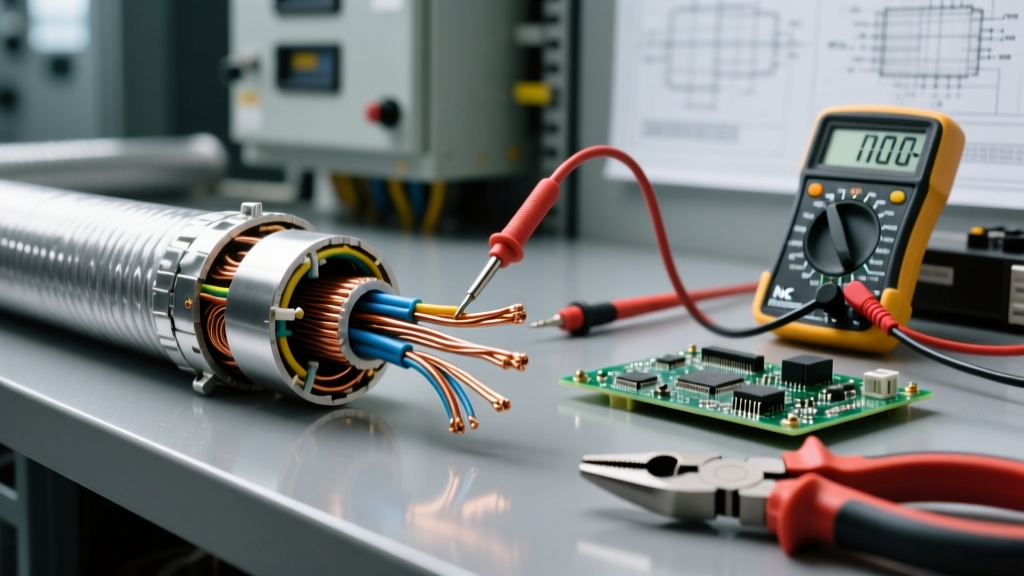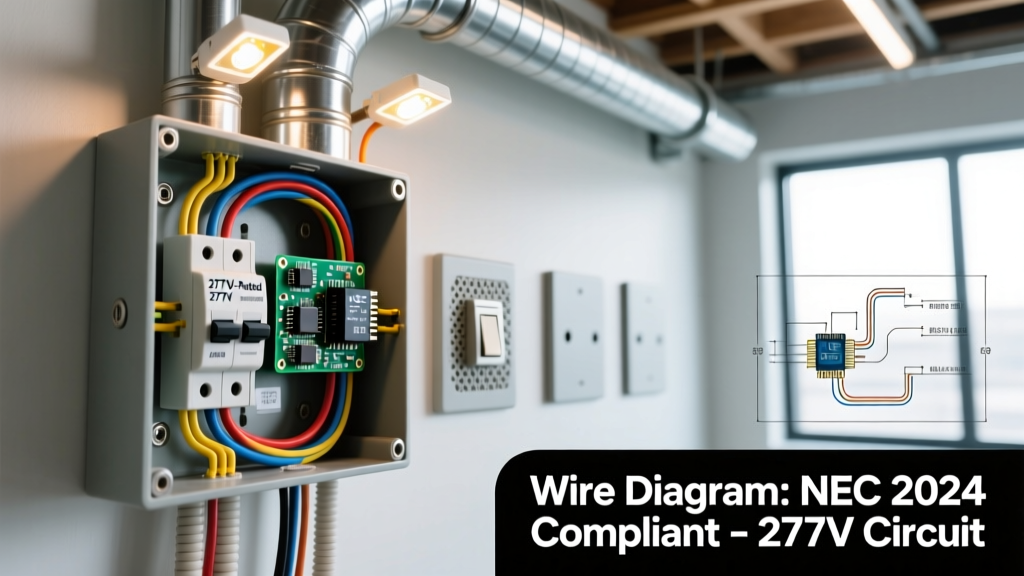

The Commercial Paradigm: 277V Lighting and 3-Phase Power
When transitioning from residential to commercial construction, the rules of the game change entirely. Commercial electrical wiring switches and lights operate in a high-voltage ecosystem dominated by 277V/480V 3-phase Wye systems, rigid metal conduit, and strict energy management codes. Unlike residential 120V branch circuits utilizing non-metallic sheathed cable (Romex), commercial lighting circuits demand a rigorous understanding of phase balancing, harmonic distortion, and specialized switchgear ratings.
In a standard 480Y/277V commercial system, lighting is typically powered by 277V single-phase circuits derived from the phase-to-neutral voltage of the 3-phase transformer. This higher voltage allows for significantly lower current draw per watt. For example, a 20-amp circuit at 277V can safely handle up to 5,540 watts of continuous LED lighting load, compared to just 1,920 watts on a standard 120V/20A residential circuit. This efficiency reduces voltage drop over long commercial runs and minimizes the copper footprint required for large-scale office spaces, warehouses, and retail environments.
Selecting Commercial Switchgear and Control Devices
Using residential-grade toggle switches in a commercial environment is a guaranteed path to premature failure, arcing, and potential fire hazards. The National Fire Protection Association (NFPA) outlines strict parameters in the National Electrical Code (NEC) for switch ratings, particularly when dealing with the inductive and capacitive loads inherent in modern commercial lighting.
Heavy-Duty and Spec-Grade Switches
For manual switching of 277V lighting circuits, you must specify AC-rated switches designed for high-voltage commercial use. Standard residential switches are typically rated for 120V/277V but lack the robust internal spring mechanisms and silver-cadmium oxide contacts required for high-cycle commercial environments.
- Hubbell HBL1221 (Heavy-Duty 20A 277V): Features a back-wired clamp mechanism that provides superior wire retention compared to standard back-stab connections. Priced around $18-$24 per unit in bulk, it is the industry standard for hospital and educational facilities.
- Leviton 1221-2 (Spec-Grade 20A 277V): Utilizes a brass self-grounding clip and reinforced thermoplastic yoke to prevent flexing during actuation. Ideal for high-traffic corridors where switches are subjected to physical abuse.
Code-Mandated Occupancy and Daylighting Sensors
Manual switching is increasingly obsolete in commercial design. ASHRAE 90.1 and the International Energy Conservation Code (IECC) mandate automatic lighting shutoff via occupancy or vacancy sensors in most commercial spaces larger than 300 square feet. Furthermore, daylight harvesting controls are required for sidelighted areas within 15 feet of windows.
Devices like the WattStopper RT-200 or Lutron PowPak Occupancy Sensors utilize passive infrared (PIR) and ultrasonic dual-technology to prevent false-offs in open-plan offices. These sensors require careful wiring; many 277V commercial sensors require a dedicated neutral connection to power their internal relay logic, meaning a 3-wire pull (Hot, Neutral, Ground) plus a switched leg is mandatory.
Wiring Methods: EMT, MC Cable, and THHN/THWN-2
Commercial electrical wiring switches and lights are rarely run through wood studs. The primary wiring methods involve Electrical Metallic Tubing (EMT) or Metal-Clad (MC) cable, housing individual THHN/THWN-2 conductors.
Color-coding is not just a best practice; it is a critical safety requirement. According to NEC Article 210.5(C), branch circuit conductors must be identified by phase or line and system. In a 480Y/277V system, the standard commercial color code is:
- Phase A: Brown
- Phase B: Orange
- Phase C: Yellow
- Neutral: Gray (or White with Gray stripe/tape)
- Ground: Green or Bare
Mixing 120V and 277V circuits in the same raceway or junction box requires strict adherence to NEC 300.2, ensuring all conductors are rated for the maximum voltage present (600V rated THHN is standard).
Comparison: Residential vs. Commercial Wiring Parameters
| Parameter | Residential (120V/240V) | Commercial (277V/480V) |
|---|---|---|
| System Type | Single-Phase, 3-Wire | 3-Phase, 4-Wire Wye |
| Lighting Voltage | 120V | 277V |
| Primary Raceway | Non-Metallic (NM-B) | EMT Conduit / MC Cable |
| Switch Rating | 15A / 120V AC | 20A / 277V AC (Heavy Duty) |
| Neutral Conductor | White (Shared in 3-wire) | Gray (Dedicated or MWBC) |
| Box Material | Plastic / PVC | Galvanized Steel / Masonry |
Critical NEC Code Compliance for Switches and Luminaires
When wiring commercial switches and LED panel lights, inspectors will heavily scrutinize your box fill calculations and multiwire branch circuit (MWBC) configurations.
Box Fill Calculations (NEC Article 314.16): Commercial steel boxes (like 4x4 or 4-11/16 deep octagon boxes) have strict volume limits. Every conductor terminating or splicing in the box counts as one volume allowance based on wire gauge. For #12 AWG THHN, each wire requires 2.25 cubic inches. If you are pulling three circuits through a single box to feed multiple sensors and switches, you must calculate the total cubic inch fill to prevent overheating and conductor insulation damage.
Luminaire Support (NEC Article 410.36): Commercial drop-ceiling LED troffers cannot simply rest on the T-bar grid. They must be secured to the building structure using safety wires or aircraft cable, independent of the ceiling grid itself, to prevent the fixture from falling during seismic events or grid modifications.
Real-World Failure Modes: The MWBC Floating Neutral
The most catastrophic and common failure mode in commercial lighting wiring involves the Multiwire Branch Circuit (MWBC). Electricians often share a single Gray neutral wire between two or three 277V phase conductors (e.g., Brown and Orange hots) to save copper and conduit space.
Expert Warning: If the shared neutral is disconnected or 'floats' while the phase conductors are energized, the 277V lighting loads will effectively become series-connected across the 480V phase-to-phase voltage. This will instantly push 480V through 277V-rated LED drivers, resulting in explosive failure, melted wire insulation, and severe arc flash risks.
The Solution: NEC 210.4(B) mandates that all ungrounded conductors of an MWBC must be provided with a means to simultaneously disconnect them. You must use a common-trip 2-pole or 3-pole breaker, or handle-tied single-pole breakers. Furthermore, always pigtail the neutral wire in the junction box; never use the neutral terminal on a switch or receptacle as the splice point for the downstream circuit.
2026 Project Cost and Labor Metrics
Budgeting for commercial electrical wiring switches and lights requires an understanding of current union and prevailing wage labor rates, as well as material volatility. As of early 2026, commercial electrical contractors are navigating the following baseline metrics:
- Journeyman Electrician Labor Rate: $95 to $145 per hour (fully burdened), varying heavily by region and union vs. non-union markets.
- 3/4" EMT Conduit Installation: $12 to $18 per linear foot (materials and labor combined) for exposed ceiling runs.
- Commercial LED Troffer (2x4) Installation: $85 to $130 per fixture, assuming a standard T-bar drop ceiling and pre-existing MC cable whips.
- Networked Lighting Controls (NLC) Commissioning: $0.15 to $0.35 per square foot. Systems like Lutron Vive or nLight require specialized low-voltage programming after the high-voltage wiring is complete.
For deeper insights into commercial energy efficiency standards that dictate these lighting control requirements, refer to the U.S. Department of Energy's Commercial Lighting guidelines. Additionally, maintaining strict adherence to OSHA's electrical safety standards is non-negotiable when working on live 277V/480V commercial panels during retrofits.
Final Thoughts on Commercial Execution
Mastering commercial electrical wiring switches and lights is about precision, code compliance, and an unwavering respect for high-voltage systems. By specifying heavy-duty 277V switchgear, strictly adhering to MWBC neutral management, and integrating modern daylighting sensors, you ensure a lighting infrastructure that is safe, energy-efficient, and built to withstand the demands of commercial operation.