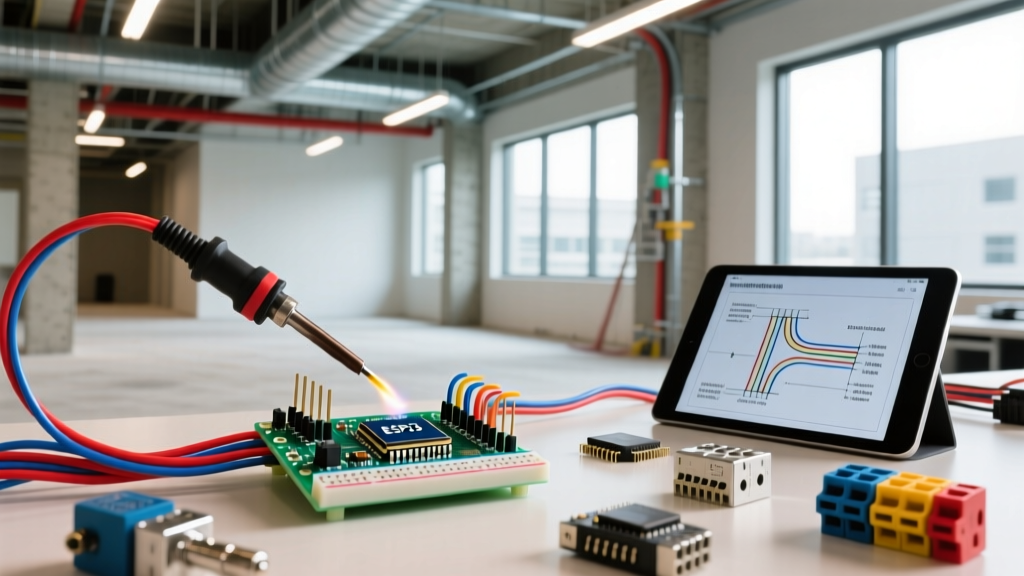

Extending electrical wiring in commercial environments is fundamentally different from residential remodels. While a home addition might rely on NM-B (Romex) cable, commercial tenant buildouts, warehouse expansions, and retail remodels demand rigid adherence to the National Electrical Code (NEC) regarding wiring methods, plenum ratings, and physical protection. When extending electrical wiring for new point-of-sale (POS) systems, HVAC upgrades, or additional lighting bays, electrical contractors must navigate complex load calculations, voltage drop limitations, and conduit fill ratios. This guide provides a comprehensive, code-compliant framework for extending commercial circuits in 2026, focusing on THHN/THWN-2 conductors, EMT conduit, and modern termination standards.
NEC Code Requirements for Commercial Extensions
The foundation of any commercial wiring extension is the NFPA 70 (National Electrical Code). Unlike residential spaces where nonmetallic-sheathed cable is permitted within walls, commercial spaces—especially those with drop ceilings or exposed structural elements—have strict limitations.
- NEC Article 334.12 (Prohibited Uses): NM cable is strictly prohibited in concealed spaces of drop ceilings or plenums used for environmental air. Extending a circuit through a commercial ceiling plenum requires metal-clad (MC) cable or conductors pulled through a metal raceway.
- NEC Article 300.4 (Protection Against Physical Damage): When extending wiring down a wall to a commercial receptacle or POS terminal, conductors must be protected by EMT (Electrical Metallic Tubing) or IMC (Intermediate Metal Conduit) to prevent damage from forklifts, pallet jacks, or heavy equipment.
- NEC Article 210.11 (Branch Circuits Required): Commercial extensions often require dedicated circuits for specific equipment. For example, extending wiring for a new commercial walk-in cooler requires a dedicated circuit sized at 125% of the continuous load.
Furthermore, workplace safety regulations enforced by OSHA under standard 1910.305 mandate that all wiring methods and components must be free from recognized hazards, emphasizing the need for proper grounding and overcurrent protection when modifying existing commercial infrastructure.
Material Selection: Conductors and Raceways
When extending commercial circuits, material selection dictates both code compliance and longevity. The industry standard for indoor, dry-location commercial extensions is THHN/THWN-2 copper wire pulled through EMT.
Conductors: THHN/THWN-2
THHN (Thermoplastic High Heat-resistant Nylon-coated) wire is the workhorse of commercial wiring. Modern variants are dual-rated as THWN-2, meaning they are also water-resistant up to 90°C in wet locations. For commercial extensions, contractors frequently use low-friction wire like Southwire SIMpull, which features a specialized jacket that reduces pulling tension by up to 50%, eliminating the need for heavy wire lubricants in long conduit runs.
Raceways: EMT vs. IMC vs. Rigid
Electrical Metallic Tubing (EMT) is the default raceway for extending wiring in commercial interiors. It is lightweight, easy to bend with a mechanical bender, and provides excellent physical protection. For areas subject to severe physical damage (e.g., warehouse loading docks), the NEC requires upgrading to IMC or Rigid Metal Conduit (RMC).
Pro Tip: When extending EMT through commercial stud walls, always use compression fittings rather than set-screw fittings for outdoor or damp transitions. Compression fittings provide a continuous, reliable grounding path that set-screws can compromise over time due to vibration.
Voltage Drop and Wire Sizing Matrix
Commercial spaces are vast. Extending electrical wiring from a main switchgear room to a distant retail bay can easily result in runs exceeding 150 feet. While the NEC does not strictly enforce voltage drop for branch circuits (it is a recommendation in NEC 210.19 Informational Note No. 4), maintaining a maximum 3% voltage drop on branch circuits and 5% combined is critical for equipment longevity and compliance with OSHA electrical safety guidelines regarding equipment performance.
| Circuit Voltage | Run Length (One Way) | Standard Wire Size | Upsized Wire (Max 3% Drop) | Max Amperage Load |
|---|---|---|---|---|
| 120V 1-Phase | 50 ft | #12 AWG | #12 AWG | 20A |
| 120V 1-Phase | 150 ft | #12 AWG | #8 AWG | 20A |
| 208V 3-Phase | 100 ft | #10 AWG | #10 AWG | 30A |
| 208V 3-Phase | 250 ft | #10 AWG | #6 AWG | 30A |
| 480V 3-Phase | 300 ft | #8 AWG | #8 AWG | 40A |
Note: Always calculate voltage drop using the actual continuous load amperage, not just the breaker rating. Use the formula: VD = (2 x K x I x D) / CM for single-phase, where K=12.9 for copper.
Step-by-Step Execution for Extending Circuits
Executing a commercial wiring extension requires methodical planning to avoid disrupting existing business operations.
- Perform a Load Calculation (NEC Article 220): Before extending a feeder or branch circuit, verify the existing panelboard (e.g., an Eaton 400A main breaker panel) has the physical busbar capacity and spare breaker spaces. If the panel is at 80% continuous capacity, you must extend the feeder to a new downstream subpanel rather than tapping the existing bus.
- Route and Bend Conduit: Map the EMT route. NEC 300.18 requires raceways to be installed complete between pull points before wire is pulled. Limit the number of bends between pull boxes to 360 degrees (NEC 358.26) to prevent wire jacket damage during the pull.
- Pull Conductors: Use a fiberglass fish tape for runs under 50 feet, and a mechanical wire pulling compound for longer runs. Ensure the pulling tension does not exceed 0.008 pounds per circular mil of conductor area.
- Terminate with Calibrated Torque: This is a critical 2026 compliance point. NEC 110.14(D) mandates that all terminations on circuit breakers and lugs must be tightened using a calibrated torque tool (such as the Klein Tools 70009 torque screwdriver) to the manufacturer's specified inch-pound rating. Hand-tightening is a code violation and a primary cause of commercial electrical fires.
Common Failure Modes and Edge Cases
Commercial environments introduce electrical anomalies rarely seen in residential wiring. When extending circuits, contractors must anticipate these edge cases:
Harmonic Overloading on Shared Neutrals
Modern commercial spaces are saturated with non-linear loads like LED drivers, variable frequency drives (VFDs), and computer power supplies. These devices generate third-order harmonics that add up on the neutral conductor rather than canceling out. If you are extending a Multi-Wire Branch Circuit (MWBC) to supply office workstations, the neutral wire can easily carry more current than the phase wires. Solution: Oversize the neutral conductor by 200% or run a dedicated neutral for every phase conductor in commercial office extensions.
Isolated Ground (IG) Receptacles for Sensitive Equipment
When extending wiring to medical equipment, server racks, or high-end audio-visual systems in commercial buildouts, standard EMT grounding is insufficient due to electromagnetic interference (EMI) traveling along the conduit. Solution: Install orange Isolated Ground (IG) receptacles and run a separate, insulated green equipment grounding conductor back to the main panel's ground bus, completely bypassing the EMT grounding path.
2026 Commercial Wiring Cost Estimates
Budgeting for commercial extensions requires accounting for labor intensity, material costs, and union vs. non-union prevailing wages. As of early 2026, commercial electrical contractors can expect the following baseline costs for extending standard 120V/208V circuits:
- 3/4" EMT Conduit Installation (Labor & Materials): $14.00 - $22.00 per linear foot. This includes bending, mounting, and pulling three #12 AWG THHN wires.
- Commercial Junction Box Installation: $150 - $250 per box (4x4 or 6x6 steel boxes with blank covers or device rings).
- Panelboard Feed Extension (Subpanel): $1,800 - $3,500 to extend a 100A, 3-phase feeder using 1.5" EMT and #2 AWG copper conductors up to 50 feet.
- After-Hours / Weekend Premiums: Commercial tenant buildouts often require work outside normal retail hours. Expect a 1.5x to 2.0x labor multiplier for night or weekend shifts.
Conclusion
Extending electrical wiring in commercial settings is a precision task that demands strict adherence to NEC wiring methods, proactive voltage drop management, and modern torque-verified termination practices. By selecting the correct THHN/THWN-2 conductors, utilizing EMT raceways properly, and anticipating commercial-specific edge cases like harmonic neutral overloading, electrical professionals can deliver safe, durable, and code-compliant power extensions that support modern commercial operations.