
Navigating the 2026 Landscape of Residential Home Electrical Wiring
When it comes to residential home electrical wiring, passing municipal inspections is not just a bureaucratic hurdle; it is the definitive validation that your installation protects human life and property from electrical fire and shock hazards. As jurisdictions across the United States continue to adopt and enforce the stringent mandates of the NEC 2023 and transition toward the upcoming 2026 code cycle, electrical inspectors are utilizing advanced thermal imaging and calibrated torque verification to ensure absolute compliance. According to the National Fire Protection Association (NFPA), electrical failures remain a leading cause of home structure fires, making rigorous adherence to wiring codes non-negotiable.
This comprehensive inspection and compliance guide breaks down the exact technical parameters, failure modes, and code mandates that electrical inspectors evaluate during both the rough-in and final phases of residential wiring projects.
Phase 1: The Rough-In Inspection Checklist
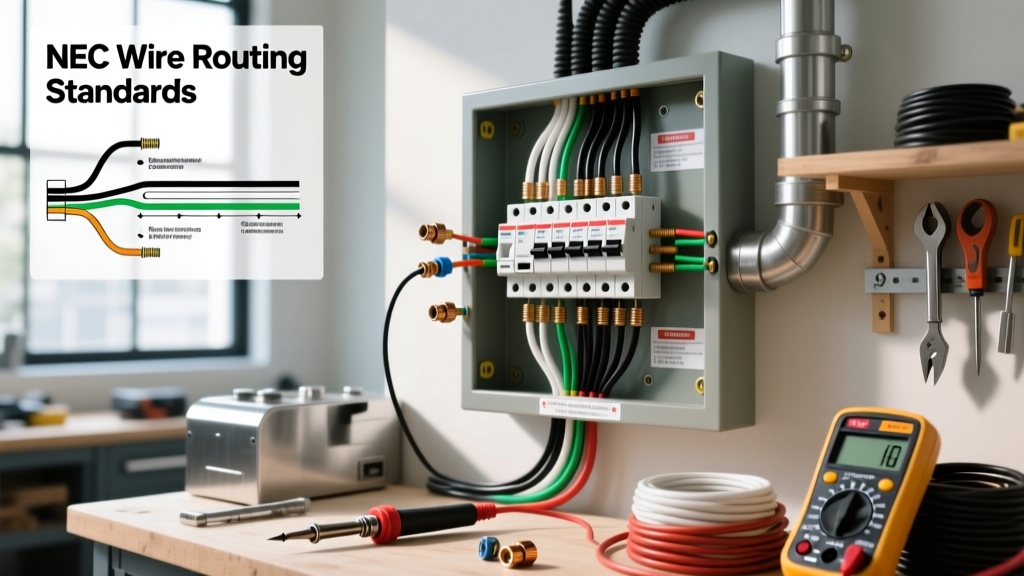
The rough-in inspection occurs after all cables are pulled and boxes are mounted, but before drywall is installed. Inspectors are primarily looking for mechanical protection, proper routing, and secure fastening of Non-Metallic Sheathed Cable (NM-B, commonly known as Romex).
NEC 334.30 Securing and Supporting NM-B Cable
One of the most frequent rough-in failures involves improper stapling. NEC Article 334.30 dictates that NM-B cable must be secured within 8 inches of every outlet box, junction box, or cabinet, and at intervals not exceeding 4.5 feet. Inspectors will specifically check for:
- Stacking Restrictions: You cannot stack multiple NM-B cables under a single staple unless the staple is specifically listed and sized for multiple cables (e.g., a 1/2-inch staple for a single 12/2 cable, but a multi-cable stacker for three 14/2 cables).
- Cable Damage: Over-driven staples that crush the cable jacket and compress the internal THHN/THWN conductors will result in an immediate fail. Inspectors look for the 'dimple' in the wire; if the jacket is breached or the wire is visibly deformed, the section must be replaced.
- Boring Holes: When running through studs, holes must be bored at least 1.25 inches from the nearest edge of the framing member to prevent drywall screws from piercing the cable later.
Nail Plates and Framing Proximity (NEC 300.4)
If a wire or cable must pass through a framing member closer than 1.25 inches to the edge, a steel nail plate (minimum 1/16 inch thick) must be installed over the edge of the stud. Inspectors meticulously scan the edges of top plates and studs for these protective plates. Missing a single nail plate in a high-density wiring area, such as a media wall or kitchen peninsula, is a guaranteed red tag.
Phase 2: Box Fill Calculations and Conductor Limits
Overcrowded junction and outlet boxes cause excessive heat buildup, which degrades wire insulation over time. Inspectors calculate 'box fill' based on NEC Article 314.16. Every conductor, device (switch/receptacle), and clamp counts as a specific volume allowance based on the wire gauge.
| Wire Gauge (AWG) | Volume Required per Conductor | Common Box Application |
|---|---|---|
| 14 AWG | 2.0 Cubic Inches | Standard lighting circuits, 3-way switch loops |
| 12 AWG | 2.25 Cubic Inches | 20A kitchen receptacles, bathroom GFCI circuits |
| 10 AWG | 2.50 Cubic Inches | 30A dryer receptacles, long-run voltage drop compensation |
| 8 AWG | 3.00 Cubic Inches | 40A-50A range circuits, EV charger hardwired connections |
Inspector Tip: A standard single-gang plastic 'old work' box typically offers 14 to 18 cubic inches. If you are pigtailing three 12/2 cables and installing a duplex receptacle in a 14-cubic-inch box, you have exceeded the fill capacity. The formula counts each current-carrying conductor, one allowance for all grounds combined, and two allowances for the device itself. Always use deep 20.5 or 22.5 cubic inch boxes for multi-cable junctions.
Phase 3: Final Inspection and Device Termination
Once the drywall is finished and devices are installed, the final inspection evaluates the safety of the terminations, the functionality of the circuit protection, and the integrity of the grounding system.
The Torque Mandate: NEC 110.14(D)
Perhaps the most significant shift in modern electrical inspections is the strict enforcement of NEC 110.14(D), which requires that all terminations be tightened to the manufacturer's specified torque using a calibrated torque tool. Inspectors in 2026 frequently carry digital torque screwdrivers to spot-check panel lugs and breaker terminals.
For standard 15A and 20A residential breakers (such as the Square D QO or Eaton BR series), the typical torque specification is 35 inch-pounds. Relying on 'hand-tight' or 'wrist-torque' is no longer acceptable. Loose connections cause high-resistance faults, leading to arcing and panel fires. Professional contractors now invest in tools like the Klein Tools 70012 Torque Screwdriver (retailing around $140) to ensure compliance and document their work.
AFCI and GFCI Expansion: What Inspectors Look For
The expansion of Arc-Fault Circuit Interrupter (AFCI) and Ground-Fault Circuit Interrupter (GFCI) requirements continues to be a major focal point for compliance. The U.S. Consumer Product Safety Commission (CPSC) heavily advocates for these devices, noting their critical role in preventing electrocution and electrical fires.
- GFCI Protection (NEC 210.8): Required in all 125-volt, single-phase, 15- and 20-ampere receptacles installed in bathrooms, kitchens, laundry areas, garages, outdoors, crawl spaces, and unfinished basements. Inspectors will use a plug-in GFCI tester to trip the circuit and verify that the reset function operates correctly.
- AFCI Protection (NEC 210.12): Required for nearly all 120-volt, single-phase, 15- and 20-amp branch circuits supplying outlets in residential living spaces. This includes bedrooms, living rooms, hallways, and closets. Combination-type AFCI breakers (which protect against both parallel and series arcing) are the standard. An Eaton BR220AFCI breaker costs approximately $45 to $60, a necessary expense for compliance.
Grounding, Bonding, and the Main Panel
A critical distinction that separates novice DIYers from licensed professionals is the understanding of grounding versus bonding. Inspectors will verify the main bonding jumper in the primary service panel, which connects the neutral bus bar to the ground bus bar and the panel enclosure. In subpanels, this bond must not exist; the neutral and ground must remain strictly isolated.
Furthermore, NEC 250.68 requires the bonding of the metal underground water pipe. The grounding electrode conductor must be connected to the metal water pipe within the first 5 feet of where it enters the building. Inspectors will physically trace this wire to ensure the clamp is tight, the pipe is clean of paint or corrosion at the connection point, and that a secondary grounding electrode (like a ground rod or ufer ground) is properly integrated into the grounding electrode system (GES).
Expert Insight: 'The most common reason I fail a 200-amp service upgrade final inspection is improper neutral isolation in subpanels and missing bonding bushings on concentric knockouts. Always use a grounding bushing with a bonding jumper on the main service conduit if the locknut does not provide a guaranteed ground path.' - Senior Municipal Electrical Inspector
Financial Impact: Compliance Costs in 2026
Understanding the financial parameters of compliance helps homeowners and contractors budget accurately. Based on current 2026 national averages, here is what you can expect to pay for inspection and compliance-related upgrades:
- Municipal Inspection Fees: $125 to $250 for a standard residential rough-in and final inspection combo.
- Third-Party Private Inspections: $300 to $500 (often required in rural areas without municipal inspectors or for specialized solar/EV integrations).
- 200-Amp Panel Upgrade (Labor & Materials): $2,800 to $4,200, heavily dependent on local permit costs and the necessity of trenching for new mast services.
- AFCI/GFCI Breaker Retrofits: Upgrading a standard panel to full AFCI/GFCI compliance can add $800 to $1,500 in material costs alone, as dual-function (CAFCI/GFCI) breakers retail for $75 to $95 each.
Frequently Asked Questions
Can a homeowner pull a permit for their own residential home electrical wiring?
Yes, in most jurisdictions, homeowners can pull an 'owner-builder' permit to wire their own primary residence, provided they pass the same rigorous rough-in and final inspections as a licensed contractor. However, you cannot perform electrical work on a property you intend to sell or rent within 12 months of completion without a master electrician's license. Always consult the Electrical Safety Foundation International (ESFI) guidelines and your local building department before starting.
What happens if my wiring fails the rough-in inspection?
The inspector will issue a 'red tag' or correction notice detailing the specific code violations (e.g., missing nail plates, improper box fill). You must correct the deficiencies and schedule a re-inspection. Most municipalities allow one free re-inspection, but subsequent failures may incur $75 to $150 re-inspection fees.
Do I need to upgrade my existing wiring to meet the 2026 NEC code?
Generally, the NEC is not retroactive. Existing residential home electrical wiring that was installed to code at the time of construction is 'grandfathered' in. However, if you undertake a major renovation, add a new circuit, or upgrade your service panel, the new work must comply with the current code cycle, and inspectors may require you to bring specific interconnected elements (like AFCI protection for the entire renovated branch circuit) up to modern standards.