
The True Cost of Electricity Protection Wiring in 2026
When planning a residential or commercial electrical upgrade, standard branch circuit wiring only tells half the story. The defensive layer of your electrical system—known as electricity protection wiring—ensures that transient voltage spikes, ground faults, arc faults, and lightning strikes do not result in catastrophic equipment failure or structural fires. In 2026, with copper prices stabilizing at a premium and smart-home integrations becoming standard, the cost to properly wire and install these protection systems has shifted significantly.
This comprehensive cost estimation guide breaks down the exact material and labor expenses for upgrading your surge protective devices (SPDs), arc-fault and ground-fault circuit interrupters (AFCI/GFCI), and grounding electrode systems. Whether you are a contractor bidding on a new construction project or a homeowner budgeting for a heavy-up service upgrade, these 2026 market rates will provide an accurate financial baseline.
Surge Protective Devices (SPDs): Type 1 vs. Type 2 Wiring
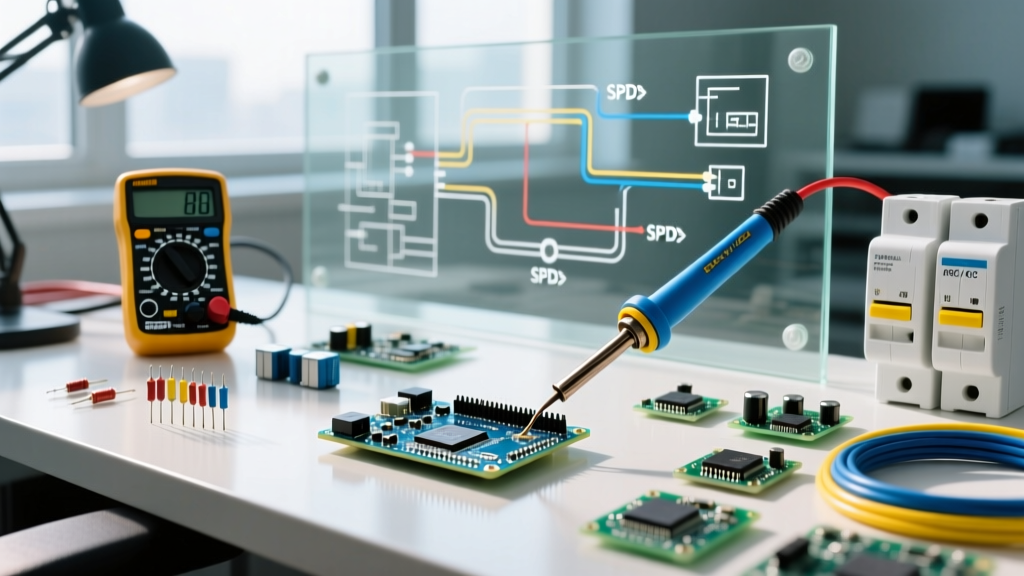
Governed by NEC Article 242, Surge Protective Devices are now mandatory on all new residential services in many jurisdictions. The cost of wiring an SPD depends heavily on the Type rating and the physical layout of your main service panel.
Type 2 SPDs (Load-Side / Panel Mount)
Type 2 SPDs are installed on the load side of the main service disconnect. They are the most common retrofit choice. In 2026, industry-leading models like the Eaton CHSPT2ULTRA (retailing around $145) and the Square D HEPD80 (around $130) dominate the market. These units typically require a dedicated 50-amp, 2-pole breaker.
- Material Cost: $130 - $180 (SPD unit + 50A breaker + 10 AWG THHN wire).
- Labor Cost: $150 - $250 (1.5 to 2 hours of licensed electrician labor).
- Total Installed: $280 - $430.
Type 1 SPDs (Service Entrance / Line-Side)
Type 1 SPDs are wired on the line side of the main disconnect, often mounted outside on the meter socket or service mast. Models like the Siemens FS140 ($220) require pulling heavy-gauge wire (typically 6 AWG or 4 AWG) through rigid metal conduit from the weatherhead to the SPD enclosure.
- Material Cost: $250 - $350 (SPD, NEMA 3R enclosure, rigid conduit, 4 AWG THWN-2 wire).
- Labor Cost: $400 - $700 (Requires utility coordination, meter pulling, and conduit bending).
- Total Installed: $650 - $1,050.
AFCI and GFCI Circuit Protection Upgrades
The National Electrical Code (NFPA 70) continues to expand the rooms requiring Arc-Fault (NEC 210.12) and Ground-Fault (NEC 210.8) protection. In 2026, the industry standard is the Dual-Function (DF) breaker, which combines both AFCI and GFCI protection into a single 1-inch breaker space, eliminating the need for bulky receptacle upgrades at the end of the run.
Dual-Function Breaker Pricing & Labor
Upgrading a standard 15A or 20A breaker to a Dual-Function model (such as the Square D QO120DF or Eaton BR120DF) involves rewiring the circuit's neutral wire directly to the breaker's pigtail, rather than the neutral bar.
- Material Cost: $55 - $75 per breaker.
- Labor Cost: $85 - $140 per circuit (Includes tracing the neutral, swapping the breaker, and testing the arc-fault signature).
- Total Per Circuit: $140 - $215.
Expert Insight: According to the Electrical Safety Foundation International (ESFI), GFCI protection reduces the risk of fatal electrocution by over 80%. However, retrofitting older homes with shared neutrals (multi-wire branch circuits) will cause DF breakers to trip immediately. Resolving this requires pulling new 12/3 Romex or installing handle-tied 2-pole DF breakers ($110+ each), adding $200-$400 in diagnostic labor per affected room.
Grounding Electrode Systems: The Foundation of Protection
No electricity protection wiring is effective without a low-impedance path to the earth. NEC Article 250 dictates the grounding electrode system (GES). In 2026, the cost of copper remains a major factor in grounding budgets.
Ground Rods vs. Ufer Grounds
For existing homes lacking a concrete-encased electrode (Ufer ground), electricians must drive ground rods. While 5/8-inch by 8-foot copper-clad steel rods are standard, high-resistivity soil (common in rocky or sandy regions) may require driving multiple rods or using chemical ground enhancement materials.
- Standard Ground Rod (Copper-Clad): $45 for the rod, $3.10/ft for 4 AWG bare copper wire. Total installed: $250 - $400.
- Ufer Ground (Concrete-Encased): Requires tying 20 feet of 4 AWG bare copper or 1/2-inch rebar into the foundation footing before the concrete pour. Material: $85. Labor (coordination with concrete crew): $150 - $250. Total: $235 - $335.
2026 Electricity Protection Wiring Cost Matrix
The following table summarizes average 2026 market rates for a standard 200-amp residential service upgrade, incorporating both materials and prevailing union/non-union labor rates ($95 - $165/hour).
| Protection Subsystem | Material Cost (2026) | Labor Cost | Total Estimated Range |
|---|---|---|---|
| Type 2 Panel-Mount SPD | $130 - $180 | $150 - $250 | $280 - $430 |
| Type 1 Service Entrance SPD | $250 - $350 | $400 - $700 | $650 - $1,050 |
| AFCI/GFCI Dual-Function Breaker (Per Circuit) | $55 - $75 | $85 - $140 | $140 - $215 |
| Whole-Home Grounding Retrofit (2 Rods + 4 AWG) | $120 - $180 | $250 - $450 | $370 - $630 |
| Isolated Ground Receptacles (Home Theater/Server) | $15 - $25 each | $100 - $150 each | $115 - $175 each |
Hidden Costs and Edge Cases to Budget For
When estimating electricity protection wiring, contractors and homeowners frequently overlook secondary costs that arise once the panel cover is removed.
1. Panel Busbar Space Limitations (LOC)
If your main service panel is fully populated, adding a Type 2 SPD requires two free breaker spaces. If none are available, you must either tandem existing circuits (if the panel allows and busbar ratings permit) or install a subpanel to free up space. A subpanel installation adds $450 to $800 to the project.
2. Obsolete Panel Upgrades
If your home utilizes a Federal Pacific (Stab-Lok), Zinsco, or Challenger panel, you cannot safely install modern protection wiring. These panels have documented failure modes where breakers fail to trip during overcurrent events. Upgrading the protection wiring mandates a full panel replacement, pushing the baseline cost up by $1,800 to $2,800.
3. Smart Panel Integrations
As noted by the U.S. Department of Energy (DOE), modern energy management systems are increasingly integrating surge protection directly into the smart breaker architecture. Systems like the Leviton Smart Load Center or Square D Wiser offer granular circuit-level monitoring and built-in surge suppression, but the breakers cost 3x to 4x more than standard thermal-magnetic breakers ($120+ per smart breaker).
Expert Verdict: Where to Allocate Your Budget
If you are working with a constrained budget in 2026, prioritize your electricity protection wiring in this order:
- Verify the Grounding Electrode System: An SPD or GFCI cannot function correctly without a low-impedance ground. Test the ground resistance; if it is above 25 ohms, invest in additional ground rods or a ground enhancement mat first.
- Install a Type 2 SPD at the Main Panel: This offers the highest ROI, protecting expensive HVAC control boards, smart appliances, and EV chargers from utility-side grid switching surges.
- Upgrade Branch Circuit Protection (AFCI/GFCI): Focus on wet areas (kitchens, bathrooms, exteriors) and sleeping areas first, as these pose the highest life-safety risks regarding shock and electrical fires.
By understanding the specific material costs, NEC code mandates, and labor variables involved in electricity protection wiring, you can accurately forecast your 2026 electrical upgrade budget and ensure a resilient, code-compliant infrastructure.