
The High-Stakes Reality of Electrical Wiring Training
Electrocution and arc flash incidents remain among the most severe hazards in the construction and maintenance trades. When conducting electrical wiring training, instructors carry the dual burden of teaching complex technical skills while instilling a deeply ingrained safety culture. A training environment must never simulate the reckless shortcuts often seen in the field; instead, it must enforce the highest tier of safety protocols. In 2026, modern training programs have moved beyond simple lecture-based safety modules, integrating rigorous hands-on simulations, strict PPE enforcement, and advanced lab engineering to ensure trainees develop muscle memory for zero-energy verification.
Navigating NFPA 70E and OSHA Compliance in the Classroom
Any credible electrical wiring training program must be anchored to current regulatory standards. The foundation of electrical safety in the United States rests on OSHA 1910 Subpart S and the consensus standards outlined in NFPA 70E. Instructors must ensure that trainees understand that safety is not a suggestion, but a legal and moral mandate.
According to OSHA's Control of Hazardous Energy guidelines, failure to properly isolate energy sources is a leading cause of electrical fatalities. Training programs must explicitly teach the hierarchy of risk controls: elimination, substitution, engineering controls, awareness, and administrative controls, with PPE serving as the absolute last line of defense. Furthermore, leveraging resources from the Electrical Safety Foundation International (ESFI) provides trainees with data-driven insights into workplace electrical hazards, reinforcing the 'why' behind the 'what' of safety protocols.
PPE Selection Matrix for Trainees
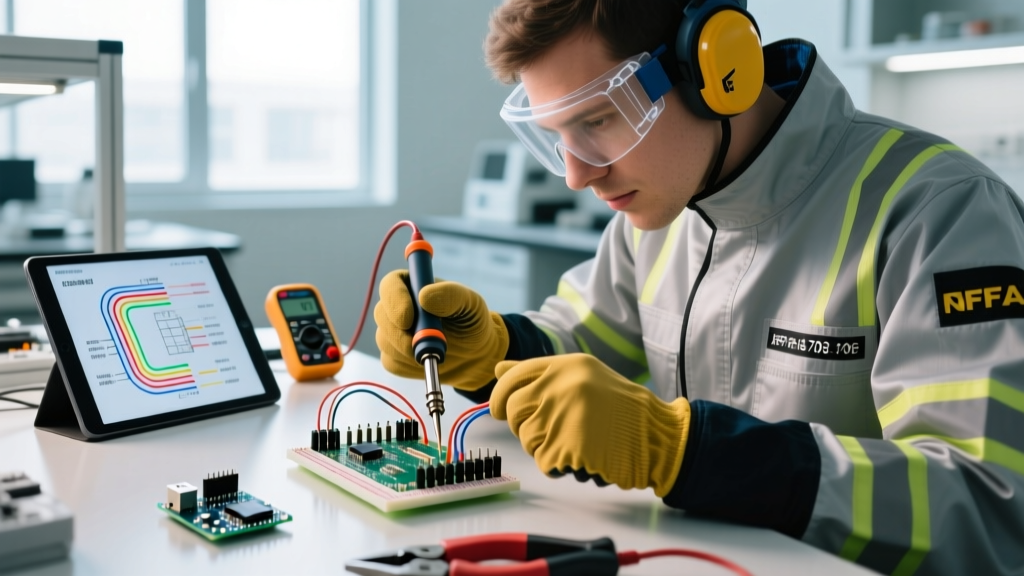
Personal Protective Equipment (PPE) for electrical wiring training must mirror real-world industrial requirements. Trainees should never be allowed to handle energized circuits above 50V without appropriate arc-rated (AR) clothing and voltage-rated gloves. Below is the standard PPE selection matrix based on incident energy levels typically encountered in residential and light commercial training labs.
| Hazard/Risk Category | Incident Energy (cal/cm²) | Required Arc-Rated Clothing | Hand Protection | Face/Head Protection |
|---|---|---|---|---|
| Category 1 | 1.2 to 4 | 4 cal/cm² AR Shirt/Pants | Class 00 Rubber + Leather | Arc-rated face shield + hard hat |
| Category 2 | 4.1 to 8 | 8 cal/cm² AR Shirt/Pants | Class 0 Rubber + Leather | 8 cal/cm² Arc flash hood/balaclava |
| Category 3 | 8.1 to 25 | 25 cal/cm² AR Flash Suit | Class 2 Rubber + Leather | 25 cal/cm² Arc flash hood |
| Category 4 | 25.1 to 40 | 40 cal/cm² AR Flash Suit | Class 4 Rubber + Leather | 40 cal/cm² Arc flash hood |
Note: Rubber insulating gloves must comply with ASTM D120 and undergo dielectric testing every 6 months. Class 00 (beige label) is rated for up to 500V AC, while Class 0 (red label) is rated for up to 1000V AC. Leather protectors are mandatory to prevent physical punctures to the rubber.
Tooling and Insulation Standards
Standard hardware store tools have no place in an electrical wiring training lab. Trainees must be issued and required to use 1000V-rated insulated tools. Brands like Wiha and Klein Tools offer VDE-certified insulated screwdrivers and pliers that feature a dual-layer insulation design (typically a bright inner layer and a dark outer layer) to provide a visual indicator if the insulation is compromised. For wire stripping, tools like the Klein Tools 11055 or the Knipex MultiStrip 10 must be utilized to prevent nicking copper conductors, which creates localized hot spots and future failure points.
Implementing Rigorous Lockout/Tagout (LOTO) Drills
Lockout/Tagout is the most critical physical safety procedure an electrician will learn. Training must utilize physical LOTO kits, such as the Brady 122068 or Panduit comprehensive stations, to build physical dexterity with padlocks, hasps, and tags. The training sequence must strictly follow these seven steps:
- Preparation: Identify all energy sources, including secondary feeds and backup generators.
- Notification: Inform all affected personnel that a shutdown is imminent.
- Shutdown: Turn off the equipment using normal operating controls.
- Isolation: Physically disconnect the equipment from the energy source (e.g., opening the main breaker).
- Application: Apply the assigned padlock and tag to the isolation device. In a group training scenario, use a multi-lock hasp so every trainee applies their own lock.
- Stored Energy Release: Bleed capacitors, block falling parts, and relieve hydraulic/pneumatic pressure.
- Verification (The 'Try' Step): Attempt to start the equipment and use a properly rated CAT III or CAT IV digital multimeter to verify zero voltage phase-to-phase and phase-to-ground.
Designing a Fail-Safe Training Lab Environment
The physical layout of the electrical wiring training lab must be engineered to protect trainees from their own inevitable mistakes. Key environmental controls include:
- Master Contactor Integration: All training benches should be fed through a master contactor controlled by the instructor. If a trainee creates a dead short, the instructor can instantly kill power to the entire bay via a prominent emergency stop (E-Stop) button.
- GFCI and AFCI Protection: Every 120V receptacle on the training bench must be protected by a 5mA Ground Fault Circuit Interrupter (GFCI) to prevent lethal shock currents.
- Illumination and Ergonomics: The IESNA (Illuminating Engineering Society) recommends a minimum of 500 lux for detailed electrical assembly work. Overhead LED panels should be supplemented with articulated bench lamps to eliminate shadows inside junction boxes.
- Anti-Fatigue Matting: Install high-quality, non-conductive anti-fatigue mats (such as Wearwell 24/Seven) to reduce physical fatigue, which is a known contributor to cognitive errors and safety lapses.
Common Trainee Failure Modes and Edge Cases
Experienced instructors know that trainees often fall into predictable cognitive traps. Addressing these edge cases explicitly during electrical wiring training prevents fatal assumptions in the field.
The 'Neutral is Safe' Fallacy
Trainees frequently assume the grounded (neutral) conductor is safe to touch. Instructors must deliberately demonstrate how a broken neutral upstream or a multi-wire branch circuit (MWBC) with an open neutral can elevate the neutral wire to full line voltage (120V or 277V). Trainees must be taught to treat the neutral with the exact same respect as the ungrounded (hot) conductor.
Capacitive Discharge in HVAC Systems
When training on commercial HVAC wiring or variable frequency drives (VFDs), trainees often forget about stored energy. A 45-microfarad run capacitor can hold a lethal charge long after the disconnect is opened. Training must include the physical practice of using a 20,000-ohm, 5-watt bleeder resistor to safely discharge capacitors before touching any terminals.
Backfed Solar and Generator Circuits
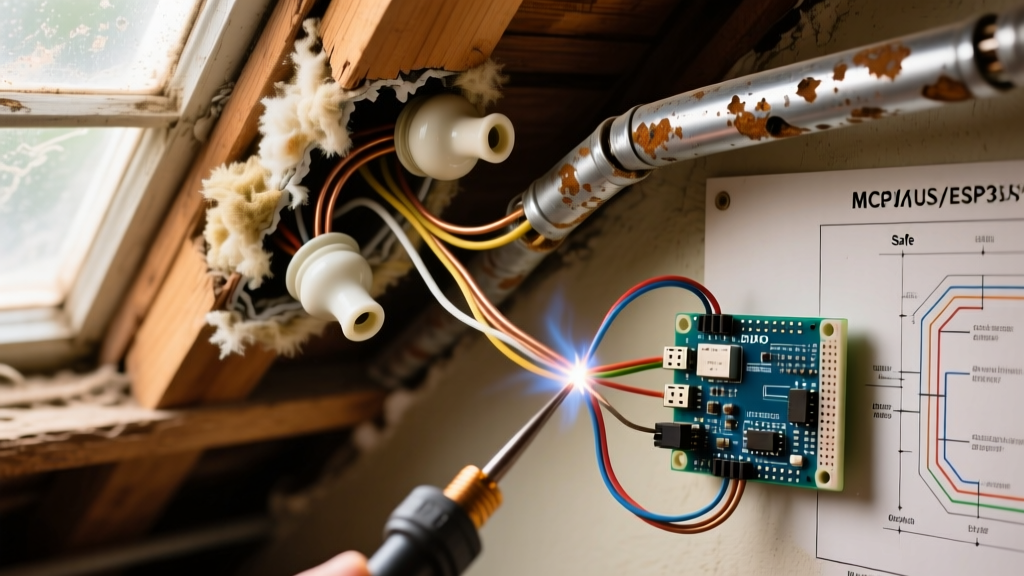
With the proliferation of residential solar and standby generators, trainees must learn to identify backfeed hazards. A main breaker that is 'OFF' does not guarantee a zero-energy state if a solar inverter is actively feeding the load-side bus. Training scenarios must include tracing schematics to identify all possible renewable and backup energy sources.
Competency Verification: Beyond the Written Test
A multiple-choice test cannot verify if a trainee possesses the physical discipline to work safely. True competency verification requires observed practical evaluations. Instructors should utilize a standardized rubric that grades the following physical actions:
- Proper inspection of rubber gloves (air-roll test) before donning.
- Correct setup and verification of a CAT-rated multimeter, including checking the fuse integrity.
- Flawless execution of the LOTO 'Try' step using the live-dead-live testing method.
- Maintenance of the limited approach boundary while peers are working on adjacent energized panels.
Safety in electrical wiring training is not a module you complete; it is the lens through which every subsequent technical skill must be taught. If a trainee can wire a perfect 3-way switch but fails to verify zero energy first, the training has failed.
By integrating strict NFPA 70E compliance, realistic PPE matrices, and engineered lab safeguards, electrical wiring training programs can produce a new generation of electricians who are as safe as they are skilled.