
Why Garage Outlet Inspections Fail
Failing an electrical inspection in a garage is one of the most common setbacks for both DIY remodelers and licensed electricians. The garage environment presents a unique intersection of heavy machinery, moisture, combustible vapors, and high-draw appliances. When evaluating electrical code garage outlets, the Authority Having Jurisdiction (AHJ) strictly enforces the National Electrical Code (NEC) to mitigate shock and fire hazards. As jurisdictions across the country adopt the NEC 2023 and prepare for the 2026 code cycle, the tolerance for legacy wiring exceptions has vanished. This guide breaks down the exact NEC articles, device specifications, and installation parameters you need to ensure your garage receptacles pass inspection on the first visit.
NEC 210.52(G): The Spacing and Quantity Mandate
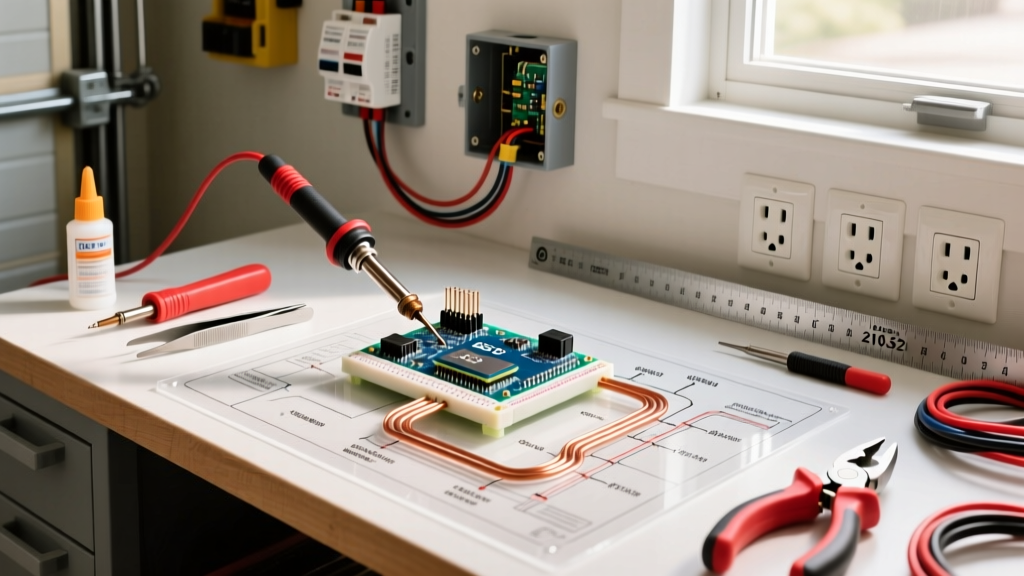
Under NEC Article 210.52(G), the code mandates specific receptacle placement to eliminate the need for dangerous extension cord runs across vehicle paths. Inspectors will immediately flag a garage that lacks adequate coverage.
- Minimum Requirement: At least one 125-volt, 15- or 20-ampere receptacle must be installed in each attached garage, and in each detached garage or accessory building that has electric power.
- Car Bay Rule: The NEC requires at least one receptacle outlet for each car space. If you have a two-car garage, you must have a minimum of two distinct receptacle outlets, positioned to serve each specific bay.
- Height Restrictions: While the NEC does not specify a strict universal height for garage outlets, local AHJs typically enforce a minimum of 18 inches above the finished floor to prevent contact with pooling water or flammable vapor layers (which settle near the ground). Inspectors will measure this during the rough-in and final phases.
The GFCI Trap: 210.8(A)(2) and the Freezer Myth
The most frequent point of failure during a garage inspection involves Ground-Fault Circuit Interrupter (GFCI) protection. Under NEC 210.8(A)(2), all 125-volt, single-phase, 15- and 20-ampere receptacles installed in garages must have GFCI protection for personnel.
Inspector's Note: The 'freezer exception' is a myth in modern code cycles. Older versions of the NEC allowed a dedicated, single-receptacle circuit for a freezer to bypass GFCI protection to prevent nuisance tripping. This exception has been entirely removed. If your freezer trips a modern GFCI, the appliance has a ground fault that must be repaired, or the GFCI device is defective. Do not attempt to wire a freezer outside of GFCI protection; it will result in an immediate inspection failure.
Approved GFCI Implementation Methods
To satisfy the AHJ, you can provide GFCI protection via two primary methods:
- GFCI Receptacles: Installing a 20A GFCI receptacle (such as the Leviton 2091-W or Hubbell GF5252W) as the first device on the circuit, feeding downstream standard duplex receptacles via the LOAD terminals.
- GFCI Circuit Breakers: Using a GFCI breaker in the main panel (e.g., Eaton BR220GFIC or Square D HOM220GFICP) to protect the entire branch circuit. This is often preferred in garages where receptacles are mounted 10 feet up on drywall for workbench lighting, making physical reset buttons hard to reach.
Dedicated Circuits: EV Chargers and 240V Loads
The modern garage is no longer just for parking; it is a charging depot. Under NEC 210.11(C)(4), a dedicated branch circuit must be provided for Electric Vehicle (EV) charging. Inspectors will look for specific wire gauges, conduit fill ratios, and receptacle configurations when evaluating these high-draw electrical code garage outlets.
| Inspection Failure Point | NEC Reference | Required Correction |
|---|---|---|
| Shared circuit for EV charger and workbench lights | 210.11(C)(4) | Run a dedicated 40A, 50A, or 60A circuit exclusively for the EVSE. |
| Standard indoor cover plate on exterior-accessible garage wall | 406.9(B)(1) | Install a Weather-Resistant (WR) receptacle with an extra-duty in-use bubble cover. |
| 15A receptacle on a 20A branch circuit with multiple outlets | 210.21(B)(3) | Upgrade to 20A rated duplex receptacles (NEMA 5-20R) or use 15A only if it is a single, dedicated receptacle. |
| Missing AFCI protection on outlets shared with living space above | 210.12(A) | Install a Dual Function (CAFCI/GFCI) breaker if the circuit extends to habitable rooms. |
Sizing the EV Charging Circuit
According to the U.S. Department of Energy, Level 2 home chargers typically require a 240V circuit rated between 30A and 60A. Because EV charging is classified as a continuous load (operating for 3 or more hours), NEC Article 210.20(A) requires the circuit to be derated by 125%. Therefore, a 40A continuous EV charger requires a 50A breaker and 6 AWG copper THHN wire. Inspectors will verify that the conduit (typically 3/4-inch EMT or Schedule 80 PVC) does not exceed the 40% fill capacity outlined in NEC Chapter 9, Table 1.
Damp Locations and Weather-Resistant (WR) Ratings
Not all garages are created equal. An attached, fully insulated, and climate-controlled garage is generally considered a dry location. However, a detached garage, a garage with unsealed overhead doors, or a space where vehicles regularly drip rain and snow onto the floor is classified as a damp location.
When the AHJ classifies your garage as damp, standard receptacles will fail inspection. You must install Weather-Resistant (WR) rated receptacles. These devices feature nickel-plated brass contacts, stainless steel mounting straps, and UV-resistant thermoplastic faces that resist corrosion and degradation. Pair these with NEMA 3R-rated extra-duty bubble covers to ensure compliance with NEC 406.9(B)(1).
Cost Breakdown: Bringing an Older Garage to Code
Upgrading a legacy garage to meet 2026 electrical code garage outlets standards requires a material and labor investment. Below is a realistic cost matrix for a standard 2-car attached garage upgrade in the current market:
- GFCI Receptacles (Qty 4): $45 - $65 each (Leviton/Hubbell commercial grade) = $180 - $260
- Dedicated 20A Freezer Circuit Run: $150 - $250 (materials and labor for 50 feet of 12/2 NM-B)
- 50A EV Charger Circuit (240V): $450 - $850 (includes 6 AWG THHN, 3/4' EMT conduit, 50A breaker, and NEMA 14-50R industrial grade receptacle like the Hubbell 9450A)
- AFCI/GFCI Dual Function Breakers: $55 - $75 per breaker (Square D Homeline or Eaton BR)
For comprehensive code updates and local amendments, always consult the National Fire Protection Association (NFPA) or reference expert analysis from Mike Holt Enterprises to ensure your specific municipality's adoption cycle is accurately represented.
Frequently Asked Questions
Can I use a GFCI extension cord for my garage workbench?
No. The NEC requires GFCI protection to be a permanent part of the branch circuit wiring (either at the receptacle or the breaker). Portable GFCI cords are considered temporary power and will not satisfy an inspector for permanent workbench wiring.
Do I need an exterior outlet if my garage door opens to the outside?
Yes. NEC 210.52(E) requires at least one outdoor receptacle at the front and rear of a dwelling. If your garage features a personnel door leading directly outside, or if the garage wall constitutes the exterior rear wall of the home, an outdoor-rated, GFCI-protected receptacle with an in-use cover is mandatory.
Are smart outlets code-compliant for garage lighting?
Smart receptacles (like the Leviton Decora Smart Wi-Fi Outlet) are UL-listed and code-compliant for controlling workbench lamps. However, they cannot be used to switch hardwired ceiling lighting fixtures unless the device is specifically rated and listed for the load type and inductive switching.