
The True Economics: Upfront Savings vs. Latent Liabilities
When homeowners evaluate electrical wiring safety, the initial calculation often revolves around immediate out-of-pocket costs. The allure of DIY electrical work is undeniable when a licensed electrician quotes $1,800 to $2,500 to rewire a kitchen or install a new 240V circuit. However, this upfront comparison ignores the massive latent liabilities inherent in unpermitted, non-compliant work. According to the National Fire Protection Association (NFPA), electrical failures or malfunctions remain one of the leading causes of home structure fires, resulting in billions in direct property damage annually.
In 2026, the average hourly rate for a licensed journeyman electrician ranges from $105 to $160, with master electricians commanding higher rates for complex commercial or high-voltage residential work. While the labor premium is steep, it includes liability insurance, bond protection, and code-compliant execution. Below is a realistic cost-benefit matrix comparing a standard 20-amp kitchen circuit upgrade.
| Cost Factor | DIY Approach (Unpermitted) | Licensed Professional (Permitted) |
|---|---|---|
| Materials (12/2 Romex, Breakers, Receptacles) | $140 - $180 | $160 - $210 (Wholesale markup) |
| Labor & Expertise | $0 (10-15 hours of your time) | $850 - $1,200 |
| Permit & Inspection Fees | $0 (Evaded) | $95 - $250 |
| Specialty Tooling (Torque drivers, tracers) | $0 (Using improper tools) | Included in service |
| Home Insurance Validity | Voided if unpermitted work causes fire | Fully covered and documented |
| Resale Appraisal Impact | Flagged during buyer inspection; requires tear-out | Adds documented value to home |
The hidden cost of DIY electrical wiring safety failures is catastrophic. If an unpermitted DIY junction box sparks an arc fault that burns down a home, major insurers like State Farm or Allstate frequently invoke "illegal acts" or "code violation" clauses to deny the claim, leaving the homeowner personally liable for hundreds of thousands of dollars in damages.
Critical Failure Modes in DIY Electrical Wiring Safety
Professional electricians do not just connect wires; they engineer connections to withstand decades of thermal cycling, mechanical vibration, and environmental stress. DIYers frequently fall into specific, lethal failure modes that pass a simple visual inspection but fail under load.
1. Under-Torqued Terminals and Thermal Cycling
Since the 2017 National Electrical Code (NEC) update, and reinforced in the 2023 and upcoming 2026 cycles, NEC Article 110.14(D) mandates that terminations must be torqued to the manufacturer's specified values using a calibrated torque tool. Most DIYers tighten terminal screws "until they feel tight." This is a critical error.
When a 12 AWG copper wire is secured under a receptacle screw with insufficient torque, the connection has higher micro-resistance. As current flows (e.g., a 1,500W microwave drawing 12.5 amps), the joint heats up. The copper expands. When the appliance turns off, it cools and contracts. Over hundreds of thermal cycles, the wire loosens, creating a microscopic air gap. This gap leads to series arc faulting, generating temperatures exceeding 10,000°F—more than enough to ignite surrounding wood framing. Professionals use insulated torque screwdrivers, such as the Klein Tools 32500INS, set precisely to 12-14 inch-pounds for standard 15A/20A devices.
2. The Multi-Wire Branch Circuit (MWBC) Neutral Trap
An MWBC shares a single neutral wire between two hot legs (phases A and B) to save wire and conduit space. If a DIYer replaces a panel and fails to install a handle-tie or a 2-pole breaker on the two hot legs, both legs could accidentally be placed on the same phase (e.g., both on Phase A). Instead of the neutral carrying the difference of the two loads, it carries the sum. A neutral wire rated for 20 amps could suddenly carry 40 amps, melting the insulation inside the walls without ever tripping a hot-leg breaker.
3. "Bootleg" Grounds and False Positives
When upgrading older two-prong ungrounded receptacles to modern three-prong GFCI outlets, some DIYers install a jumper wire between the neutral and ground terminals to trick a standard $12 receptacle tester into showing a "Correct" green light. This is known as a bootleg ground. If a hot wire shorts to the chassis of a plugged-in metal appliance (like a toaster), the chassis becomes energized at 120V, waiting for a human to touch it and complete the circuit to earth. The Electrical Safety Foundation International (ESFI) explicitly warns against this practice, noting that proper GFCI protection without an equipment grounding conductor must be labeled "No Equipment Ground."
The Tooling Gap: Consumer Testers vs. Professional Diagnostics
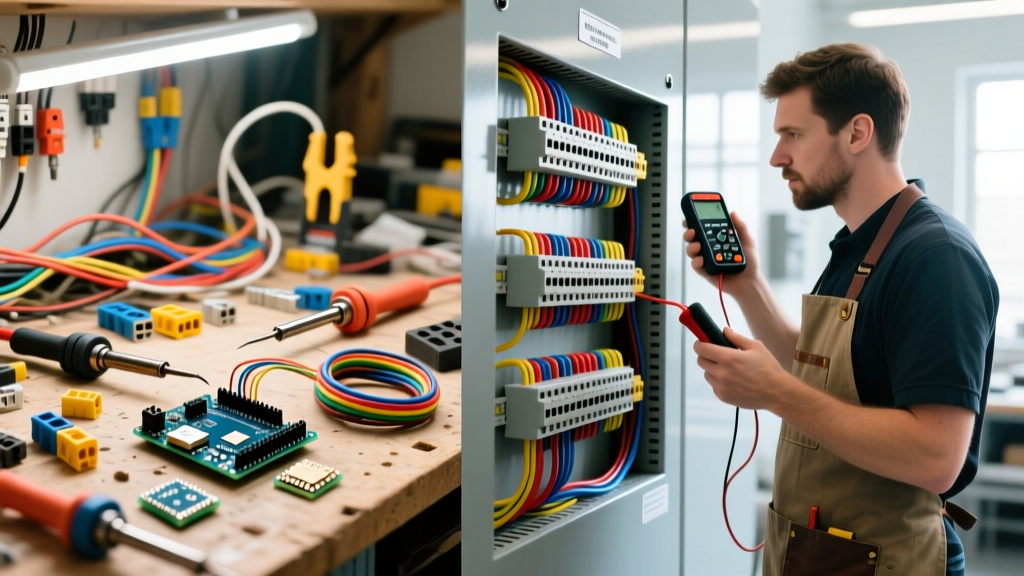
Achieving true electrical wiring safety requires verifying the absence of voltage and the integrity of the circuit. The gap between consumer-grade and professional-grade diagnostic tools is vast.
- Voltage Detection: A standard $15 non-contact voltage (NCV) pen can yield false positives due to phantom voltage or fail to detect low-voltage leakage. Professionals use True-RMS multimeters like the Fluke 117 (approx. $220) or the Klein Tools ET920, which combine NCV, voltage, and current measurement with CAT III/IV safety ratings to prevent arc flashes during testing.
- Circuit Tracing: Finding which breaker controls a specific outlet in a chaotic, unlabeled 1980s subpanel is a nightmare for DIYers who rely on trial and error with a radio. Professionals use advanced tone-and-probe tracers like the Amprobe AT-3500 ($350+), which can trace live wires through drywall and identify the exact breaker in seconds without tripping the circuit.
- Receptacle Analysis: While a basic three-light tester checks for basic wiring faults, professional inspectors use solenoid testers (Wiggy) or digital receptacle analyzers like the Extech CT70 to measure actual ground impedance and trip GFCI circuits under load, ensuring the internal trip mechanism hasn't degraded over time.
Code Compliance: NEC Mandates You Cannot Ignore
The NEC is not a suggestion; it is a living document written in the blood and ashes of past electrical failures. The U.S. Consumer Product Safety Commission (CPSC) heavily relies on NEC updates to shape consumer safety guidelines. Two major areas where DIYers consistently violate modern code include:
The AFCI Expansion: Under NEC Article 210.12, Arc-Fault Circuit Interrupters (AFCIs) are now required in virtually all 120V, 15A and 20A branch circuits supplying living areas, kitchens, and laundry rooms. DIYers frequently swap out old breakers for standard thermal-magnetic breakers to save $35 per breaker, unknowingly stripping the home of its primary defense against parallel and series arc faults.
Furthermore, DIYers often violate NEC 240.4(D), the specific overcurrent device requirements for small conductors. Using 14 AWG wire on a 20-amp breaker because "the 15-amp breakers were out of stock" is a severe fire hazard. The 20-amp breaker will allow 19 amps to flow indefinitely, slowly baking the 14 AWG wire's PVC insulation until it becomes brittle and shorts out.
The Decision Matrix: When is DIY Actually Safe?
Not all electrical work requires a master electrician. However, strict boundaries must be established to maintain electrical wiring safety. Use this matrix to determine if a project is within your legal and technical scope.
| Project Scope | DIY Viability | Safety & Legal Requirements |
|---|---|---|
| Replacing a like-for-like 15A receptacle or switch | High | Must turn off breaker, verify zero voltage with a multimeter, and torque terminals to spec. No permit usually required. |
| Swapping a light fixture | High | Must verify box is rated for the new fixture's weight and heat output. Check for proper grounding. |
| Installing a new GFCI outlet in a bathroom | Medium | Requires understanding of LINE vs. LOAD terminals. Must not bootleg ground. Permit may be required depending on municipality. |
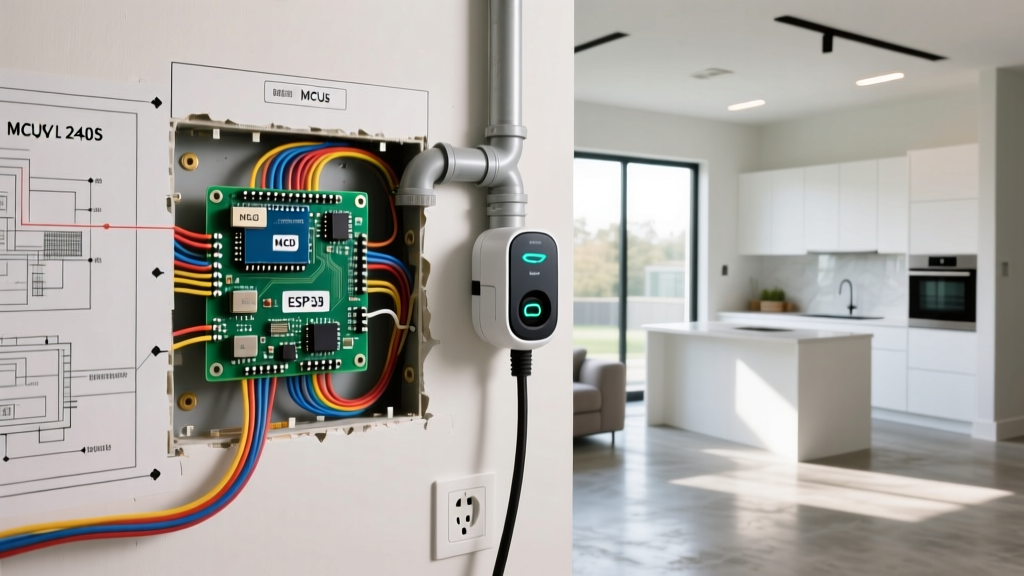
| Running a new dedicated circuit (e.g., EV charger, hot tub) | Zero (Hire a Pro) | Requires load calculation, conduit bending, panel bus-bar rating verification, and strict municipal inspections. |
| Upgrading service from 100A to 200A | Zero (Hire a Pro) | Involves utility company coordination, working on live service laterals, and high arc-flash risks. Strictly prohibited for DIY. |
Final Verdict on Electrical Wiring Safety
Ultimately, electrical wiring safety is not merely about making a device turn on; it is about ensuring the system remains stable under fault conditions, thermal stress, and the test of time. While DIY electrical work can save a few hundred dollars on a Saturday afternoon, the compounding risks of under-torqued connections, missing AFCI protection, and voided insurance policies make it a mathematically poor gamble. For any project involving new circuit runs, panel modifications, or high-amperage appliances, the professional premium is not just paying for labor—it is buying guaranteed code compliance, documented safety, and peace of mind.