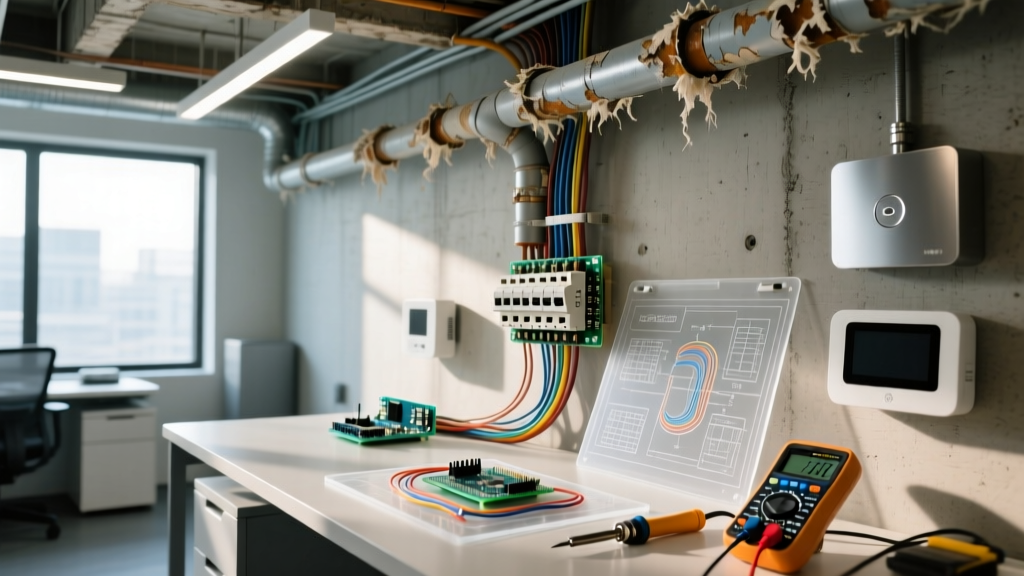

The Hidden Dangers in Aging Commercial Infrastructure
Managing a commercial facility in 2026 requires balancing operational efficiency with stringent safety compliance. While modern buildings are designed to handle the massive power draws of high-density server racks, Variable Frequency Drives (VFDs), and Level 3 EV charging stations, older properties are often still relying on legacy electrical infrastructure. Facility managers and property owners frequently ask: what are the risks of outdated electrical wiring in a commercial setting? The answer extends far beyond simple nuisance tripping. Outdated wiring in commercial spaces introduces severe fire hazards, catastrophic equipment failure, and massive legal liabilities.
According to the Occupational Safety and Health Administration (OSHA), electrical hazards remain a leading cause of workplace fatalities and commercial property fires. When commercial buildings undergo tenant improvements or technology upgrades without a corresponding electrical infrastructure overhaul, the legacy wiring becomes the weakest link in the entire power distribution chain.
Core Hazards: What Are the Risks of Outdated Electrical Wiring?
To understand the risks, we must look at the specific physical and electrical failure modes that occur as commercial wiring ages past its 30-to-40-year expected lifespan.
1. Thermal Degradation and Insulation Breakdown
Older commercial wiring, particularly THW (Thermoplastic Heat and Water-resistant) and early generations of THHN installed in the 1970s and 1980s, suffers from plasticizer migration. Over decades of thermal cycling—especially in conduit runs located above unventilated drop ceilings or near HVAC ductwork—the insulation becomes brittle. When maintenance workers pull new cables through the same conduit, the vibration and friction can easily crack the degraded insulation on adjacent legacy wires, exposing bare copper and creating immediate arc-fault conditions.
2. Triplen Harmonics and Neutral Conductor Overloading
This is a uniquely commercial risk. Older 3-phase, 4-wire wye systems were designed with a neutral conductor sized equally to the phase conductors. Today's commercial environments are saturated with non-linear loads: LED lighting drivers, commercial HVAC VFDs, and IT power supplies. These devices generate 'triplen' harmonics (3rd, 9th, 15th). These harmonic currents do not cancel out in the neutral; they add up. In an outdated panel, the neutral conductor can carry up to 1.73 times the phase current, leading to severe overheating, melted busbars, and electrical fires, even when the phase breakers never trip.
3. Aluminum Oxidation and High-Resistance Connections
During the copper shortages of the late 1960s and 1970s, many commercial feeders and branch circuits were wired with aluminum. Aluminum oxidizes rapidly when exposed to air, creating a highly resistive surface layer. In older panels where anti-oxidant paste (like Noalox) was either not applied or has dried out over 50 years, the connection points at lugs and breakers generate immense heat. This thermal runaway eventually melts the breaker casing and ignites surrounding combustible materials.
Commercial Wiring Failure Matrix
The following table outlines specific legacy wiring types found in commercial buildings and their primary failure modes under modern 2026 electrical loads.
| Era Installed | Wiring Type | Primary Commercial Failure Mode | NEC Code Violation Risk |
|---|---|---|---|
| Pre-1950s | Cloth-Covered BX / Knob & Tube | Insulation turns to dust when disturbed; lack of equipment grounding path. | NEC Article 250 (Grounding), Article 300 (Wiring Methods) |
| 1960s-1970s | Aluminum THW / XHHW | Creep and oxidation at lug terminations causing high-resistance thermal faults. | NEC Article 110.14 (Terminals), Article 310 |
| 1980s-1990s | Early PVC THHN / THWN | Plasticizer loss leading to brittle insulation; fails modern megger testing. | NEC Article 310.12 (Single-Phase), General Safety Standards |
| 1970s-2000s | Federal Pacific / Zinsco Panels | Busbar design flaws prevent breakers from tripping during dead-short faults. | NEC Article 240 (Overcurrent Protection), OSHA mandates |
The Financial and Legal Liability
Understanding what the risks of outdated electrical wiring are is only half the battle; quantifying the financial exposure is critical for commercial stakeholders. Deferred electrical maintenance directly impacts the bottom line in three distinct ways:
- Insurance Premium Hikes and Claim Denials: Commercial property insurers in 2026 are utilizing advanced predictive modeling and requiring up-to-date NETA (InterNational Electrical Testing Association) certified inspection reports. If a fire originates from a known, unremediated legacy panel (like a Zinsco or Federal Pacific), insurers frequently deny the claim, citing 'deferred maintenance' and 'willful negligence.' Furthermore, buildings with pre-1985 wiring often face premium surcharges of 15% to 30%.
- Tenant Litigation: If an electrical fire damages a tenant's inventory or halts their business operations, the property owner can be held liable for lost revenue and property damage if it is proven the electrical infrastructure was not brought up to current NEC standards during the last remodel.
- OSHA Fines: The Electrical Safety Foundation International (ESFI) notes that workplace electrical incidents carry severe regulatory penalties. OSHA can issue fines exceeding $16,000 per serious violation, and willful violations regarding known, outdated electrical hazards can result in fines exceeding $160,000 per instance.
Expert Insight: "We see a massive spike in commercial insurance disputes when a tenant installs modern, high-draw equipment like commercial 3D printers or crypto-mining rigs on 1980s branch circuits. The outdated wiring acts as a resistor, generating heat inside the walls long before the 20-amp breaker ever trips." — Senior Commercial Electrical Forensic Engineer
Advanced Diagnostic Protocol for Facility Managers
You cannot manage what you do not measure. To accurately assess the risks of outdated electrical wiring in your facility, visual inspections are insufficient. You must implement a data-driven diagnostic protocol using modern testing equipment.
Step 1: Infrared Thermography (IR Scanning)
Utilize a high-resolution thermal imaging camera (such as the Fluke Ti480 PRO, priced around $15,000, or hire a certified thermographer). Scan all main distribution panels, switchgear, and sub-panels under full load. Look for temperature anomalies (Delta T) between phases. A temperature difference of just 4°C (7°F) between identical phases indicates a failing connection or degraded wire resistance. A Delta T of 15°C requires immediate shutdown and repair.
Step 2: Insulation Resistance Testing (Megger Testing)
Use an insulation resistance tester (like the Megger MIT485/2) to test the integrity of the wire insulation. For standard 480V commercial systems, apply 1000V DC for one minute.
Acceptable threshold: >100 Megohms.
Warning threshold: 1 to 100 Megohms (indicates aging, moisture ingress, or thermal degradation).
Failure threshold: <1 Megohm (imminent failure, wire must be replaced).
Step 3: Power Quality and Harmonic Analysis
Deploy a power quality analyzer (e.g., Fluke 435-II) at the main service entrance and major sub-panels. Measure the Total Harmonic Distortion (THD). If voltage THD exceeds 5% or current THD exceeds 20%, the legacy wiring and transformers are being subjected to destructive harmonic heating. This data justifies the installation of active harmonic filters or a complete feeder upgrade using K-rated transformers and oversized neutrals.
Strategic Upgrade Pathways and 2026 Cost Realities
Mitigating the risks of outdated electrical wiring requires capital expenditure. In the 2026 commercial construction market, complete facility rewiring typically costs between $8.50 and $18.00 per square foot, depending on ceiling heights, conduit accessibility, and whether hazardous materials (like asbestos conduit mastic) require abatement.
Facility managers generally choose between two pathways:
- Phased Panel and Feeder Upgrades (CapEx Optimization): Instead of tearing out all branch wiring, replace the main switchgear, distribution panels, and feeders with modern, smart-monitored equipment (like Schneider Electric EcoStruxure or Eaton Brightlayer). Install Arc-Fault Circuit Interrupters (AFCIs) and Ground-Fault Equipment Protection (GFPE) at the panel level to mitigate the risks of the older branch wiring still in the walls. This reduces immediate costs by 40% while satisfying insurance mandates for modern overcurrent protection.
- Complete Tear-Out and Conduit Repull (Future-Proofing): For properties undergoing a change of use (e.g., converting an old retail space into a high-density data center or automated warehouse), a complete tear-out is mandatory. This involves pulling new XHHW-2 copper conductors, which feature superior moisture and heat resistance, and upgrading the grounding infrastructure to meet the stringent requirements of NEC Article 250.
Conclusion
So, what are the risks of outdated electrical wiring in commercial real estate? They are compounding, expensive, and potentially lethal. From hidden harmonic overheating to brittle insulation that fails during routine maintenance, legacy wiring is a ticking clock. By leveraging advanced diagnostics like IR thermography and Megger testing, facility managers can transition from reactive emergency repairs to proactive, data-driven infrastructure management. Do not wait for an insurance audit or a thermal event to force your hand; schedule a comprehensive NETA-certified electrical assessment today to protect your asset, your tenants, and your bottom line.