
When it comes to marine electrical wiring, the hostile environment of saltwater, constant vibration, and UV exposure renders standard residential wiring practices not just inadequate, but actively dangerous. A floating vessel is essentially an isolated power grid surrounded by a highly conductive electrolyte. In the United States, marine wiring is governed by a complex intersection of standards, primarily the American Boat and Yacht Council (ABYC) and the National Fire Protection Association’s National Electrical Code (NEC). Understanding where one code ends and the other begins is critical for any marine electrician, boat builder, or advanced DIYer in 2026.
The Jurisdictional Divide: Where ABYC Ends and NEC Begins
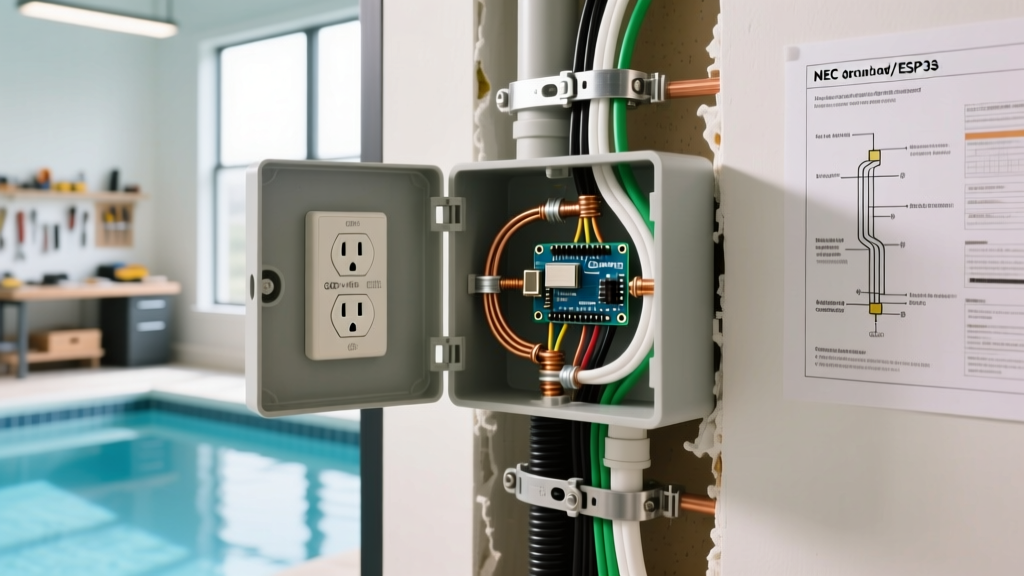
The most common point of confusion in marine electrical installations is jurisdiction. The NFPA 70: National Electrical Code (NEC) and the American Boat and Yacht Council (ABYC) govern different physical domains.
- NEC Article 555 & 553: The NEC governs the shore-side infrastructure. This includes marina pedestals, dock wiring, shore power cables, and floating buildings. If the wiring is attached to the earth or the dock, it falls under NEC jurisdiction.
- ABYC E-11: The ABYC governs the vessel itself. Once the shore power cord plugs into the boat’s inlet, the boat’s internal AC and DC systems are governed by ABYC standards (specifically E-11 for AC and DC electrical systems).
Expert Insight: While the US Coast Guard does not legally mandate ABYC compliance for recreational vessels in the same way the NEC is enforced by local building inspectors, ABYC standards are the recognized benchmark for marine surveyors, insurance underwriters, and liability courts. A boat that fails ABYC standards will likely fail its marine survey and face insurance denial.
ABYC E-11: The Gold Standard for Vessel Wiring
ABYC E-11 is the definitive standard for AC and DC electrical systems on boats. It addresses the unique mechanical and chemical stresses of the marine environment. Here are the critical material and installation requirements that separate marine wiring from household wiring.
Conductor Specifications: UL 1426 and Type III Stranding
You cannot use standard THHN building wire on a vessel. ABYC requires wire to meet UL 1426 (Standard for Electrical Cables for Use on Boats) or SAE J378 (for engine compartments). Furthermore, the wire must utilize Type III stranding. While standard residential wire might have 7 to 19 strands per conductor, Type III marine wire features hundreds of ultra-fine copper strands. This high strand count provides the flexibility necessary to withstand constant engine vibration and hull flexing without suffering from metal fatigue and internal breakage.
Additionally, marine wire must be tinned copper. Untinned copper reacts with salt air and moisture to form copper oxide—a black, powdery substance that is highly resistive and causes severe voltage drop and thermal buildup at termination points.
The Color Code Clash: ABYC vs. NEC
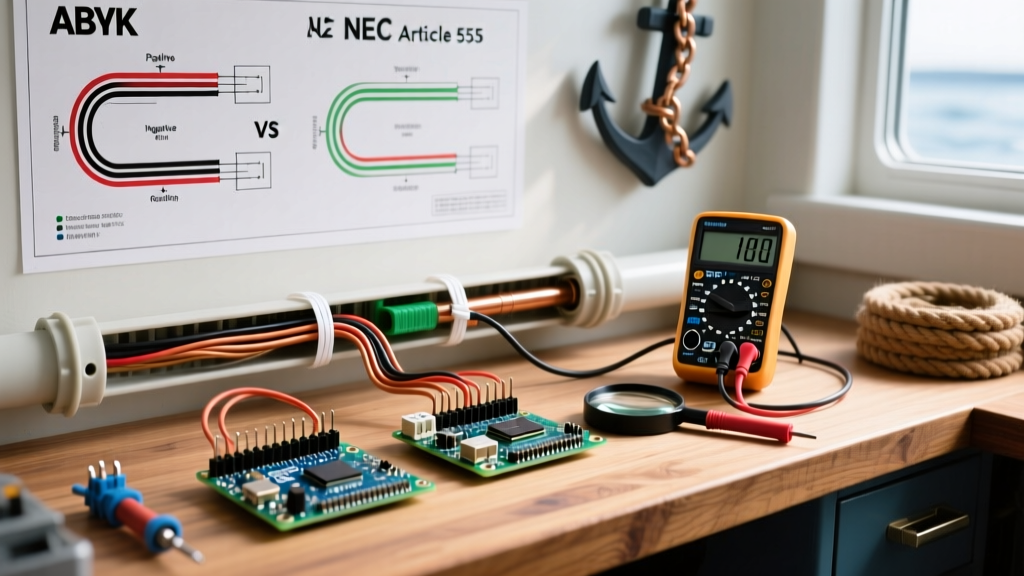
One of the most hazardous aspects of marine wiring is the conflicting color codes between ABYC DC systems, ABYC AC systems, and NEC AC systems. Mixing these up can result in catastrophic short circuits or lethal shock hazards.
| Function | ABYC DC (Vessel) | ABYC AC (Vessel) | NEC AC (Shore/Dock) |
|---|---|---|---|
| Ground / Grounding | Yellow (or Yellow w/ Green Stripe) | Green (or Green w/ Yellow Stripe) | Green or Bare Copper |
| Neutral / Negative | Yellow-Black (or Black) | White | White or Gray |
| Hot / Positive (Phase A) | Red | Black | Black |
| Hot (Phase B) | N/A (Usually 12V/24V DC) | Red | Red |
Note: In 2026, with the rise of high-voltage DC systems for electric marine propulsion (400V+ DC), ABYC has introduced specific orange and orange-yellow designations for high-voltage DC cables to prevent accidental contact.
NEC Article 555: Marinas, Boatyards, and Shore Power
When wiring the dock or marina pedestal, electricians must follow NEC Article 555. The primary focus here is mitigating leakage current and preventing galvanic corrosion, which can sink neighboring vessels.
- GFCI Protection: NEC Article 555.3 mandates Ground-Fault Circuit Interrupter (GFCI) protection for all 15A and 20A single-phase, 125V/250V receptacles installed in marinas and boatyards. In recent code cycles, this has expanded to require ground-fault equipment protection (GFEP) at higher thresholds (typically 30mA to 100mA) for main marina feeders to prevent nuisance tripping while still protecting against lethal faults.
- Isolation Transformers and Galvanic Isolators: While NEC governs the shore side, the interaction between shore ground and the boat’s DC ground creates a galvanic cell. To comply with safety and prevent the boat’s underwater metals (props, shafts, outdrives) from dissolving, vessels must utilize a Galvanic Isolator (GI) or an Isolation Transformer. ABYC TE-4 specifically addresses the testing and installation of GIs.
Voltage Drop Calculations: The 3% vs 10% Rule
Unlike residential wiring where a 5% voltage drop is generally acceptable, ABYC E-11 enforces a strict bifurcated voltage drop limit based on the criticality of the circuit. Because marine systems often run on 12V or 24V DC, even a small voltage drop translates to a massive percentage loss and significant heat generation.
- 3% Maximum Drop: Required for navigation lights, bilge blowers, engine electronics, and communication equipment.
- 10% Maximum Drop: Acceptable for non-critical loads like cabin lighting, galley appliances, and winches.
12V DC Voltage Drop Matrix (3% Limit)
| Current (Amps) | Distance (One Way Feet) | Minimum AWG Required (3% Drop) | Common Application |
|---|---|---|---|
| 5A | 15 ft | 14 AWG | LED Navigation Lights |
| 10A | 15 ft | 10 AWG | VHF Radio / Chartplotter |
| 15A | 20 ft | 8 AWG | Marine Refrigeration Compressor |
| 30A | 20 ft | 4 AWG | Windlass / Anchor Winch |
| 50A | 10 ft | 2 AWG | Inverter / Charger DC Feed |
Distances represent the one-way run from the battery bank to the load. The total circuit length for voltage drop calculations is double this number (positive + negative return).
Real-World Failure Modes in Marine Environments
According to data compiled by BoatUS Expert Advice and marine surveyors, electrical fires are a leading cause of vessel loss. Understanding the specific failure modes is crucial for prevention.
- Capillary Wicking: If a wire is exposed to moisture at the termination point, water can wick up inside the insulation jacket via capillary action, traveling feet along the wire and causing corrosion at the breaker panel. Prevention: Always route wires in a downward drip loop before entering a terminal, and use adhesive-lined heat shrink.
- Vibration-Induced Creep: Engine-mounted alternators and starters experience high-frequency vibration. Standard ring terminals will loosen over time, increasing resistance and causing thermal runaway. Prevention: Use lock washers, Belleville spring washers, or nylon-insert lock nuts on all engine-block terminations.
- Over-fusing Lithium Banks: With the mass adoption of LiFePO4 batteries in 2026, many DIYers use standard Class T fuses sized for lead-acid cranking amps. Lithium batteries can deliver sustained fault currents that require specific DC-rated breakers (like Blue Sea Systems C-Series) that can interrupt high DC arcs without welding shut.
2026 Material Costs and Component Selection
Marine-grade components carry a premium due to the stringent testing required for UL 1426 and ABYC compliance. When budgeting a full vessel rewire, expect the following baseline material costs:
- Ancor Marine Grade Wire (10 AWG): ~$1.85 per foot (compared to $0.45/ft for standard THHN). The premium pays for Type III tinned stranding and UV-resistant insulation.
- Blue Sea Systems ST Blade Fuse Block (12 Circuit): ~$85 - $110. Features tinned copper busses and integrated negative busses, eliminating the need for separate ground blocks.
- Adhesive-Lined Heat Shrink Terminals (Ancor/3M): ~$0.75 to $1.20 per crimp. The internal polyamide adhesive melts during heating, creating a waterproof environmental seal that prevents wicking.
- Marine-Rated Circuit Breakers (Blue Sea C-Series): ~$45 - $60 per breaker. Designed specifically to extinguish DC arcs, which burn hotter and longer than AC arcs.
Step-by-Step: Executing an ABYC-Compliant DC Termination
To ensure a termination passes a rigorous marine survey, follow this exact sequence:
- Strip the Wire: Use a precision wire stripper to remove exactly the length of insulation required for the terminal barrel. Do not nick the copper strands; a nicked strand reduces the ampacity and creates a fatigue point.
- Select the Crimp Tool: Use a ratcheting crimp tool specifically calibrated for the terminal size. A ratcheting tool ensures the crimp cycle is fully completed before releasing, applying the exact tonnage required for a cold-weld connection.
- Crimp and Inspect: Insert the wire into the terminal barrel. Crimp firmly. Perform a pull-test (tug firmly by hand). The wire should not slip. The insulation grip should hold the wire jacket, not the copper strands.
- Apply Adhesive Heat Shrink: If using non-pre-insulated terminals, slide a piece of dual-wall adhesive heat shrink over the barrel. Apply heat evenly from the center outward until a small bead of adhesive squeezes out the ends, indicating a complete waterproof seal.
- Torque the Terminal: Attach the ring terminal to the busbar or stud. Use a calibrated torque wrench to tighten the nut to the manufacturer’s specification (e.g., 45 in-lbs for a #10 stud). Apply a thin layer of dielectric grease or specialized marine anti-corrosion compound (like NO-OX-ID A-Special) over the exposed metal to prevent galvanic corrosion.
Final Thoughts on Marine Compliance
Mastering marine electrical wiring requires a paradigm shift from standard electrical work. You are not just managing current; you are managing vibration, moisture, and galvanic reactions. By strictly adhering to ABYC E-11 for the vessel and NEC Article 555 for the shore infrastructure, utilizing Type III tinned wire, and executing flawless environmental seals at every termination, you ensure the vessel remains safe, insurable, and reliable on the water for decades to come.