
Why You Need a Dedicated Electrical Wiring Residential Book
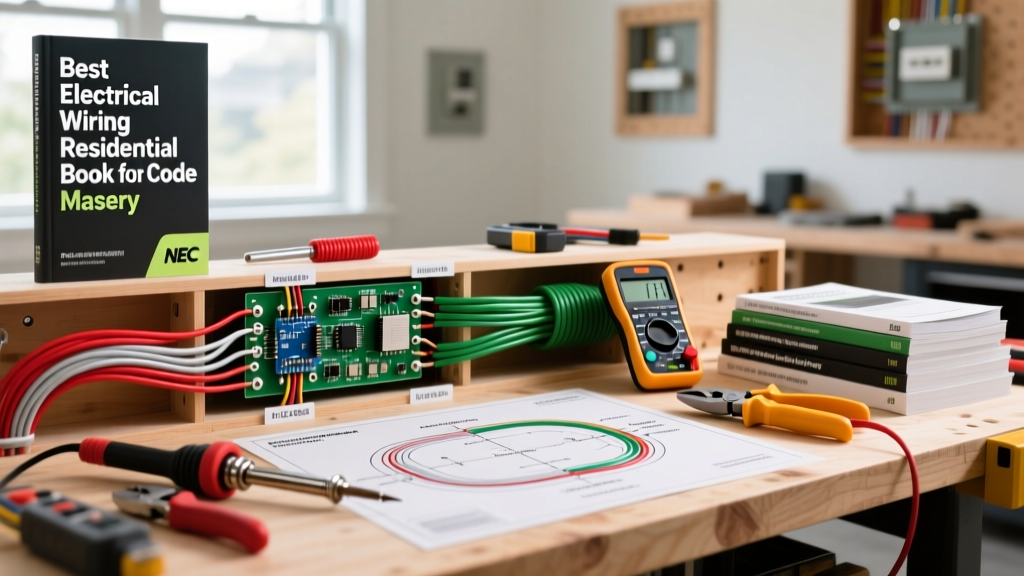
Navigating the National Electrical Code (NEC) can feel like deciphering an ancient language. Whether you are a seasoned journeyman, an apprentice, or an advanced DIYer tackling a whole-home remodel, relying on fragmented online tutorials is a recipe for failed inspections and fire hazards. To achieve true code mastery, you need a comprehensive electrical wiring residential book that bridges the gap between abstract code text and practical, real-world application.
As jurisdictions across the United States continue to adopt the 2023 NEC and begin preparing for the upcoming 2026 NEC cycle, the rules governing residential wiring have become stricter. Expanded requirements for Arc-Fault Circuit Interrupters (AFCIs), Ground-Fault Circuit Interrupters (GFCIs), and exterior emergency disconnects mean that older references are now dangerously obsolete. A modern, code-aligned textbook provides the visual blueprints, load calculation worksheets, and step-by-step wiring diagrams necessary to ensure your work passes the scrutiny of local Authority Having Jurisdiction (AHJ) inspectors.
Top Contenders: Comparing the Best Residential Wiring Books
Not all reference materials are created equal. Some prioritize visual hand-holding for beginners, while others dive deep into complex load calculations and multi-wire branch circuits. Below, we break down the top three industry-standard books to help you choose the right electrical wiring residential book for your specific needs.
1. Electrical Wiring Residential by Ray C. Mullin and Phil Simmons
Widely considered the gold standard in trade schools and apprenticeship programs, this textbook is currently in its 20th Edition (aligned with the 2020/2023 NEC). It is structured around the actual blueprints of a sample home, guiding the reader through every phase of the electrical rough-in and trim-out. It includes exhaustive appendices on conduit fill tables, voltage drop calculations, and service sizing.
- Target Audience: Electricians, apprentices, and serious DIYers.
- Price Range: $130 - $165 (Hardcover/Textbook).
- Key Feature: Includes a complete set of residential blueprints for practical mapping exercises.
2. Black & Decker The Complete Guide to Wiring (7th Edition)
If you are a homeowner or DIY enthusiast looking for a highly visual, approachable guide, this is the best electrical wiring residential book for your shelf. Updated to reflect recent NEC changes, it relies heavily on step-by-step photography rather than dense technical jargon. It excels at demonstrating proper tool usage, wire stripping techniques, and standard receptacle replacements.
- Target Audience: Homeowners, DIYers, and visual learners.
- Price Range: $25 - $35 (Paperback).
- Key Feature: Over 800 color photographs showing real-world hand placements and tool usage.
3. Wiring a House by Rex Cauldwell
Written by a master electrician and inspector, this book focuses on the "pro-tips" that separate a passable job from a masterpiece. Cauldwell emphasizes long-term reliability, detailing how to avoid common failure modes like loose neutrals, overloaded shared neutrals, and improper grounding electrode connections. It is less about basic code definitions and more about field-tested craftsmanship.
- Target Audience: Professional electricians and advanced remodelers.
- Price Range: $30 - $45 (Paperback).
- Key Feature: Deep dives into troubleshooting and avoiding common field mistakes.
Comparison Matrix: Finding Your Ideal Reference
| Book Title | NEC Alignment | Best For | Format | Est. Cost |
|---|---|---|---|---|
| Electrical Wiring Residential (Mullin) | 2020/2023 | Trade Students & Pros | Textbook / Blueprints | $130 - $165 |
| Complete Guide to Wiring (B&D) | 2020/2023 | DIYers & Homeowners | Visual Paperback | $25 - $35 |
| Wiring a House (Cauldwell) | General/Field | Pros & Remodelers | Field Guide | $30 - $45 |
Decoding the NEC: How to Use Your Book for Code Compliance
Owning the right electrical wiring residential book is only half the battle; knowing how to cross-reference it with the official NFPA 70 (NEC) is where true expertise lies. Here is how to apply your reference material to critical code sections:
Mastering Article 210: Branch Circuits
Article 210 dictates the rules for branch circuits. A high-quality textbook will visually map out NEC 210.11 (Branch Circuits Required) and 210.12 (Arc-Fault Circuit-Interrupter Protection). For example, the 2023 NEC mandates AFCI protection in virtually all residential living spaces. Your reference book should clearly illustrate how to wire a dual-function AFCI/GFCI breaker or receptacle, ensuring you do not mix up the load and line terminals—a common failure point that causes immediate nuisance tripping.
Conquering Article 250: Grounding and Bonding
Grounding is the most misunderstood aspect of residential wiring. According to experts at Mike Holt Enterprises, improper neutral-to-ground bonding in subpanels is one of the most frequent code violations. Your textbook must clearly differentiate between the service disconnect (where the neutral and ground are bonded) and downstream subpanels (where they must remain isolated via separate busbars). Look for diagrams that explicitly show the removal of the green bonding screw in subpanel installations.
Meeting Torque Requirements (NEC 110.14(D))
Modern code requires that all terminations be torqued to the manufacturer's specifications. A modern electrical wiring residential book will emphasize the necessity of using a calibrated torque screwdriver (such as the Klein Tools 32308 or Ideal Industries torque models) rather than relying on the "tighten until it stops" method. This prevents thermal expansion and contraction from loosening connections over time, which is a leading cause of residential electrical fires.
Inspector's Insight: The International Association of Electrical Inspectors (IAEI) frequently notes that while DIYers and even some pros understand wire sizing, they fail at proper physical support and securing. Always cross-reference your book's chapter on NEC Article 300 (General Requirements for Wiring Methods) to ensure Romex (NM-B) is stapled within 8 inches of every single-gang box and secured at intervals not exceeding 4.5 feet.
Critical Code Updates to Look for in Modern Editions
If you are shopping for a new reference guide, ensure it covers the recent paradigm shifts in residential electrical design. Older editions will completely miss these critical safety mandates:
- Exterior Emergency Disconnects (NEC 230.85): Modern codes now require a readily accessible, lockable exterior disconnect for one- and two-family dwellings. This allows first responders to kill power without entering a burning or flooded structure. Your book must detail how to wire a service-rated transfer switch or a dedicated exterior disconnect enclosure.
- EV Receptacle Requirements (NEC 210.17 & 511): With the surge in electric vehicle adoption, new construction often requires a dedicated 50-amp (or higher) circuit for EV charging. A current textbook will explain the load calculation impacts of adding a continuous 40A draw to a standard 200A residential service, and when a service upgrade to 320A is mathematically required.
- GFCI Expansion (NEC 210.8): GFCI protection has expanded beyond bathrooms and kitchens to include all 125V to 250V receptacles supplied by single-phase branch circuits rated 150V or less, including basements, crawlspaces, and even certain attic locations where HVAC equipment is serviced.
Frequently Asked Questions (FAQ)
Do I need to buy the official NEC codebook if I have a residential wiring textbook?
Yes. While a high-quality electrical wiring residential book translates and explains the code with diagrams, it is not a legal document. Your local AHJ will only recognize the official NFPA 70 codebook (or your state-specific adopted version) during an inspection dispute. Use the textbook to learn and plan, but keep the official codebook on hand for final verification.
How often should I replace my residential wiring reference book?
The NEC is updated every three years (2020, 2023, 2026). Because code changes can fundamentally alter how circuits must be protected (such as the expansion of AFCI requirements), you should aim to update your primary reference material every two to three cycles, or at minimum, whenever your state officially adopts a new code year.
Can I use a Canadian wiring book for US residential projects?
No. The Canadian Electrical Code (CEC) and the US National Electrical Code (NEC) have significant differences in wire color coding (e.g., red vs. blue for travelers), grounding rules, and AFCI mandates. Always use a textbook specifically written for the NEC and US jurisdictions to avoid catastrophic inspection failures and safety hazards.
Final Thoughts on Code Mastery
Investing in the right electrical wiring residential book is an investment in safety, compliance, and professional reputation. Whether you choose the exhaustive blueprint-based approach of Mullin's textbook or the visual clarity of the Black & Decker guide, the key to success is active application. Do not just read the diagrams; take them to the job site, measure your voltage drops, torque your lugs, and build every circuit as if the inspector is watching over your shoulder. In the world of electrical wiring, the code is not just a set of rules—it is the cumulative knowledge of past failures, written to protect the future.