
The Core Function of the Red Wire in Residential Circuits
When tackling home electrical upgrades, encountering an unfamiliar wire color can bring a DIY project to a sudden, confusing halt. In standard North American residential electrical systems, the electrical wiring red wire serves a very specific and critical purpose: it is a secondary ungrounded (hot) conductor. According to the National Electrical Code (NEC) published by the NFPA, red wires are strictly reserved for carrying live current and must never be used as a neutral or equipment ground.
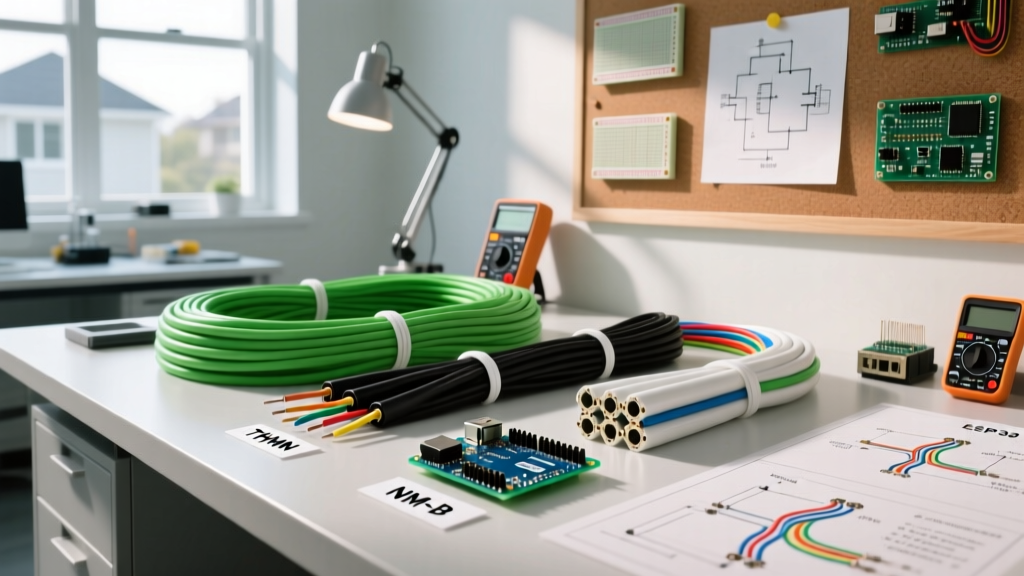
While the black wire is the primary hot leg delivering 120 volts from your breaker panel, the red wire acts as either a secondary phase (for 240-volt circuits) or a switched traveler (for complex lighting setups). Understanding this distinction is the difference between a successful home renovation and a catastrophic short circuit. As of 2026, standard 12/3 NM-B (Romex) cable from manufacturers like Southwire or CerroWire costs approximately $1.15 to $1.40 per linear foot and includes a black, red, white, and bare copper wire, specifically designed to accommodate these secondary hot requirements.
Standard US Wire Color Coding (NEC Guidelines)
| Wire Color | Primary Function | NEC Article Reference | Typical Gauge for 15A/20A |
|---|---|---|---|
| Black | Primary Hot (Ungrounded) | Article 200 / 310 | 14 AWG (15A) / 12 AWG (20A) |
| Red | Secondary Hot / Traveler | Article 200 / 310 | 14 AWG (15A) / 12 AWG (20A) |
| White / Gray | Neutral (Grounded) | Article 200.2 | 14 AWG (15A) / 12 AWG (20A) |
| Bare / Green | Equipment Ground | Article 250.119 | 14 AWG (15A) / 12 AWG (20A) |
3 Common Home Projects Where You Will Encounter a Red Wire
If you are remodeling a kitchen, upgrading a laundry room, or installing smart home lighting, you will inevitably cross paths with a red wire. Here is a deep dive into the three most common residential applications.
1. Three-Way and Four-Way Switch Configurations
In a standard single-pole switch, you only need a primary hot (black) and a switched leg. However, when you want to control a single light fixture from two different locations (like the top and bottom of a staircase), you must install a 3-way switch system. This is where the electrical wiring red wire shines as a traveler.
- The Setup: A 14/3 or 12/3 NM-B cable is run between the two 3-way switches.
- The Travelers: The red wire and the black wire act as the traveler pair, carrying the alternating hot current between the switches depending on the toggle position.
- The Neutral: The white wire bypasses the switches entirely and runs straight to the light fixture to complete the circuit.
- Pro Tip: Always mark the white wire used as a traveler in a switch loop with black or red electrical tape at both termination points to comply with NEC Article 200.7(C)(2), signaling to future electricians that it is carrying live current, not acting as a neutral.
2. 240-Volt Appliance Circuits (Dryers, Ranges, and EV Chargers)
Heavy-duty appliances require double the voltage of standard outlets. Your home's electrical panel receives split-phase power from the utility transformer, providing two 120V legs that are 180 degrees out of phase. When combined, they yield 240 volts.
In a dedicated 240V circuit utilizing a double-pole breaker, the black wire connects to one breaker pole, and the red wire connects to the opposite pole. This is standard for NEMA 14-30 (dryer) and NEMA 14-50 (range or Level 2 EV charger) receptacles. If you are installing a home EV charger in 2026, utilizing a 50-amp circuit with 6/3 NM-B cable (which includes a hefty red wire) is the standard for delivering up to 40 amps of continuous charging current safely.
3. Ceiling Fan and Light Kit Separations
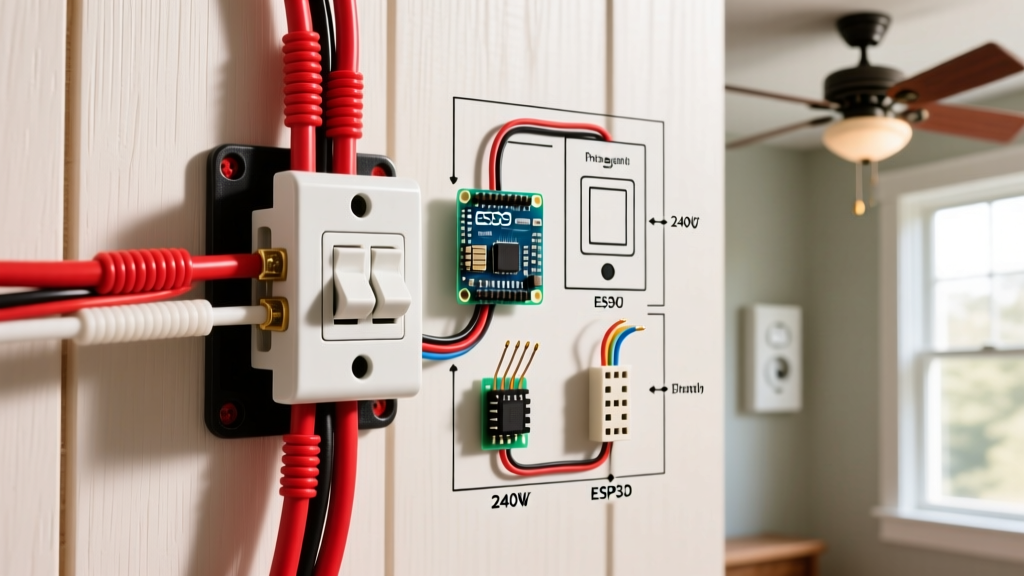
When replacing a standard light fixture with a ceiling fan that includes a light kit, homeowners often want independent wall control for the fan motor and the lights. If your ceiling junction box is wired with a 12/3 or 14/3 cable from a dual-switch wall box, you will see a red wire.
- Black Wire: Connects to the fan motor's hot lead (usually black or blue).
- Red Wire: Connects to the light kit's hot lead (usually blue or white with a stripe), allowing the second wall switch to control the lights independently.
- White Wire: Connects to the neutral bundle.
Safety Protocols and NEC Code Requirements
Misidentifying a red wire can lead to severe electrical shock or fire. The Electrical Safety Foundation International (ESFI) strongly advises homeowners to treat all ungrounded conductors as live until proven otherwise with a calibrated testing instrument.
CRITICAL WARNING: Never use a red wire as a neutral or an equipment grounding conductor. NEC Article 250.119 strictly mandates that ground wires must be bare, green, or green with a yellow stripe. Repurposing a red wire for grounding violates code and creates a lethal shock hazard if a fault occurs.
Essential Tools for Identifying Red Wires
Do not rely on non-contact voltage testers (NCVT) alone when working inside crowded junction boxes, as they can yield false positives due to phantom voltage. Invest in a True-RMS digital multimeter. The Fluke 117 (approx. $220) or the budget-friendly Klein Tools MM400 (approx. $45) are industry standards for DIYers and pros alike.
Step-by-Step Troubleshooting: Tracing a Mystery Red Wire
Opening an older home's junction box often reveals a tangled nest of wires. If you find a capped red wire and don't know its purpose, follow this systematic tracing protocol:
- Kill the Power: Turn off the main breaker or the specific circuit breaker. Verify the circuit is dead using your multimeter (Black probe to ground, Red probe to black/white wires). It should read 0.00V.
- Visual Inspection: Check if the red wire is bundled with a black and white wire in a 3-conductor cable (NM-B). If so, it is likely a traveler or a 240V secondary leg.
- Continuity Test: With the power OFF, set your multimeter to the continuity setting (the soundwave icon). Place one probe on the mystery red wire and the other on known traveler terminals at nearby 3-way switches. A beep confirms it is a switch traveler.
- Voltage Test: If continuity yields no results, restore power. Carefully measure AC Voltage between the Red wire and the Bare ground. A reading of ~120V indicates it is a switched hot (like a ceiling fan light leg) or a half-hot receptacle feed. A reading of ~240V between the Red and Black wires confirms a split-phase appliance circuit.
Frequently Asked Questions (FAQ)
Can I use a red wire as a ground if I run out of bare copper?
No. This is a severe NEC violation. Equipment grounding conductors must be instantly recognizable to anyone working on the panel or junction box. Using a red wire as a ground could result in a future DIYer touching the wire, assuming it is a hot traveler, and receiving a fatal shock if a ground fault is present. Always pull new cable or run a separate bare/green ground wire.
What if my home has old fabric-covered wiring with a red wire?
In legacy Knob-and-Tube or early cloth-covered wiring (pre-1950s), color coding was not strictly standardized like it is today. A red wire might have been used as a primary hot, a switched leg, or even a neutral in some highly unusual, non-compliant historical setups. According to the U.S. Department of Energy, homes with older wiring systems should be evaluated by a licensed electrician, as the insulation may be degraded and the color coding unreliable. Always test with a multimeter before touching legacy conductors.
Does the red wire need to be the same gauge as the black wire?
Yes. In any multi-conductor cable (like 12/3 NM-B), the red and black wires are manufactured to the exact same gauge. If you are pulling individual THHN wires through conduit for a 240V circuit, the NEC requires both ungrounded (hot) conductors to be sized identically to handle the balanced load of the circuit. For a 20-amp circuit, both must be 12 AWG; for a 30-amp circuit, both must be 10 AWG.
Final Thoughts on Home Wiring Projects
Mastering the purpose of the electrical wiring red wire unlocks your ability to safely install advanced lighting controls, heavy-duty appliances, and modern ceiling fixtures. Always prioritize NEC compliance, utilize True-RMS testing equipment, and when in doubt, consult a licensed master electrician. Electrical systems are unforgiving of guesswork, but with the right knowledge and respect for the code, your home projects will be both safe and successful.