
Commercial Lighting Load Calculations and NEC Compliance
Designing the electrical wiring light fixture layout for commercial spaces requires strict adherence to the National Electrical Code (NEC) and a deep understanding of modern lighting loads. Unlike residential wiring, commercial environments typically utilize 277V/480V three-phase wye systems, demanding precise load balancing and specialized overcurrent protection. According to the NFPA NEC guidelines, specifically Article 220.12, general lighting loads for commercial office spaces are calculated at a minimum of 3.5 Volt-Amperes (VA) per square foot.
Real-World 10,000 Sq. Ft. Office Calculation
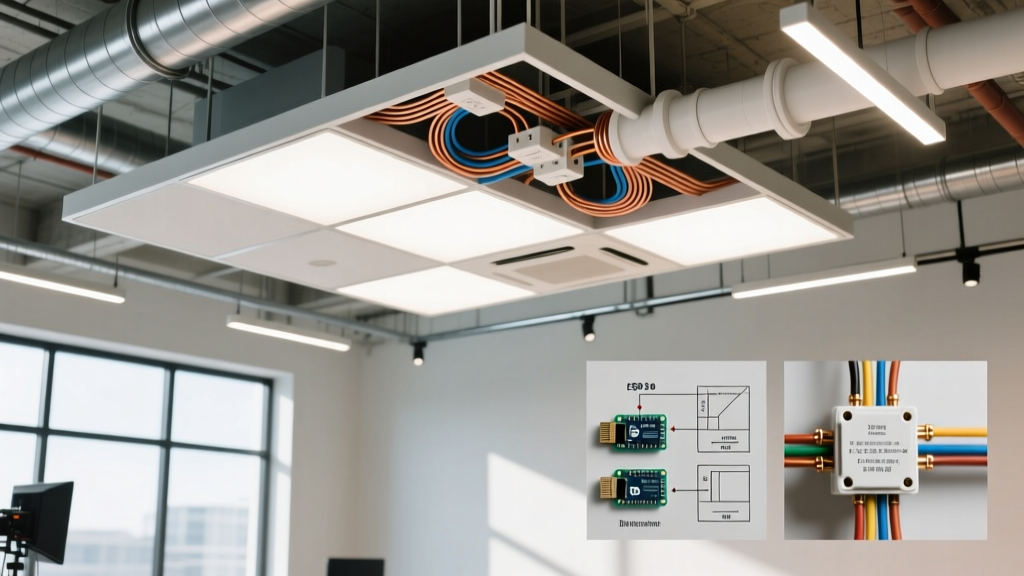
When planning the electrical wiring light fixture infrastructure for a 10,000 sq. ft. open-plan office, the minimum general lighting load is 35,000 VA. On a standard 277V single-phase lighting circuit, this equates to approximately 126.3 Amps. While modern high-efficacy LED troffers (such as the Lithonia BLT4 2x4 drawing merely 32W per unit) will consume significantly less actual power, the NEC requires branch circuits and feeders to be sized based on these calculated VA loads, not the connected LED wattage. This ensures future-proofing if higher-draw fixtures are installed later.
2026 Code Update Note: With the widespread adoption of ASHRAE 90.1-2025 energy standards, commercial spaces now heavily integrate networked lighting controls (NLC). Ensure your panel schedules account for the continuous 24/7 standby power draw of PoE (Power over Ethernet) lighting nodes and DALI-2 bus power supplies, which add roughly 0.2 VA to 0.5 VA per square foot to your baseline calculations.Branch Circuit Sizing and EMT Conduit Fill Limits
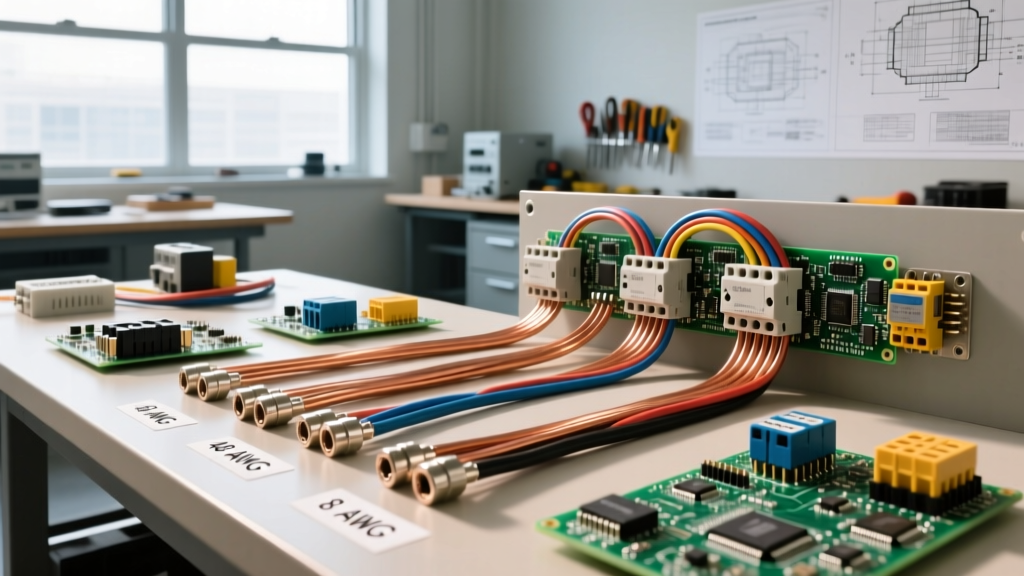
Commercial lighting circuits are predominantly wired using 12 AWG or 10 AWG THHN/THWN-2 copper conductors routed through Electrical Metallic Tubing (EMT). For a standard 20A, 277V branch circuit, 12 AWG wire is the minimum requirement. However, due to the rising cost of copper in 2026 (averaging $3.85 per foot for 10 AWG THHN), many contractors are optimizing conduit fill to maximize the number of 12 AWG circuits per run.
NEC Chapter 9, Table 1 dictates that when pulling three or more current-carrying conductors through a raceway, the maximum fill capacity is 40%. Below is a practical reference matrix for commercial lighting rough-ins:
| Conduit Size (EMT) | Max 12 AWG THHN (40% Fill) | Max 10 AWG THHN (40% Fill) | Typical Commercial Application |
|---|---|---|---|
| 1/2 inch | 9 conductors | 5 conductors | Short hallway runs, single home-runs |
| 3/4 inch | 16 conductors | 10 conductors | Standard open-office grid layouts |
| 1 inch | 26 conductors | 17 conductors | Main lighting feeder trunks to subpanels |
Note: When utilizing multi-wire branch circuits (MWBC) sharing a neutral on a 3-phase system, all conductors count as current-carrying for derating purposes under NEC 310.15(C)(1).
Wiring 0-10V Dimming Controls in Commercial Troffers
The modern commercial electrical wiring light fixture ecosystem relies heavily on 0-10V analog dimming to meet stringent daylight harvesting codes. Unlike line-voltage wiring, the 0-10V control circuit requires specialized attention to prevent signal degradation and phantom voltage issues.
Step-by-Step 0-10V Control Wiring
- Select the Correct Cable: Do not use standard THHN for low-voltage control runs in shared conduits. Use an 18 AWG or 16 AWG shielded twisted pair (STP) cable, such as Belden 88760. The shield must be grounded at the dimmer/panel end only to prevent ground loops.
- Identify Sinking vs. Sourcing: Most commercial LED drivers (e.g., Philips Xitanium, Inventronics) are 'current sinking,' meaning they provide the 10V source and the dimmer pulls it down. Verify the driver spec sheet. Wiring a sourcing dimmer to a sourcing driver will instantly fry the control board.
- Color Coding Standards: While the NEC doesn't strictly mandate colors for Class 1 or Class 2 low-voltage control wires, the industry standard (and NEMA LSD-64 recommendation) is Purple for V+ (10V) and Gray/Pink for V- (Dim/Ground).
- Separation from Line Voltage: If running 0-10V wires in the same raceway as 277V/480V power, the low-voltage cable must be rated for the maximum voltage present in the conduit (typically 600V rated insulation). If using standard 300V rated thermostat wire, a physical barrier must separate the line and low-voltage conductors.
Voltage Drop Mitigation in Large Footprint Facilities
When executing the electrical wiring light fixture plan in a massive warehouse or big-box retail environment, voltage drop becomes a critical failure point. While the NEC does not strictly enforce a maximum voltage drop for branch circuits, Informational Note No. 4 in NEC 210.19(A)(1) strongly recommends keeping it under 3% for optimal equipment longevity and light output consistency.
'Branch circuit conductors should be sized to prevent a maximum voltage drop of 3 percent. The maximum total voltage drop on both feeder and branch circuits should not exceed 5 percent.' — NEC 210.19(A)(1) Informational Note.
At 277V, a 3% drop allows for 8.31V of loss. Using the standard voltage drop formula VD = (2 x K x I x D) / CM (where K=12.9 for copper, I=current, D=one-way distance, CM=circular mils), a 20A load on a 12 AWG wire (6,530 CM) can only travel approximately 134 feet before exceeding the 3% threshold. For runs exceeding this, contractors must upsize to 10 AWG or 8 AWG, or transition to a higher voltage distribution system with local step-down transformers.
Common Commercial Lighting Failure Modes & Edge Cases
Even with perfect schematics, field conditions introduce variables that can compromise a commercial lighting installation. According to data published by the Illuminating Engineering Society (IES), improper wiring practices account for nearly 30% of premature commercial LED driver failures.
- Switched Neutral Faults: In older retrofits, electricians sometimes switch the neutral instead of the ungrounded (hot) conductor to save wire. In 277V LED systems, this leaves the driver energized 24/7, relying on internal switching components that eventually fail, and creates a severe shock hazard during maintenance.
- Arc Fault Nuances in High-Bays: When wiring high-bay fixtures (like the Philips SmartBright 400W) in warehouses with high ceilings, the long whip connections from the J-box to the fixture are susceptible to vibration. Using rigid metal whips instead of flexible MC cable prevents the internal conductors from fraying against the metal conduit edges over time.
- Harmonic Distortion on Shared Neutrals: LED drivers are non-linear loads that generate triplen harmonics (3rd, 9th, 15th). In a 3-phase wye system, these harmonics add up on the neutral bus rather than canceling out. If your lighting panel features shared neutrals (MWBC), the neutral conductor can easily carry 150% to 200% of the phase current. Always size the neutral bus bar and shared neutral conductors at 200% capacity in heavy LED commercial applications.
For further reading on commercial energy efficiency and lighting design basics, the U.S. Department of Energy's Commercial Lighting portal provides excellent baseline metrics for LPD (Lighting Power Density) compliance in modern construction.
Frequently Asked Questions (FAQ)
Can I use 120V for commercial lighting instead of 277V?
While technically possible for small retail spaces, 277V is the commercial standard. It allows you to pull 2.3 times more wattage on the same 20A breaker compared to 120V, drastically reducing the number of home-runs, conduit size, and overall copper costs.
Do I need a dedicated ground wire in EMT conduit for lighting?
NEC 250.118 allows properly installed EMT and its fittings to serve as the Equipment Grounding Conductor (EGC). However, best practice for commercial mission-critical spaces (like hospitals or data centers) is to pull a dedicated green THHN ground wire to ensure an uninterrupted fault path, regardless of conduit vibration or fitting corrosion.