
Core Principles of Commercial Swimming Pool Pump Electrical Wiring
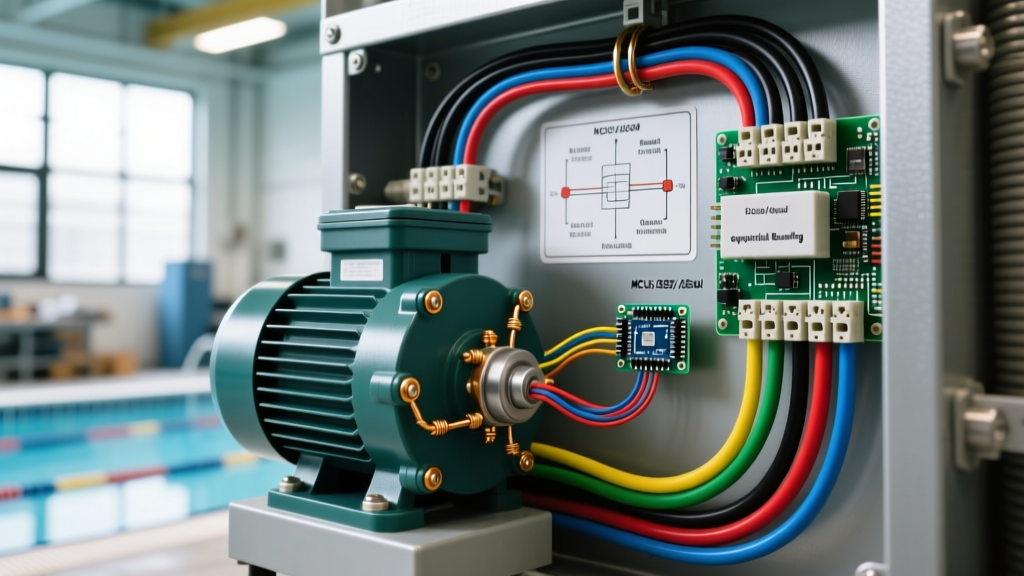
Wiring a commercial aquatic facility requires a fundamentally different approach than residential installations. While a standard backyard pool might rely on a 1.5-HP single-phase pump, commercial venues—such as hotels, municipal recreation centers, and university athletic facilities—frequently deploy 3-HP to 10-HP variable speed pumps operating on 208V or 460V 3-phase power. The stakes for safety and reliability are exponentially higher, governed strictly by NFPA 70 (National Electrical Code) Article 680. This guide details the precise methodologies for commercial swimming pool pump electrical wiring, focusing on 3-phase configurations, equipotential bonding, and mitigating VFD-induced GFCI nuisance tripping.
Single-Phase vs. 3-Phase Commercial Pump Configurations
In commercial environments, 3-phase power is the standard for circulation and feature pumps due to its superior efficiency, lower amperage draw per phase, and extended motor lifespan. When planning the swimming pool pump electrical wiring for a commercial facility, electrical contractors must calculate the Full Load Amps (FLA) to determine the correct wire gauge and overcurrent protection. Commercial pumps like the Pentair WhisperFlo VST 3-HP (Model 011521) or the Hayward TriStar VS 5-HP (Model SP3205EE) require precise sizing to handle startup inrush currents without tripping the breaker.
Commercial 3-Phase Pump Wire & Breaker Sizing Matrix
| Pump Horsepower | Voltage / Phase | Approx. FLA | Min. Copper Wire (THHN/THWN-2) | Breaker Size (Inverse Time) |
|---|---|---|---|---|
| 3 HP | 208V / 3-Phase | 9.6A | 14 AWG | 15A |
| 5 HP | 208V / 3-Phase | 15.2A | 12 AWG | 20A |
| 7.5 HP | 460V / 3-Phase | 9.0A | 14 AWG | 15A |
| 10 HP | 460V / 3-Phase | 11.0A | 14 AWG | 15A |
Note: Wire sizing must account for voltage drop if the pump room is located more than 100 feet from the main switchgear. Keep voltage drop under 3% for branch circuits per NEC recommendations.
Conduit Routing and Physical Protection (NEC 680.10)
One of the most frequently cited violations in commercial pool inspections involves improper conduit selection near the water. According to NEC 680.10, electrical wiring within 5 feet of the inside wall of the pool must be installed in rigid metal conduit (RMC), intermediate metal conduit (IMC), or Schedule 80 PVC. Schedule 40 PVC is strictly prohibited in this zone due to its vulnerability to physical damage from maintenance equipment, landscaping tools, and heavy foot traffic. Furthermore, all conduits must be sealed with duct seal or an approved fitting at the equipment end to prevent moisture migration into the switchgear or VFD enclosures, a critical failure point in humid indoor natatoriums.
Equipotential Bonding: The Critical Safety Grid
Grounding and bonding are not synonymous. While the equipment grounding conductor (EGC) provides a low-impedance path back to the source to clear a fault, the equipotential bonding grid eliminates voltage gradients between conductive surfaces. For commercial swimming pool pump electrical wiring, NEC 680.26 mandates a continuous 8 AWG solid bare copper conductor that interconnects four specific points:
- The Pool Water: Achieved via an inline bonding lug installed on the pump's wet end (usually a brass or stainless steel fitting on the discharge port).
- The Pool Shell: Tied to the structural reinforcing steel (rebar) or a copper wire grid beneath gunite/concrete shells.
- Metallic Components: Including metal conduit, ladders, diving stands, and pool covers within 5 feet of the pool edge.
- Electrical Equipment: The external bonding lug on the pump motor housing and the metal enclosures of time clocks and VFDs.
Expert Insight: In commercial retrofits, we frequently find that the bonding wire was cut or corroded at the motor lug. Always use a listed, irreversible crimp connector or a bronze split-bolt connector coated with anti-oxidant paste when splicing the 8 AWG bonding wire in a commercial pump vault.
For comprehensive technical standards on commercial aquatic bonding, refer to the guidelines published by the Association of Pool & Spa Professionals (APSP).
VFD Integration and GFCI Nuisance Tripping
Modern commercial facilities mandate Variable Frequency Drives (VFDs) to comply with Department of Energy efficiency mandates. However, VFDs generate high-frequency common-mode noise and capacitive leakage current. When a commercial VFD ramps up a 5-HP pool pump, this leakage current can easily exceed the 30mA threshold of a standard Class A GFCI breaker, causing nuisance tripping and shutting down the facility's filtration system.
Troubleshooting and Mitigation Strategies
- Upgrade to Type F or VFD-Compatible GFCIs: Standard residential GFCI breakers cannot handle the harmonic distortion of a commercial VFD. Specify breakers like the Siemens Type F or Eaton 30mA breakers explicitly rated for inductive loads and VFD applications.
- Install dV/dT Filters: If the motor leads from the VFD to the pump exceed 50 feet, the cable capacitance multiplies the leakage current. Installing an output dV/dT filter at the VFD terminals will smooth the PWM waveform and drastically reduce ground leakage.
- Verify Shielded Cable Grounding: When using VFD-rated shielded tray cable (e.g., 3-conductor with a symmetric ground and copper braid shield), ensure the shield is grounded at the VFD end only. Grounding the shield at both the VFD and the motor creates a ground loop that will instantly trip the GFCI.
Understanding the interaction between power electronics and ground-fault protection is a hallmark of advanced commercial electrical work. For deeper analysis on grounding power electronics, EC&M Magazine's Codes and Standards section provides excellent field case studies.
2026 Cost Estimates for Commercial Pool Pump Upgrades
When bidding on commercial swimming pool pump electrical wiring projects, contractors must account for the premium materials and specialized labor required. Below is a realistic 2026 pricing framework for a standard 5-HP 3-phase commercial pump upgrade:
- Commercial VFD Pump Unit (5-HP, 208V/460V): $3,200 – $4,800
- 3-Phase Wiring Pull (12 AWG THHN in Sch 80 PVC): $18 – $28 per linear foot (including labor and trenching if necessary)
- Equipotential Bonding Ring Retrofit: $1,500 – $3,500 (highly dependent on deck demolition and concrete patching requirements)
- VFD-Compatible 30mA GFCI Breaker: $350 – $600 per pole
- Output dV/dT Filter (if required): $450 – $800
By mastering the nuances of NEC Article 680, 3-phase motor theory, and VFD harmonic mitigation, electrical contractors can deliver safe, code-compliant, and highly reliable aquatic systems that stand up to the rigorous demands of commercial operation.