
The Core Framework: Matching Cable to Commercial Environments
Selecting the correct electrical wiring cable types for commercial construction requires balancing National Electrical Code (NEC) compliance, environmental resilience, and labor efficiency. Unlike residential wiring, which relies heavily on standard Non-Metallic (NM) sheathed cable, commercial projects demand robust insulation, physical protection, and specific fire-resistance ratings. As of 2026, with widespread adoption of the NEC 2023 and early 2026 code cycles, electrical contractors must navigate stricter requirements for life-safety circuits, energy efficiency, and arc-flash mitigation.
According to the NFPA 70 National Electrical Code, conductor applications and insulations are governed primarily by Article 310. Choosing the wrong jacket or insulation type can lead to catastrophic dielectric breakdown, especially in wet locations or areas exposed to industrial solvents. This guide dissects the most critical commercial electrical wiring cable types, providing actionable specifications, real-world pricing, and installation edge cases.
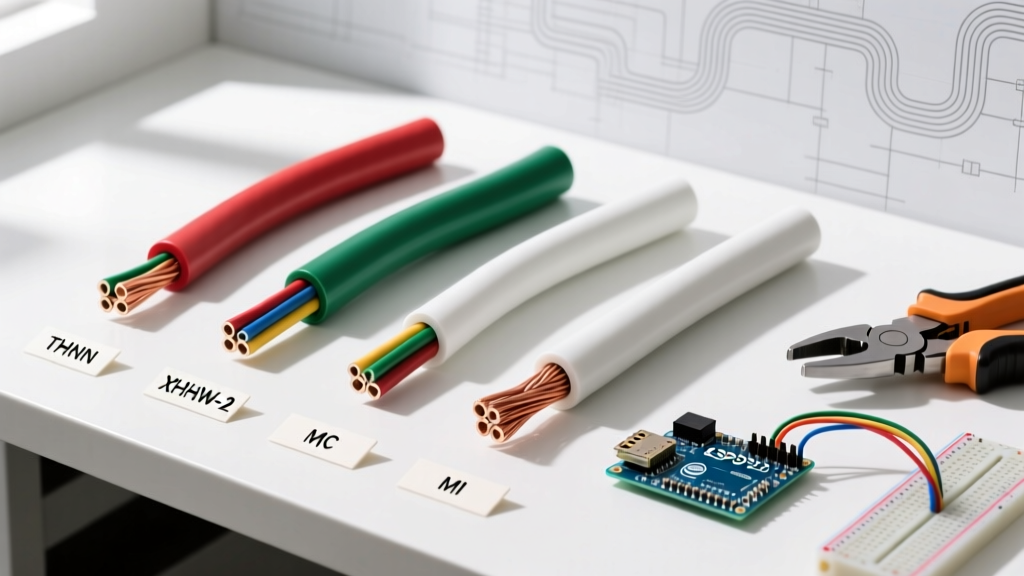
Conduit Pull Wires: THHN/THWN-2 vs. XHHW-2
When pulling single conductors through EMT (Electrical Metallic Tubing) or rigid steel conduit, electricians generally choose between two primary insulation types. While both are rated for 90°C in dry locations, their physical properties dictate their specific use cases.
THHN/THWN-2: The Commercial Workhorse
THHN (Thermoplastic High Heat-resistant Nylon-coated) is the most ubiquitous wire in commercial lighting and receptacle branch circuits. Modern manufacturing almost universally dual-rates this wire as THWN-2, meaning it is also approved for wet locations up to 90°C. The slick nylon outer jacket reduces friction during long conduit pulls, allowing contractors to maximize conduit fill capacity.
Edge Case & Failure Mode: The nylon jacket on THHN is highly susceptible to degradation when exposed to certain hydrocarbons, industrial solvents, and prolonged UV exposure. If pulled through underground PVC conduit that has pooled with petroleum-based cutting oils from the threading process, the nylon can soften and strip off during the pull, compromising the underlying PVC insulation.
XHHW-2: The Heavy-Duty Alternative
XHHW-2 (Cross-Linked Polyethylene High Heat Water-resistant) lacks the nylon jacket. Instead, it utilizes a thermoset XLPE insulation. This makes it slightly more rigid but vastly superior in moisture resistance and physical toughness. For commercial feeders (e.g., 4/0 AWG to 500 kcmil) pulled through large underground duct banks or wet vaults, XHHW-2 is the superior choice.
| Specification | THHN/THWN-2 | XHHW-2 |
|---|---|---|
| Insulation Material | PVC with Nylon Jacket | Thermoset XLPE |
| Max Temperature (Wet/Dry) | 90°C / 90°C | 90°C / 90°C |
| Short-Circuit Withstand | Moderate | High (Superior thermal stability) |
| Conduit Fill Advantage | Smaller OD (Nylon allows tighter packing) | Larger OD (Thicker insulation wall) |
| Approx. Cost (12 AWG) | $0.38 - $0.45 per foot | $0.42 - $0.50 per foot |
Armored Solutions: Metal-Clad (MC) and Armored Cable (AC)
For commercial spaces where open plenums, drop ceilings, or surface-mounted runs are required, pulling individual wires through conduit becomes labor-prohibitive. This is where manufactured cable assemblies come into play.
Metal-Clad (MC) Cable (NEC Article 330)
MC cable features insulated conductors wrapped in a continuous interlocked aluminum or steel armor. It is the dominant wiring method for commercial retail build-outs, hospital corridors, and office tenant improvements. Modern MC cable includes an insulated green equipment grounding conductor (EGC) alongside the bare aluminum bonding strip. This ensures a low-impedance fault path, which is critical for clearing faults rapidly and meeting OSHA electrical safety standards for worker protection.
Code Alert: Do not confuse MC cable with AC (Armored Cable, NEC Article 320). AC cable relies entirely on the metal armor and an internal bonding strip for grounding, and it is restricted to dry locations. MC cable, with its dedicated insulated EGC, can be rated for wet locations if the individual conductors inside are THWN-2 or XHHW-2 and the armor is properly sealed.
Corrugated vs. Interlocked Armor
Standard commercial MC uses interlocked armor, which is flexible but can allow moisture ingress if submerged. For underground commercial runs or concrete encasement, contractors must specify continuous corrugated aluminum armor MC cable. The corrugated version acts as a hermetically sealed tube, preventing the alkaline environment of wet concrete from causing galvanic corrosion on the armor.
Specialized Commercial Applications: MI and Tray Cables
Mineral-Insulated (MI) Cable for Life Safety
When routing power to commercial fire pumps, emergency stairwell pressurization fans, or critical hospital surgical suites, standard insulation will not survive a structural fire. Mineral-Insulated (MI) cable utilizes solid copper conductors embedded in highly compressed magnesium oxide (MgO) powder, all encased in a continuous copper or stainless steel sheath. Because MgO is an inorganic mineral, it will not burn or emit toxic smoke. MI cable is exceptionally expensive—often exceeding $25 per foot for multi-conductor setups—and requires specialized terminator kits to prevent the hygroscopic MgO from absorbing ambient moisture during installation.
Tray Cable (TC) in Industrial Facilities
In large-scale commercial manufacturing or data centers, conductors are often routed through ladder-style cable trays rather than individual conduits. Tray Cable (TC) is a factory-assembled bundle of THHN/THWN-2 or XHHW-2 conductors wrapped in a heavy-duty, sunlight-resistant, and flame-retardant outer PVC or CPE jacket. Per NEC Article 392, TC cable offers massive labor savings, allowing crews to lay down hundreds of feet of pre-assembled feeder or control wiring in a single pull.
2026 Pricing & Procurement Matrix
Material costs fluctuate based on global copper and aluminum commodities. Below is a baseline procurement matrix for standard commercial electrical wiring cable types as of early 2026. Note that bulk contractor pricing (via master reels) typically yields a 15-20% discount over cut-to-length retail pricing.
| Cable Type | Configuration | Avg. Cost per Foot | Labor Factor (Relative) | Primary Commercial Use |
|---|---|---|---|---|
| THHN/THWN-2 | 12 AWG Solid/Stranded | $0.40 | High (Requires conduit bending/pulling) | Branch circuits in EMT |
| XHHW-2 | 4/0 AWG Stranded | $14.50 | High (Heavy pulling tension) | Main switchboard feeders |
| MC Cable | 12/2 AWG w/ Ground | $1.15 | Low (Cut, strip, and terminate) | Drop ceiling lighting/receptacles |
| MC Cable | 3/0-3/0-3/0-1/0 AWG | $38.00 | Medium (Heavy but pre-assembled) | Panel-to-panel distribution |
| MI Cable | 4-Conductor 10 AWG | $28.50 | Very High (Requires torching/epoxy) | Fire pumps, life safety feeders |
Common Installation Failures and Edge Cases
Even experienced commercial electricians encounter edge cases that lead to failed inspections or premature system degradation. Avoid these common pitfalls:
- The 75°C Termination Trap: Both THHN and XHHW-2 are rated for 90°C. However, per NEC 110.14(C), the ampacity of the wire must be based on the lowest temperature rating of any connected device. Since most commercial circuit breakers, lugs, and disconnects are only rated for 75°C, you must size your wire using the 75°C column in NEC Table 310.16, regardless of the wire's 90°C insulation. Using the 90°C column for sizing will result in an overloaded, overheated breaker termination.
- MC Cable Armor as a Ground: While some older code cycles and specific listed assemblies allow the MC armor and internal bonding strip to serve as the Equipment Grounding Conductor (EGC), many commercial jurisdictions with strict local amendments require an explicit, insulated green EGC wire inside the cable. Always specify MC cable with an internal green wire to prevent failed inspections.
- Conduit Fill Violations: When pulling multiple circuits through a single EMT run, contractors often exceed the 40% conduit fill limit outlined in NEC Chapter 9, Table 1. Overfilling causes excessive heat buildup (requiring ampacity derating per Table 310.15(C)(1)) and increases the physical force required to pull the wire, leading to stretched conductors or stripped insulation.
- Galvanic Corrosion on Aluminum MC: If standard interlocked aluminum MC cable is run through commercial concrete floors without a continuous PVC jacket, the alkaline moisture in the concrete will rapidly corrode the aluminum armor. Always specify PVC-jacketed MC cable for direct burial or concrete encasement.
Final Considerations for Commercial Contractors
Mastering the selection of electrical wiring cable types is a cornerstone of profitable and safe commercial electrical contracting. While THHN remains the default for conduit branch circuits, transitioning to XHHW-2 for wet locations and utilizing MC cable for exposed runs dramatically optimizes labor costs. Furthermore, as commercial buildings increasingly integrate high-density data centers and EV charging infrastructure, the thermal limits and short-circuit withstand ratings of XLPE-insulated cables will become even more critical. Always consult the latest edition of the Electrical Contractor Magazine codes and standards section to stay updated on local amendments and emerging NEC interpretations before finalizing your project's bill of materials.