
The Reality Behind 'Electrical Wiring for Dummies'
When homeowners search for electrical wiring for dummies, they are typically looking for a simplified, jargon-free path to fixing or upgrading their home's electrical system. The appeal is obvious: saving money on expensive contractor fees and gaining a sense of self-reliance. However, electricity does not grade on a curve, and it certainly does not care about simplified guides. A single loose neutral or reversed polarity can lead to catastrophic arc faults, equipment destruction, or fatal shocks.
As a senior electrical analyst, I frequently evaluate the boundary between what a motivated beginner can safely accomplish and what strictly requires a licensed professional. In 2026, with the widespread adoption of the latest National Electrical Code (NEC) editions and the integration of smart home ecosystems, that boundary has shifted. This comprehensive analysis breaks down the DIY sweet spot, the professional domain, and the hidden costs of crossing the line.
The DIY Sweet Spot: Where Beginners Can Safely Operate
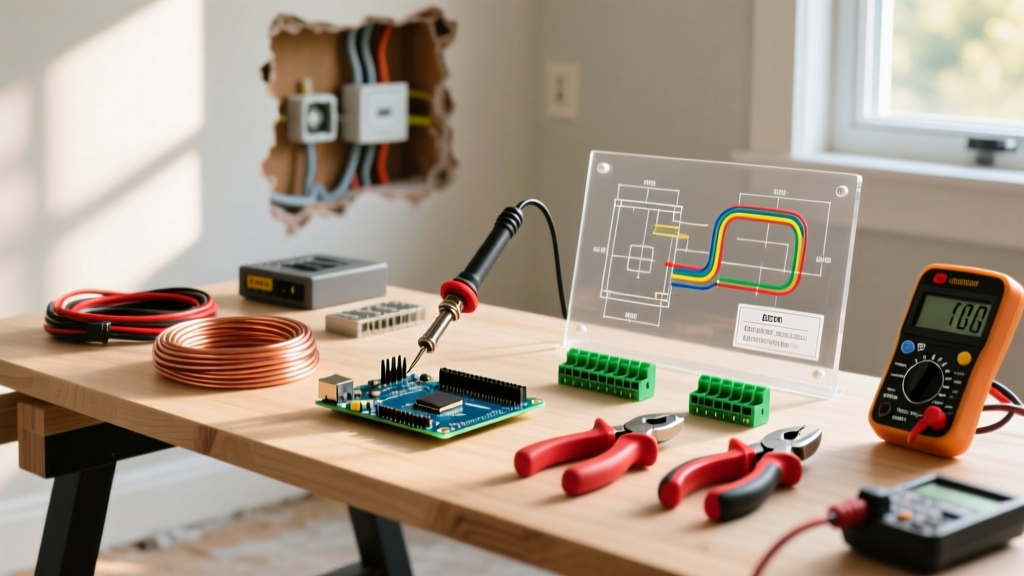
Not all electrical work requires a master electrician. There is a distinct category of maintenance and light remodeling that falls within the capabilities of a careful, well-researched DIYer. The key is understanding the limitations of your knowledge and adhering strictly to material standards.
1. Device Swapping (Receptacles and Switches)
Replacing a worn-out 15-amp duplex receptacle or a standard single-pole toggle switch is the quintessential beginner project. However, the 'dummy' approach often leads to dangerous shortcuts. Professional electricians do not use the push-in 'backstab' connectors found on the back of cheap $1.50 receptacles. Under thermal cycling, these spring-loaded connections loosen, increasing resistance and generating heat.
- The Pro Method: Use commercial-grade receptacles (e.g., Leviton Decora 5262 or Hubbell 5262). Strip the wire using a precision tool like the Klein Tools 11063W, loop the bare copper clockwise around the side-wire screw terminal, and torque it to the manufacturer's specification—typically 14 in-lbs for 14 AWG and 12 AWG wire.
- The Code Requirement: NEC Article 110.14(D) mandates the use of calibrated torque tools for terminations. While rarely enforced on DIYers, buying a $40 torque screwdriver is a non-negotiable safety investment.
2. Extending an Existing 120V Circuit
Adding a single outlet to an existing living room circuit is feasible if you understand wire gauge and box fill calculations. For a standard 15-amp circuit, you must use 14/2 NM-B (Romex) cable. For a 20-amp circuit, 12/2 NM-B is mandatory. When pulling wire through studs, professionals use wire pulling lubricant (like Ideal 31-090) to prevent jacket tearing, which can expose conductors to ground faults inside the wall cavity.
The Professional Domain: Do Not Touch
The phrase 'electrical wiring for dummies' becomes a dangerous misnomer when applied to service equipment, high-voltage circuits, and complex grounding systems. The Electrical Safety Foundation International (ESFI) strongly advises that any work involving the main service panel, subpanels, or 240V appliances be left to licensed professionals.
Service Panels and Breaker Upgrades
Upgrading a 100-amp panel to a 200-amp service, or even just swapping out a faulty breaker in an Eaton BR or Square D Homeline panel, involves working near the main lugs. These lugs remain energized at lethal amperages even when the main breaker is turned off, unless the utility company pulls the meter. An arc flash in a residential panel can reach temperatures exceeding 35,000°F—four times hotter than the surface of the sun.
240V Circuits and EV Chargers
Installing a Level 2 Electric Vehicle (EV) charger or a new electric range requires running 240V circuits. This involves double-pole breakers, 6 AWG or 8 AWG copper conductors, and precise neutral-to-ground bonding rules that change depending on whether you are wiring a main panel or a subpanel. Misbonding a subpanel can energize the grounding system, creating a shock hazard on every metal appliance in the home.
Expert Insight: According to data from the Consumer Product Safety Commission (CPSC), electrical wiring and related equipment are consistently among the leading causes of residential fires, with improper DIY panel work and overloaded circuits acting as primary catalysts.
Cost vs. Risk Matrix: DIY vs Professional (2026 Data)
To provide a realistic perspective, we must weigh the material savings of DIY against the labor costs of a professional, factoring in the 2026 market rates for licensed electricians ($95 to $165 per hour, depending on the region).
| Project Scope | DIY Material Cost | Pro Labor Cost (2026) | Permit Required? | Risk Factor |
|---|---|---|---|---|
| Swap 15A Receptacles (up to 10) | $35 - $60 | $250 - $400 | No | Low (if torqued correctly) |
| Install GFCI in Bathroom | $25 - $45 | $175 - $250 | Varies by municipality | Low-Medium |
| Add 20A Circuit for Garage Tools | $80 - $120 | $450 - $700 | Yes | Medium (Box fill / AFCI rules) |
| Install 50A EV Charger Circuit | $150 - $300 | $800 - $1,500+ | Yes | High (240V / Load calc) |
| Upgrade Main Panel to 200A | $400 - $800 | $2,500 - $4,500 | Yes | Extreme (Arc flash / Utility) |
Hidden Costs and Failure Modes of DIY Mistakes
When DIY electrical work fails, it rarely fails immediately. It fails silently over months or years, leading to what industry experts call the 'Dummy Tax'—the cost of repairing the damage caused by improper installation.
Failure Mode 1: The Loose Neutral
In a multi-wire branch circuit (MWBC) or a standard 120V circuit, a loose neutral wire at a wire nut or terminal causes voltage fluctuations. If the neutral connection degrades, 120V appliances can suddenly receive 240V, instantly frying HVAC control boards, televisions, and computer power supplies. A $50 DIY repair can easily result in $3,000 of destroyed electronics.
Failure Mode 2: Ignoring AFCI/GFCI Mandates
The National Fire Protection Association (NFPA) updates the NEC to reflect modern fire safety science. Current codes require Arc Fault Circuit Interrupters (AFCI) in almost all living spaces and Ground Fault Circuit Interrupters (GFCI) in wet locations. DIYers often attempt to bypass nuisance tripping by swapping an AFCI breaker for a standard thermal-magnetic breaker. This removes the fire-prevention layer, leaving the home vulnerable to parallel arc faults caused by damaged wire insulation inside the walls.
Failure Mode 3: Overcrowded Junction Boxes
NEC Article 314 dictates strict box fill calculations based on the gauge and number of wires entering a junction box. Shoving six 12 AWG wires into a standard 18-cubic-inch plastic box crushes the conductors, damaging the insulation and creating short-circuit risks. Professionals calculate cubic inch requirements precisely, upgrading to deep 22.5 or 25-cubic-inch boxes when necessary.
Permitting, Inspections, and Insurance Realities
A common misconception among beginners is that permits are just a way for the city to collect revenue. In reality, the permitting process ensures that your electrical modifications are reviewed by a third-party inspector who verifies compliance with the NEC.
If you perform unpermitted electrical work and your home subsequently suffers an electrical fire, your homeowner's insurance provider can legally deny the claim. Insurance adjusters frequently request proof of permitting and final inspection certificates for any major electrical modifications. The $150 permit fee is essentially an insurance policy for your home's insurability.
The Final Verdict: Framework for Decision Making
The concept of 'electrical wiring for dummies' is best viewed as a starting point for education, not a blueprint for execution. Use simplified guides to understand the theory of how circuits work, how current flows, and why grounding matters. But when it comes to physical execution, apply this strict framework:
- The Device Level: If you are only touching the load side of a circuit (switches, receptacles, light fixtures) and the wiring is already in place, DIY is acceptable provided you use a torque screwdriver and commercial-grade materials.
- The Circuit Level: If you are running new cable, calculating loads, or adding breakers, you are entering professional territory. You may do the physical wire pulling yourself to save on labor, but hire an electrician to make the panel terminations and pull the permit.
- The Service Level: Anything involving the main service disconnect, meter base, or grounding electrode system must be handled exclusively by a licensed, bonded, and insured electrical contractor.
Respecting the complexity of electrical systems is the hallmark of a true professional. By knowing your limits, you ensure that your home remains safe, code-compliant, and protected for decades to come.