
The Inspector's Mindset: Safety Over Functionality
When approaching electrical wiring for beginners, the most common mistake is focusing solely on making the circuit work. A light turns on, and the DIYer assumes success. However, municipal electrical inspectors do not test for functionality; they test for safety, longevity, and strict adherence to the National Electrical Code (NEC). According to the National Fire Protection Association (NFPA), electrical failures or malfunctions account for tens of thousands of home structure fires annually. Passing an inspection is not about memorizing the entire 900-page NEC handbook; it is about understanding the core mechanical and spatial requirements that prevent arcs, shorts, and overheating.
This guide bridges the gap between basic circuit theory and real-world code compliance, detailing the exact measurements, tools, and techniques required to pass both rough-in and final inspections in 2026.
Phase 1: The Rough-In Inspection
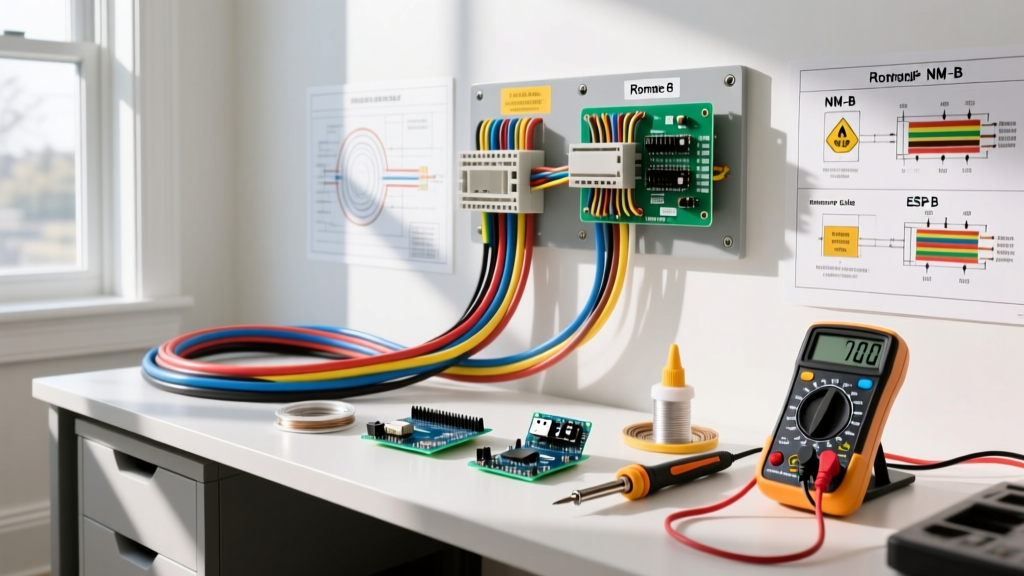
The rough-in inspection occurs after all cables are pulled and boxes are mounted, but before drywall is hung. Inspectors are looking for physical protection of the Non-Metallic (NM-B / Romex) sheathed cable.
Stapling and Securing (NEC 334.30)
Beginners often leave cables drooping or use the wrong fasteners. The NEC mandates precise securing intervals to prevent stress on terminal connections.
- Box Proximity: Cables must be secured within 8 inches of a single-gang box without internal cable clamps, or within 12 inches of a box with internal clamps.
- Run Intervals: Secure the cable at intervals not exceeding 4.5 feet (54 inches).
- Fastener Type: Use UL-listed insulated plastic staples (e.g., Gardner Bender H3090) or nail-in cable ties. Never use standard framing nails or drywall screws to pinch the cable against a stud, as this compromises the dielectric insulation.
Bored Holes and Nail Plates (NEC 300.4)
When drilling through framing members to run wire, spatial awareness is critical to prevent a drywaller from driving a screw directly into your cable.
The 1.25-Inch Rule: NEC 300.4(A)(1) requires that cables run through bored holes in studs must be at least 1.25 inches from the nearest edge of the framing member. Since a standard 2x4 stud is only 1.5 inches deep, drilling a perfectly centered hole leaves exactly 0.75 inches of wood on either side.
Because achieving 1.25 inches in a 2x4 is mathematically impossible when running standard 14/2 or 12/2 NM cable, you must install a 1/16-inch thick steel nail plate (such as the Simpson Strong-Tie NP15) over the edge of the stud wherever the wire passes through. Failing to use nail plates is the number one reason beginners receive a red tag during rough-in.
Phase 2: Box Fill Calculations (NEC 314.16)
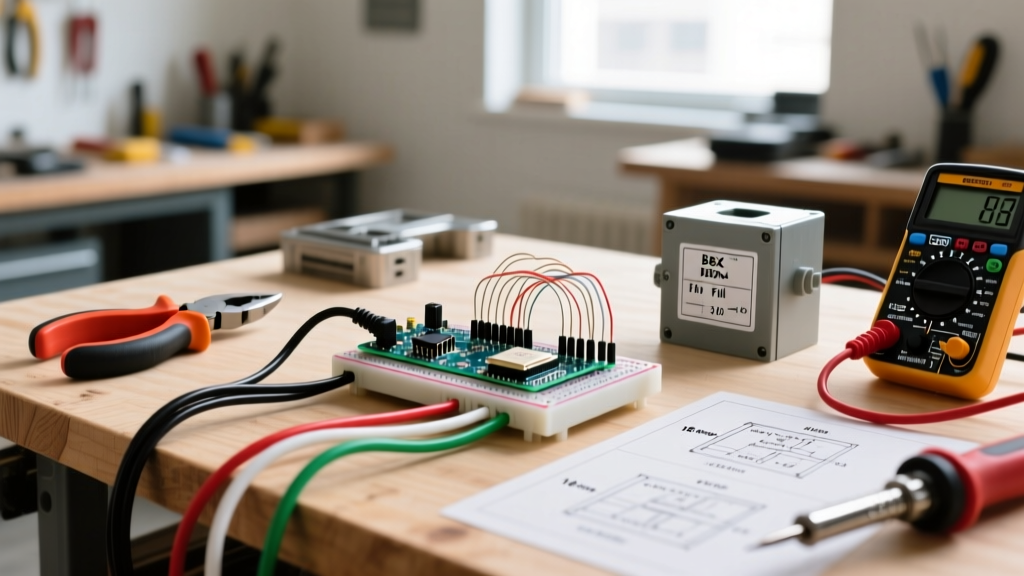
Overcrowding an electrical box causes wires to pinch, insulation to tear, and heat to build up. Inspectors will physically open your boxes and count the conductors. Box fill is calculated by assigning a 'volume allowance' to every item inside the box based on the largest wire size present.
| Wire Size (AWG) | Cubic Inches per Wire | Device (Receptacle/Switch) | Ground Wires (Combined) | Internal Clamps |
|---|---|---|---|---|
| 14 AWG | 2.0 cu in. | 4.0 cu in. (counts as 2) | 2.0 cu in. (counts as 1) | 2.0 cu in. (counts as 1) |
| 12 AWG | 2.25 cu in. | 4.5 cu in. (counts as 2) | 2.25 cu in. (counts as 1) | 2.25 cu in. (counts as 1) |
| 10 AWG | 2.5 cu in. | 5.0 cu in. (counts as 2) | 2.5 cu in. (counts as 1) | 2.5 cu in. (counts as 1) |
Pro-Tip for Beginners: A standard single-gang 'old work' drywall box typically offers only 14 to 18 cubic inches of space. If you are running 12 AWG wire and have two cables entering the box (4 current-carrying conductors, 1 ground, 1 device), your total fill is 15.75 cubic inches. Always buy 'deep' single-gang boxes (22.5 cu in. or higher) to give yourself a margin of error and make pushing the wires into the box significantly easier.
Phase 3: Final Inspection & Terminations
The final inspection happens after drywall, paint, and flooring are complete, and all devices (receptacles, switches, breakers) are terminated. The focus shifts from physical cable protection to electrical connection integrity.
The Torque Screwdriver Requirement (NEC 110.14)
One of the most heavily enforced modern code updates is NEC 110.14(D). It mandates that any electrical termination marked with a specific tightening torque must be tightened using a calibrated torque tool. Hand-tightening with a standard screwdriver is no longer compliant for most breakers and lugs.
- Breaker Lugs: A standard Square D QO or Eaton BR 15A/20A breaker typically requires 35 to 40 inch-pounds of torque for 12-10 AWG copper wire.
- Tool Required: Invest in a calibrated torque screwdriver (e.g., Klein Tools 69411 or CDI 401SM) that measures in inch-pounds, not foot-pounds. Using a foot-pound wrench will instantly snap the terminal screw.
AFCI and GFCI Protection Matrix
Beginners frequently confuse Arc-Fault Circuit Interrupters (AFCI) with Ground-Fault Circuit Interrupters (GFCI). The Electrical Safety Foundation International (ESFI) notes that understanding the distinct purposes of these devices is critical for fire and shock prevention. Inspectors will verify that the correct protection is applied to the correct rooms.
| Room / Location | GFCI Required? (Shock Protection) | AFCI Required? (Fire Protection) | Notes for Compliance |
|---|---|---|---|
| Kitchens | Yes (All countertop receptacles) | No | Must be on 20A small-appliance branch circuits. |
| Bathrooms | Yes (All receptacles) | No | Must be on 20A circuit; no lighting on this circuit. |
| Bedrooms | No | Yes (All 120V outlets/lights) | Use AFCI breakers or combination-type AFCI receptacles. |
| Living Rooms / Family Rooms | No | Yes | Includes ceiling fans, lighting, and wall receptacles. |
| Garages & Outdoors | Yes | No (with exceptions) | GFCI must be readily accessible; weatherproof covers required outdoors. |
Common Beginner 'Red Tags' and How to Avoid Them
A 'red tag' means your work failed inspection and must be corrected before proceeding. Here are the most frequent compliance failures for novices, backed by industry data from Mike Holt Enterprises, a premier NEC training authority:
- Reverse Polarity: Wiring the hot (black) to the silver terminal and neutral (white) to the brass. Fix: Remember 'Black to Brass, White to Silver, Bare to Green'.
- Exposed Copper at Terminals: Stripping too much insulation, leaving bare copper visible outside the breaker or receptacle lug. Fix: Use the strip gauge printed on the back of the device. Usually, 3/4 inch is the maximum.
- Missing Equipment Grounding Conductor (EGC): Failing to bond the ground wire to a metal electrical box using a green grounding screw or clip. Fix: Always run a ground pigtail to the metal box before connecting the device.
- Overcrowded Neutral Bus Bar: Terminating two neutral wires under a single screw lug in the main panel. Fix: NEC 408.41 strictly prohibits landing more than one neutral on a single terminal lug. Use an auxiliary ground/neutral bar if space is limited.
Frequently Asked Questions (FAQ)
Can I wire my own house as a beginner?
In most jurisdictions, homeowners can wire their own primary residence under a 'Homeowner's Permit,' provided they pass all rough-in and final inspections. However, you cannot wire a home you intend to sell or rent out immediately. Always check with your local Authority Having Jurisdiction (AHJ) before starting.
Do I need a permit to replace a single outlet?
Generally, no. Like-for-like replacements of receptacles, switches, and light fixtures do not require a permit. However, running a new circuit, upgrading a service panel, or adding outlets to a kitchen or bathroom absolutely requires a permit and inspection.
What is the difference between 14 AWG and 12 AWG wire?
14 AWG wire is rated for 15 Amps and must be protected by a 15A breaker. 12 AWG wire is thicker, rated for 20 Amps, and can be used on both 15A and 20A breakers. For beginners, standardizing on 12 AWG for all receptacle circuits eliminates the risk of accidentally placing a 12 AWG wire on a 20A breaker (which is legal) versus placing a 14 AWG wire on a 20A breaker (which is a severe fire hazard and an instant code violation).