
The True Cost of Home Electrical Wiring Colors
Understanding home electrical wiring colors is not merely an academic exercise for electricians; it is the fundamental baseline for residential safety, troubleshooting, and National Electrical Code (NEC) compliance. When wiring colors are faded, incorrectly installed, or outdated, the financial impact extends far beyond a simple roll of electrical tape. In 2026, with the widespread adoption of AFCI/GFCI protection and smart home ecosystems, misidentified wires cause nuisance tripping, failed inspections, and severe shock hazards.
This comprehensive cost estimation guide breaks down the exact pricing, material costs, and labor rates associated with identifying, correcting, and replacing non-compliant wiring in residential properties.
Standard NEC Color Code Matrix & Material Costs
The NEC strictly dictates the function of specific insulation colors to prevent catastrophic cross-wiring. Below is the 2026 standard residential color matrix, alongside current contractor pricing for Southwire ROMEX SIMpull and Cerro Wire NM-B cables.
| Wire Color | NEC Function | Common Gauge | 2026 Material Cost (Per Ft) | NEC Article Reference |
|---|---|---|---|---|
| Black | Ungrounded (Hot) | 14 AWG / 12 AWG | $0.45 - $0.65 | Art. 200.2 |
| Red | Secondary Hot / Switch Leg | 14 AWG / 12 AWG | $0.60 - $0.85 | Art. 200.2 |
| White / Gray | Grounded (Neutral) | 14 AWG / 12 AWG | Included in NM-B | Art. 200.2 |
| Bare / Green | Equipment Grounding | 14 AWG / 10 AWG | $0.15 - $0.30 | Art. 250.119 |
| Blue / Yellow | Travelers / 3-Way Loops | 12 AWG (THHN) | $0.25 - $0.40 | Art. 310.110 |
The Hidden Costs of Non-Compliant Switch Loops
One of the most common and costly color-code violations in older homes is the traditional 'switch loop.' Historically, electricians ran 14/2 NM-B cable from a light fixture to a switch, using the white wire as the 'hot' feed and the black wire as the 'switched hot' returning to the fixture. While the NEC allowed this if the white wire was re-identified with black tape, many DIYers and hasty contractors skipped this step.
The NEC 404.2(C) Neutral Requirement
Modern smart switches, motion sensors, and Wi-Fi relays require a dedicated neutral wire to function. The NEC now mandates that a neutral (white wire) must be present at nearly every switch box. If your home relies on old 14/2 switch loops where the white wire is being used as a hot, you cannot simply swap in a smart switch. You must pull new 14/3 cable (Black, Red, White, Bare) to provide a true hot, a switched hot, and a dedicated neutral.
2026 Upgrade Cost Estimate: Upgrading a single 14/2 switch loop to a compliant 14/3 circuit requires fishing new wire through finished drywall. Expect to pay $180 to $275 per switch location in labor and materials, assuming standard single-story accessibility. Multi-story or concrete-block homes can push this cost past $400 per drop.
Diagnostic Fees: Tracing Miscolored Circuits
When a home inspector flags 'French ties' (multiple neutrals from different circuits tied together) or unidentified white wires acting as hots, an electrician must map the circuit before any repairs begin. Miscolored wires cause shared-neutral GFCI trips and pose a severe electrocution risk to future workers who assume a white wire is dead.
- Circuit Tracing Rate: $95 - $145 per hour (Journeyman electrician rates in 2026).
- Average Time per Circuit: 1.5 to 3 hours using advanced tone generators and clamp-on ammeters.
- Re-identification Cost: If the wire is safely sized but incorrectly colored, an electrician will apply colored heat-shrink tubing or NEC-approved electrical tape at every termination point. This adds roughly $45 to $85 per termination box in labor.
Whole-House Rewiring: When Colors Fade to Gray
In homes built between 1920 and 1960, early rubber-insulated and cloth-sheathed wiring often suffers from severe color degradation. What was once distinct white and black insulation bakes into a uniform, brittle gray or brown over decades of thermal cycling. According to the Electrical Safety Foundation International (ESFI), attempting to re-terminate brittle cloth wiring often results in the insulation crumbling back to the bare copper, necessitating a full wire pull.
2026 Whole-House Rewiring Cost Breakdown
If an insurance inspector or local AHJ (Authority Having Jurisdiction) mandates a rewire due to unidentifiable conductor colors, the costs are substantial. The National Fire Protection Association (NFPA) consistently highlights outdated wiring as a leading cause of residential electrical fires, making this an unavoidable investment for older properties.
| Home Size | Estimated Linear Feet of Wire | Material Cost (NM-B & Panels) | Labor Cost (2-3 Weeks) | Total Project Range |
|---|---|---|---|---|
| 1,200 Sq Ft | 2,500 - 3,500 ft | $2,800 - $4,200 | $6,500 - $9,000 | $9,300 - $13,200 |
| 2,000 Sq Ft | 4,500 - 6,000 ft | $4,500 - $6,800 | $11,000 - $15,000 | $15,500 - $21,800 |
| 3,200 Sq Ft | 7,500 - 9,500 ft | $7,200 - $10,500 | $18,000 - $24,000 | $25,200 - $34,500 |
Note: These estimates assume standard drywall cutting and patching. If extensive plaster repair or high-end finish restoration is required, add 20% to 35% to the final labor total.
Material Deep Dive: NM-B Cable vs. THHN in Conduit
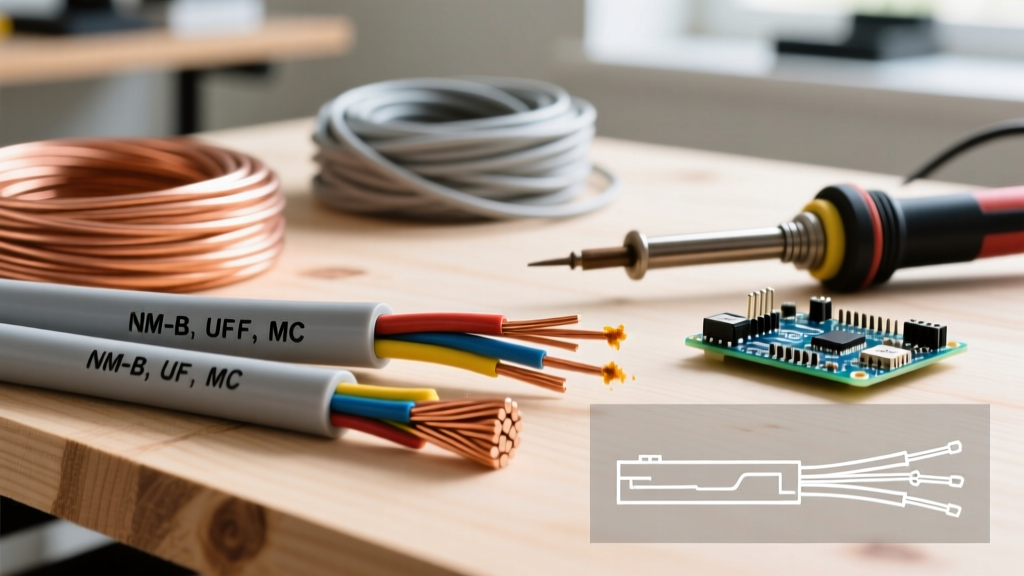
When correcting color-code violations, the choice of wiring method drastically alters the budget. Standard NM-B (Romex) comes with pre-assigned colors (Black, White, Bare for 2-wire; Black, Red, White, Bare for 3-wire). However, in jurisdictions requiring metal conduit (EMT) or flexible metal conduit (FMC) like Chicago or New York City, electricians must pull individual THHN/THWN-2 wires.
Cost Comparison: NM-B vs THHN
- 12/2 NM-B Cable: ~$0.95 per foot. Contains Black, White, and Bare. Ready to staple and terminate. Best for: Standard residential remodels in non-conduit jurisdictions.
- Individual 12 AWG THHN: ~$0.35 per foot, per color. To replicate a 12/2 circuit, you must buy Black, White, and Green ($1.05/ft total), plus the cost of EMT conduit ($2.10/ft), fittings, and the extra labor to bend conduit and fish individual wires. Best for: Commercial applications, exposed basement ceilings, and strict municipal codes.
While THHN offers ultimate flexibility for custom color-coding (e.g., using blue and yellow for 3-way travelers), the labor premium for conduit bending and wire pulling increases installation costs by 40% to 60% compared to standard NM-B rough-ins.
Edge Cases and Failure Modes
Ignoring home electrical wiring colors leads to specific, measurable failure modes that cost hundreds of dollars to diagnose:
- Inductive Heating in Panels: If a hot (black) and neutral (white) from the same circuit are not routed together or are swapped with different circuits, the alternating magnetic fields fail to cancel out. This causes inductive heating in metal conduit or panel knockouts, potentially melting insulation and starting fires.
- AFCI Nuisance Tripping: Arc Fault Circuit Interrupters rely on precise current balancing between the hot and neutral. If a white wire is improperly shared between two circuits (a 'borrowed neutral'), the AFCI breaker will trip immediately upon load application. Diagnosing a shared neutral in a finished wall costs an average of $225 in diagnostic labor.
- 240V Appliance Damage: In older 3-wire dryer or range setups (Black, Red, White), the white wire acted as both neutral and ground. Modern NEC code requires a 4-wire setup (Black, Red, White, Bare). Failing to upgrade the receptacle and pigtail correctly when replacing a $2,500 smart range can fry the appliance's logic board, a mistake not covered by manufacturer warranties.
Frequently Asked Questions (FAQ)
Can I use a white wire as a hot if I tape it black?
Yes, but with strict limitations. Under NEC Article 200.7(C)(1), a white or gray conductor can be used as an ungrounded (hot) conductor only if it is permanently re-identified at every location where the conductor is visible and accessible. In 2026, most inspectors require 3M Super 33+ vinyl electrical tape or, preferably, black heat-shrink tubing applied before the wire is terminated. However, you can never use a white wire as a hot if it is part of a standard NM-B cable feeding a standard receptacle; it is generally restricted to switch legs or specific conduit pulls.
Why do some homes have blue and yellow wires?
Blue and yellow wires are rarely found inside standard NM-B Romex cables. They are typically THHN wires pulled through conduit. In residential settings, they are most often used as 'traveler' wires for 3-way and 4-way switch configurations, or to denote specific switched circuits (like a garbage disposal or switched outlet) to help future electricians identify the circuit's purpose at a glance.
How much does it cost to fix a reversed hot and neutral?
If an outlet tester reveals a reversed hot and neutral (white wire on the brass screw, black wire on the silver screw), the physical repair takes less than five minutes. However, if an electrician is already on-site, you will pay the standard minimum service call fee, which ranges from $125 to $185 in most metropolitan areas in 2026. If the reversal is traced back to a miswired junction box buried behind drywall, the cost to open the wall, correct the splice, and patch the drywall will range from $350 to $600.