
The Residential Trap: Why NM-B Fails in Commercial Walls
Transitioning from residential to commercial electrical work requires a fundamental shift in how you approach electrical wiring in walls. In residential construction, Type NM-B (Romex) is the undisputed king of wall cavities. However, in commercial buildouts, relying on NM-B is not just a bad practice—it is a direct violation of the National Electrical Code (NEC) in most scenarios.
NEC Article 334.12 Restriction: Type NM cable is strictly prohibited in commercial occupancies classified as assembly, educational, or business spaces, as well as in any building exceeding three floors above grade, regardless of construction type. For commercial wall cavities, you must utilize armored cable, metal-clad cable, or raceway systems.
Commercial spaces demand higher fault tolerance, superior fire resistance, and physical protection against the inevitable wear-and-tear of tenant turnover and remodels. According to the NFPA 70 (National Electrical Code), commercial wall assemblies must maintain their fire-resistance ratings, meaning the wiring methods you choose must not compromise the structural integrity of fire-rated drywall partitions.
Approved Cable and Conduit Types for Commercial Cavities
When routing electrical wiring in walls for commercial spaces, electricians primarily rely on three methods: Metal-Clad (MC) Cable, Armored Cable (AC), and Electrical Metallic Tubing (EMT). The choice depends on labor budgets, wall depth, and local AHJ (Authority Having Jurisdiction) preferences.
| Material | NEC Article | 2026 Est. Material Cost | Labor Intensity | Best Commercial Application |
|---|---|---|---|---|
| Metal-Clad (MC) Cable | Article 330 | $1.65 - $2.10 / ft (12/4 AWG) | Low | Standard office partitions, retail tenant walls |
| Armored Cable (AC) | Article 320 | $1.40 - $1.80 / ft (12/3 AWG) | Low | Dry locations requiring flexible armor, older retrofits |
| EMT Conduit (1/2" to 3/4") | Article 358 | $0.85 - $1.20 / ft (plus fittings) | High | High-security walls, hospitals, exposed-to-concealed transitions |
Metal-Clad (MC) Cable: The Commercial Workhorse
MC cable has largely replaced AC cable in modern commercial buildouts. Unlike AC cable, which relies on the armor itself and an internal bonding strip for grounding, MC cable contains a dedicated green insulated equipment grounding conductor (EGC). This makes MC compatible with standard commercial grounding requirements and eliminates the grounding continuity issues often associated with AC cable fittings. Southwire's continuous corrugated aluminum MC cable is currently the industry standard due to its flexibility and ease of stripping with specialized tools like the Klein Tools Katapult MC stripper.
EMT Conduit Inside Framed Walls
While pulling EMT (thin-wall steel conduit) inside a standard 3-5/8" metal stud wall is labor-intensive, it is required in specific commercial environments. Psychiatric facilities, correctional institutions, and certain hospital zones mandate EMT or RMC (Rigid Metal Conduit) inside walls to prevent tampering and provide maximum crush resistance. When bending EMT inside a wall cavity, remember that NEC 358.24 limits you to no more than 360 degrees of total bends between pull points.
Firestopping and Plenum Requirements in Wall Cavities
One of the most frequently failed inspection points for commercial electrical wiring in walls is improper firestopping. When you drill through the top or bottom track of a fire-rated metal stud wall to route MC cable or EMT, you breach the fire barrier.
- Fire-Rated Partitions (1-Hour or 2-Hour): Any penetration must be sealed with an ASTM E814 / UL 1479 tested firestop system. A standard choice in 2026 is 3M Fire Barrier Sealant CP 25WB+ (approx. $14 per tube), which intumesces during a fire to choke off oxygen and smoke.
- Acoustic (STC) Rated Walls: In commercial offices and hotels, walls are rated for Sound Transmission Class (STC). Standard caulk ruins the acoustic seal. You must use acoustic-rated firestop putty pads or sealants that maintain the STC rating while sealing the electrical box penetration.
- Plenum-Rated Wall Cavities (NEC 300.22): If a wall cavity is used as a return air plenum for the HVAC system, standard MC cable is prohibited. You must use MC cable with a plenum-rated jacket or route individual THHN/THWN-2 wires inside a plenum-rated raceway.
Step-by-Step: Pulling MC Cable Through Metal Studs
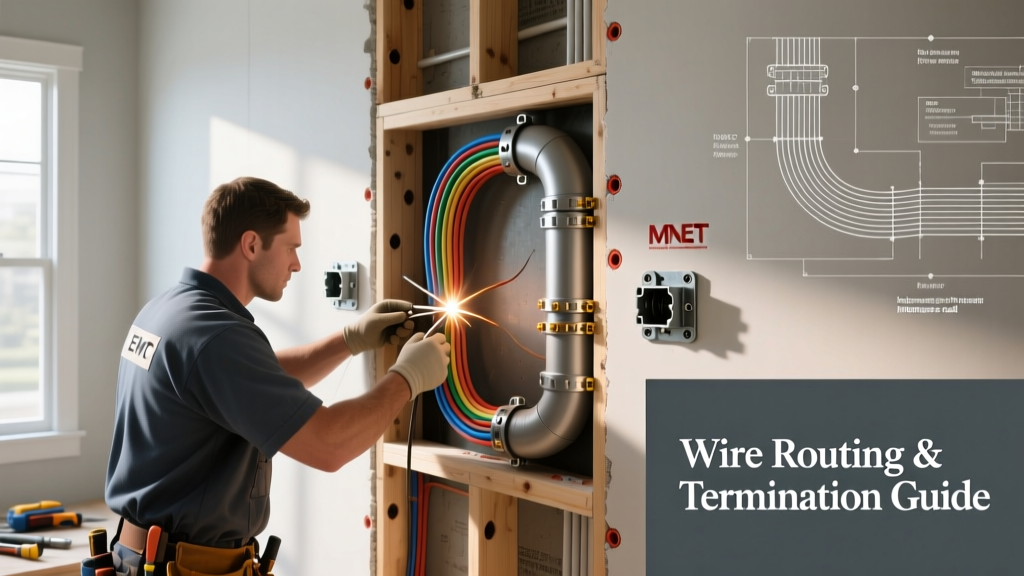
Routing MC cable through 25-gauge or 20-gauge steel studs requires precision to avoid damaging the cable armor or the wire insulation. Follow this exact sequence for commercial rough-ins:
- Layout and Punching: Mark the center of the stud cavity. Use a Greenlee 7238ST stud punch to create a clean 3/4" or 1" hole. Avoid using drill bits, which leave jagged metal burrs that will slice the MC cable armor during the pull.
- Install Protective Grommets: If the knockout is not perfectly smooth, snap in a plastic or metal stud grommet. This is a mandatory requirement under NEC 300.4(B)(1) to protect cables from abrasion against metal edges.
- Apply Pulling Lubricant: For runs exceeding 30 feet or involving more than two 90-degree bends, apply a water-based cable pulling compound (e.g., Klein Tools 53711) to the exterior of the MC armor to reduce friction against the steel studs.
- Maintain Bend Radius: As you pull and secure the cable to the studs with metal MC straps, ensure you do not kink the armor. NEC 330.24 strictly mandates that the bend radius of the inner edge of the cable must not be less than 7 times the external diameter of the MC cable.
- Terminate with Anti-Short Bushings: When cutting the armor back to terminate at the junction box, insert the required red plastic anti-short bushing ("redhead") between the armor and the conductors to prevent the sharp corrugated metal edge from cutting into the THHN insulation over time.
Common Failure Modes and Edge Cases
Even experienced commercial electricians encounter edge cases when managing electrical wiring in walls. Here are the most common failure modes to avoid:
1. Thermal Insulation Compression: In exterior commercial walls, fiberglass batt insulation is compressed behind the MC cable, creating a thermal bridge and reducing the R-value. Solution: Run MC cable through pre-slit insulation or use rigid foam board insulation where code permits, keeping the cable tight to the stud face.
2. Inductive Heating in Ferrous Metals: If you are feeding a 277V single-phase circuit and a separate neutral through different holes in a steel stud, the alternating magnetic field will induce eddy currents in the steel, causing the stud to heat up. Solution: Always keep all circuit conductors (phase, neutral, and ground) within the same MC cable or the same conduit to cancel out the magnetic fields, per NEC 300.3(B).
3. Vibration Loosening Fittings: Commercial walls adjacent to heavy machinery or elevator shafts are subject to constant micro-vibrations. Standard set-screw MC fittings can loosen over time, compromising the ground path. Solution: Use compression-type MC fittings or apply a torque-seal compound to set-screws in high-vibration zones.
FAQ: Commercial Wall Wiring
Can I use PVC conduit inside a commercial wood-framed wall?
Schedule 40 PVC (NEC Article 352) is permitted inside walls of Type V (wood-frame) commercial construction, provided the building does not exceed the height restrictions that mandate non-combustible wiring methods. However, PVC is rarely used in concealed commercial walls because it lacks the physical crush resistance of EMT and requires solvent welding inside tight stud bays, which is a fire hazard and labor bottleneck.
How do I support MC cable inside a vertical commercial wall?
NEC 330.30 requires MC cable to be secured at regular intervals not exceeding 6 feet, and within 12 inches of every junction box or fitting. In commercial metal stud walls, electricians use spring-loaded metal MC cable straps or self-tapping strap screws driven directly into the stud webbing. Zip ties are strictly prohibited for supporting MC cable unless they are specifically listed for the purpose and used in a horizontal tray system.
What are the OSHA requirements for commercial wall wiring safety?
During the rough-in phase, OSHA electrical safety standards mandate that all energized conductors inside open wall cavities must be properly terminated or capped. Exposed 277V or 480V pigtails left dangling in commercial wall cavities during multi-trade construction phases pose a severe electrocution hazard to drywallers and HVAC technicians. Always use proper wire nuts or Wago push-in connectors and fold them safely into the back of the box.