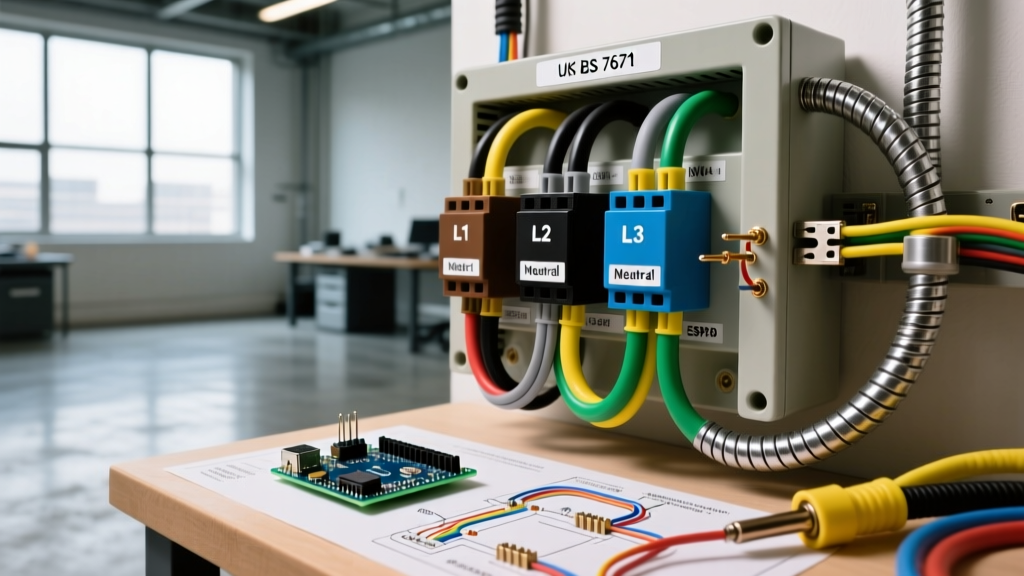

The Critical Importance of Colour Coding in Commercial Installations
In the high-stakes environment of commercial electrical contracting, misidentifying a single conductor can lead to catastrophic equipment failure, arc flash incidents, or fatal electric shocks. Understanding electrical wiring UK colours is not merely a matter of memorising a chart; it is a fundamental life-safety protocol governed strictly by BS 7671 (The IET Wiring Regulations, 18th Edition, Amendment 2:2022). While domestic electricians primarily deal with single-phase 230V ring and radial circuits, commercial electricians must navigate complex 3-phase 400V distribution networks, heavy-duty Steel Wire Armoured (SWA) cables, and intricate control panels.
This comprehensive guide details the exact colour standards for commercial environments, addresses the severe risks of legacy mixed-colour installations, and provides actionable protocols for safe isolation and termination in modern UK commercial facilities.
The Harmonisation Shift: Why Commercial Electricians Must Know Both Eras
In 2004, the UK adopted the European IEC 60446 standard to harmonise cable colours across the continent. The transition period officially ended in 2006. However, the commercial sector faces a unique challenge: industrial estates, retail parks, and heritage commercial buildings constructed before 2006 still contain vast amounts of legacy wiring. According to the Health and Safety Executive (HSE), working on older commercial infrastructure requires extreme vigilance, as old and new colour codes frequently coexist within the same distribution board or cable tray.
Commercial contractors must be fluent in both the pre-2006 and post-2006 colour palettes. Failing to recognise that a black core in a pre-2006 3-phase cable is a Neutral, whereas a black core in a post-2006 cable is Phase 2 (L2), is a common and deadly edge case in commercial fault-finding.
3-Phase Electrical Wiring UK Colours: The Modern BS 7671 Standard
Modern commercial power distribution relies on 3-phase alternating current to efficiently run heavy machinery, HVAC systems, and commercial lifts. Under the current harmonised standards, the core colours for 3-phase and neutral conductors are strictly defined.
| Function | Designation | Modern Colour (Post-2006) | Legacy Colour (Pre-2006) |
|---|---|---|---|
| Phase 1 | L1 | Brown | Red |
| Phase 2 | L2 | Black | Yellow |
| Phase 3 | L3 | Grey | Blue |
| Neutral | N | Blue | Black |
| Protective Earth | PE | Green & Yellow | Green (or bare copper) |
Note: Single-phase commercial circuits derived from a 3-phase board will typically utilise Brown (Line), Blue (Neutral), and Green/Yellow (Earth).
Navigating Mixed-Colour Distribution Boards (The Commercial Edge Case)
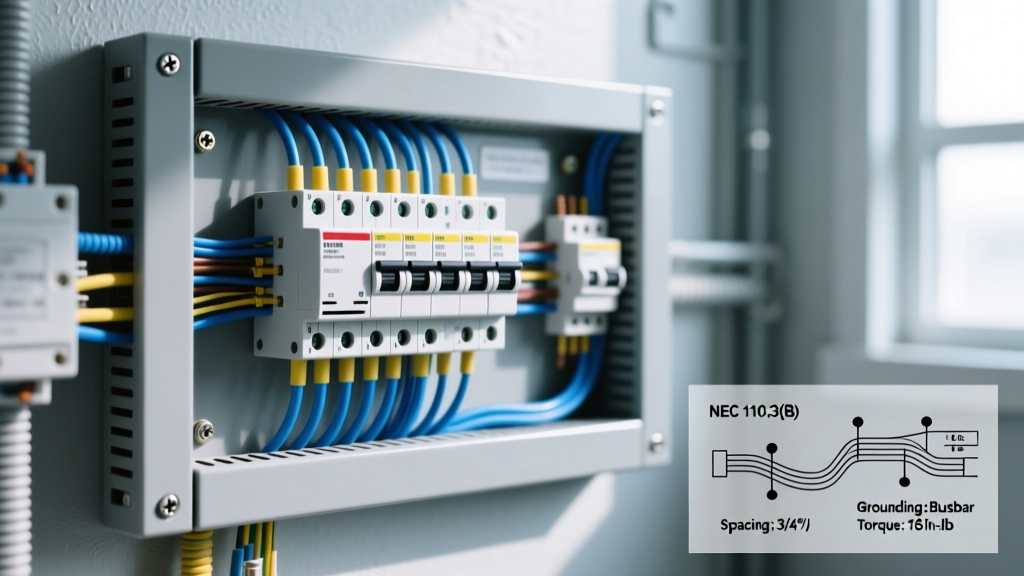
The most hazardous scenario a commercial electrician will encounter is a legacy Distribution Board (DB) that has been incrementally expanded over two decades. It is entirely common to open a 32-way TP&N (Triple Pole and Neutral) board and find a mixture of old Red/Yellow/Blue phases alongside new Brown/Black/Grey phases.
BS 7671 Regulation 514.11.1 Requirement:
Where a mixture of old and new cable colours exists within an installation or distribution board, a prominent warning notice must be permanently fixed at or near the distribution board. The label must state: "CAUTION: This installation has wiring colours to two standards. Great care should be taken before undertaking extension, alteration or repair that all conductors are correctly identified."
Step-by-Step Protocol for Mixed-Colour DB Identification
When extending or fault-finding in a mixed-colour commercial DB, never assume the installer followed the rules. Follow this strict identification protocol:
- Visual Trace: Trace the incoming supply tails back to the main switch or meter. Identify the standard the incoming supply uses.
- Sleeving Verification: Check if legacy cables have been correctly marked with modern sleeving at the terminations. If a legacy Red phase has been sleeved Brown, verify this with a voltage tester before trusting the sleeve.
- Phase Rotation Check: Use a phase rotation meter (e.g., Fluke 9040) at the outgoing ways to confirm L1, L2, and L3 sequencing, especially if the board has been modified by multiple contractors over the years.
- Live Testing: Use a CAT IV 1000V rated voltage indicator to prove the presence and absence of voltage on individual ways before touching any busbar or terminal.
Commercial Cable Types and Outer Sheath Colour Coding
In commercial wiring, the outer sheath colour is just as critical as the internal core colours. The sheath indicates the cable's fire-performance characteristics, which is vital for compliance with BS 7671 Chapter 52 regarding escape routes and public spaces.
SWA (Steel Wire Armoured) and MICC (Pyro)
For underground feeds to outbuildings or mechanical plant rooms, contractors typically use Prysmian GenCab SWA (XLPE insulated, PVC sheathed). The standard outer sheath is black PVC. However, if this cable is routed through a designated commercial fire escape route, standard PVC is illegal due to toxic smoke emission.
In these zones, you must specify LSZH (Low Smoke Zero Halogen) SWA cables. LSZH outer sheaths are typically coloured orange or white to provide immediate visual identification for building inspectors and fire safety officers. Similarly, MICC (Mineral Insulated Copper Clad) cables, often used for life-safety circuits like fire alarms and emergency lighting, feature a bare copper sheath or a white LSZH outer coating, relying entirely on coloured identification sleeves at the termination glands to denote phase and neutral.
DC and Control Circuit Wiring Colours in Commercial Automation
Commercial facilities heavily utilise Building Management Systems (BMS) and industrial automation. Control panels operating on DC voltages follow a different standard, primarily governed by BS EN 60204-1 (Safety of machinery - Electrical equipment of machines).
- Black: DC power circuits (e.g., 24V or 48V main supply).
- Blue: DC control circuits (e.g., PLC inputs/outputs, relay coils).
- Red: Interlock control circuits (derived from a separate power source).
- White (or Grey): Data, network, and low-voltage signal cables (e.g., RS-485, Modbus, BACnet).
Mixing AC power (Brown/Blue) and DC control (Black/Blue) in the same trunking without physical separation or metallic dividers is a direct violation of BS 7671 segregation rules and will cause severe electromagnetic interference (EMI) in commercial BMS networks.
Earthing and Bonding: Beyond the Green and Yellow
While the internal earth core of a standard commercial flex or SWA cable is Green/Yellow, commercial earthing and bonding conductors take various forms. In a TN-S system (common in older commercial sites with their own supply transformer), the earth may be the metallic armour of the SWA cable itself, or a separate bare copper tape. In modern TN-C-S (PME) systems, the earth is derived from the neutral at the intake.
When installing supplementary or protective bonding conductors (e.g., bonding commercial steel structural frameworks or metallic water mains), the conductor must be sleeved Green/Yellow at every point of connection and termination, even if the cable used is a standard single-core black or green legacy cable. For commercial earthing, a minimum of 10mm² or 16mm² green/yellow earth cable is typically required for main protective bonding, depending on the size of the incoming supply tails and the specific earthing arrangement.
Safe Isolation and Verification in 3-Phase Environments
Working on commercial 3-phase systems requires rigorous safe isolation procedures. The Electrical Safety First organisation mandates that no commercial electrical work should commence without a proven dead circuit. Because 3-phase systems carry 400V between phases, standard domestic CAT III testers are insufficient.
The Commercial Safe Isolation Checklist
- Identify: Locate the correct isolator for the specific circuit or DB. Do not rely on faded or hand-written labels on legacy commercial boards.
- Isolate and Lock Off: Switch off the isolator and apply a physical padlock. Retain the key. Place a 'Danger: Do Not Operate' warning tag.
- Select Approved Tester: Use a dedicated voltage indicator and proving unit (e.g., Fluke T6-1000 or Martindale VIPD1). Never use a standard multimeter for proving dead in high-energy commercial environments.
- Prove the Tester: Test the indicator on the proving unit to ensure it is functioning.
- Test the Circuit: Test between all phases (L1-L2, L2-L3, L1-L3), all phases to Neutral, and all phases to Earth. A 3-pole voltage indicator is highly recommended for simultaneous phase testing.
- Re-Prove the Tester: Test the indicator on the proving unit again to confirm the tester did not fail during the isolation check.
Cost Implications of Upgrading Legacy Commercial Wiring
For commercial facility managers, deciding whether to adapt a mixed-colour legacy system or entirely replace it is a major financial consideration. As of 2026, upgrading a commercial 32-way TP&N distribution board (such as a Hager Sentry or Chint equivalent) to include modern RCBO protection and re-terminating mixed SWA cables typically costs between £2,800 and £4,500 per board, depending on site access, working hours (often restricted to nights/weekends in retail environments), and the condition of the incoming supply tails. While the upfront cost is significant, it eliminates the severe liability and downtime risks associated with misidentified electrical wiring UK colours in legacy commercial infrastructure.