
Executing a commercial retail buildout requires a fundamental shift in how you approach infrastructure. Unlike residential projects that rely on single-phase power and non-metallic (NM) sheathed cables, commercial electrical and wiring systems demand three-phase power management, rigid metal raceways, and strict adherence to advanced safety codes. Whether you are wiring a 5,000-square-foot boutique or a 20,000-square-foot big-box store, understanding the nuances of commercial load distribution, harmonic mitigation, and modern lighting controls is critical for a safe, code-compliant, and future-proof installation.
Core Differences: Commercial vs. Residential Wiring
The most immediate difference in commercial electrical and wiring is the power supply and the physical protection of the conductors. Residential wiring typically utilizes 120/240V single-phase, three-wire systems. Commercial spaces, however, are predominantly fed by three-phase, four-wire wye systems—most commonly 208Y/120V for standard retail spaces or 480Y/277V for larger industrial or big-box retail environments.
Furthermore, the National Electrical Code (NEC) heavily restricts the use of NM-B (Romex) cable in commercial construction. Under NEC Article 334.10, NM cable is generally prohibited in commercial spaces that exceed specific height or fire-resistance thresholds, necessitating the use of individual conductors (like THHN/THWN-2) pulled through metallic raceways or the use of Metal-Clad (MC) cable.
Three-Phase Power and the Harmonic Neutral Problem
When designing commercial electrical and wiring layouts, electricians must account for non-linear loads. Modern retail spaces are saturated with LED lighting drivers, variable frequency drives (VFDs) for HVAC, and point-of-sale (POS) switching power supplies. These non-linear loads generate triplen harmonics (3rd, 9th, 15th).
Expert Insight: In a 3-phase, 4-wire wye system, triplen harmonics do not cancel out on the neutral bus. Instead, they accumulate. If your retail space has heavy non-linear loads, the neutral conductor can carry more current than the phase conductors, leading to catastrophic overheating and potential fires. Always specify panelboards with a 200% rated neutral busbar for commercial lighting and receptacle panels.
Conductor Derating for Harmonics
According to NEC 310.15(C)(1), when harmonic loads are present, the neutral conductor must be counted as a current-carrying conductor for the purpose of applying derating factors. If you are pulling four current-carrying conductors in a single conduit, you must apply an 80% adjustment factor to the ampacity of your THHN wires.
Panelboard Selection and Load Calculation
Commercial load calculations fall under NEC Article 220. Unlike residential calculations that use general VA per square foot estimations, commercial calculations require precise tracking of continuous vs. non-continuous loads, motor loads, and HVAC requirements. For a standard retail buildout, you will typically specify either a lighting and appliance panelboard or a distribution panelboard.
| Brand / Series | Type | Main Bus Rating | Est. Cost (USD) | Best Application |
|---|---|---|---|---|
| Square D NF | Lighting & Appliance | 225A - 600A | $1,800 - $3,500 | Retail receptacles, 120V/208V POS systems |
| Eaton PRL | Distribution | 400A - 800A | $3,200 - $6,500 | Main distribution, heavy HVAC feeders |
| Siemens P1 | Lighting & Appliance | 225A - 400A | $1,500 - $2,800 | Small retail footprints, quick-turn builds |
Raceway Systems: EMT vs. MC Cable vs. Rigid
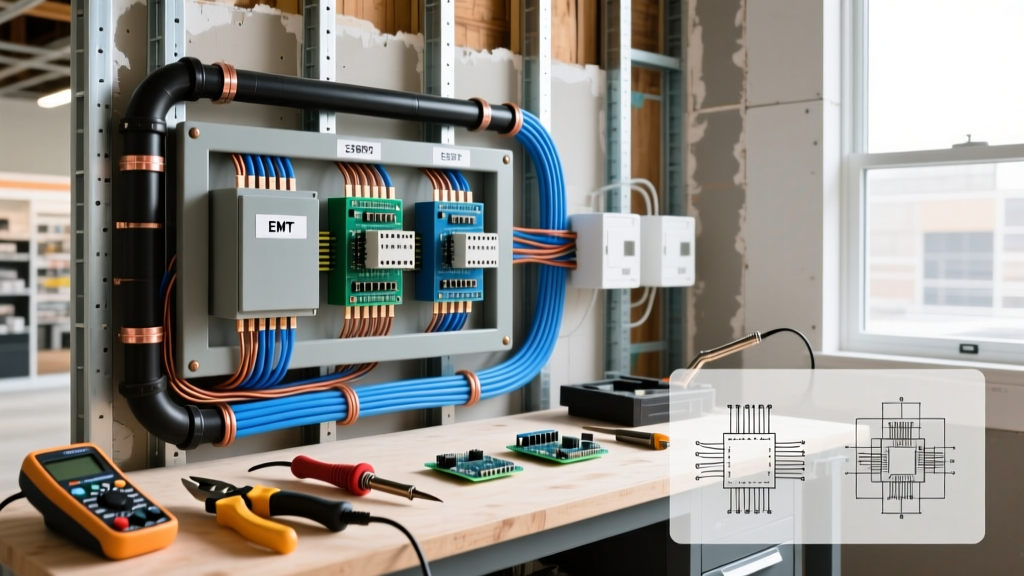
Selecting the correct raceway is a defining characteristic of commercial electrical and wiring projects. The choice impacts material costs, labor hours, and electromagnetic interference (EMI) shielding.
Raceway Comparison Matrix
| Raceway Type | Material Cost (per 100ft) | Labor Intensity | Primary Use Case |
|---|---|---|---|
| 3/4' EMT (Electrical Metallic Tubing) | $85 - $120 | High (requires bending/threading) | Exposed ceiling runs, commercial walls |
| 12/3 MC (Metal-Clad) Cable | $280 - $350 | Low (pull and strap) | Drop ceilings, quick-turn tenant finish |
| 1' RMC (Rigid Metal Conduit) | $450 - $600 | Very High (threaded fittings) | Physical protection, underground sweeps |
Pro-Tip for EMT Routing: When bending 3/4-inch EMT for retail storefronts, maintain a minimum bending radius of 4 inches (NEC Chapter 9, Table 2). Using a mechanical bender rather than a hand bender ensures the conduit does not crimp, which can damage the insulation of THHN/THWN-2 wires during the pull.
Code Compliance: NEC Mandates for Commercial Spaces
Staying compliant with the National Fire Protection Association (NFPA) standards is non-negotiable. Recent NEC cycles have drastically expanded ground-fault circuit-interrupter (GFCI) and arc-fault circuit-interrupter (AFCI) requirements in commercial settings.
- GFCI Expansion (NEC 210.8(B)): All 15- and 20-ampere, 125-volt through 250-volt receptacles supplied by single-phase branch circuits in commercial kitchens, rooftops, and outdoor retail areas now require GFCI protection. This includes hardwired equipment connected via a receptacle.
- Assured Equipment Grounding Conductor Program (AEGCP): For temporary commercial wiring during the buildout phase, OSHA regulations mandate either GFCI protection or a rigorous AEGCP with daily visual inspections and quarterly continuity testing.
- Plenum-Rated Cables: If your wiring runs through the environmental air-handling space (a drop ceiling used as a return air plenum), NEC Article 300.22 requires you to use plenum-rated (CMP) communication cables or plenum-rated MC cable. Standard PVC-jacketed MC cable will fail inspection and poses a severe toxic smoke hazard.
Advanced Lighting Controls: 0-10V and PoE Integration
Modern commercial electrical and wiring extends beyond simply delivering line voltage to a fixture. Energy codes (like ASHRAE 90.1) require advanced dimming and occupancy controls. According to the U.S. Department of Energy, optimized commercial lighting controls can reduce lighting energy consumption by up to 40%.
0-10V Dimming Infrastructure
For standard commercial LED troffers and high-bay fixtures, 0-10V dimming remains the industry standard. This requires pulling two additional low-voltage control wires (typically purple for +10VDC and gray for ground/return) alongside your standard 277V line and neutral. Crucial Edge Case: Never run 0-10V control wires in the same conduit as 480V or 277V power conductors unless the control wires are rated for the maximum voltage present in the raceway (e.g., 600V rated THHN). Otherwise, use a physical barrier or separate conduits to prevent induced voltage and signal degradation.
Power over Ethernet (PoE) Lighting
Looking ahead, PoE lighting is disrupting commercial wiring. By utilizing Category 6A cabling, a single network switch can deliver both data and up to 90W of DC power (via IEEE 802.3bt Type 4) to LED fixtures. While the upfront material cost for Cat6A and PoE switches is 20-30% higher than traditional AC wiring, the elimination of conduit, line-voltage wire, and dedicated lighting contactors significantly reduces electrical labor costs and allows IT teams to manage lighting layouts dynamically.
Frequently Asked Questions (FAQ)
What is the acceptable voltage drop limit for commercial branch circuits?
While the NEC provides recommendations rather than strict mandates for voltage drop, Informational Note No. 4 in NEC 210.19 recommends a maximum of 3% voltage drop for the farthest outlet on a branch circuit, and a maximum of 5% total for the feeder and branch circuit combined. For a 208V circuit, a 3% drop equates to a maximum loss of 6.24 volts. Always upsize your wire gauge (e.g., moving from 12 AWG to 10 AWG) for runs exceeding 100 feet to maintain equipment efficiency and prevent motor burnout.
Can I use aluminum wire for commercial branch circuits?
Aluminum conductors (like XHHW-2) are highly cost-effective and widely used for commercial feeders and service entrance conductors (typically 2 AWG and larger). However, for standard 15A and 20A branch circuits powering receptacles and lighting, copper (THHN/THWN-2) is the strict industry standard. Aluminum's higher coefficient of thermal expansion can lead to loose connections and arcing at standard 120V receptacle terminals over time.
How do I handle grounding in a commercial metal building?
In commercial steel-framed buildings, the structural steel can serve as a grounding electrode system (NEC 250.52(A)(2)) if it is effectively bonded to the earth and meets specific thickness and length requirements. However, you must still run a dedicated Equipment Grounding Conductor (EGC) inside your conduit or MC cable to ground your panelboards and equipment. Do not rely solely on the metal studs or building steel as the fault-current return path for branch circuits.