
The Unique Electrical Environment of Basements
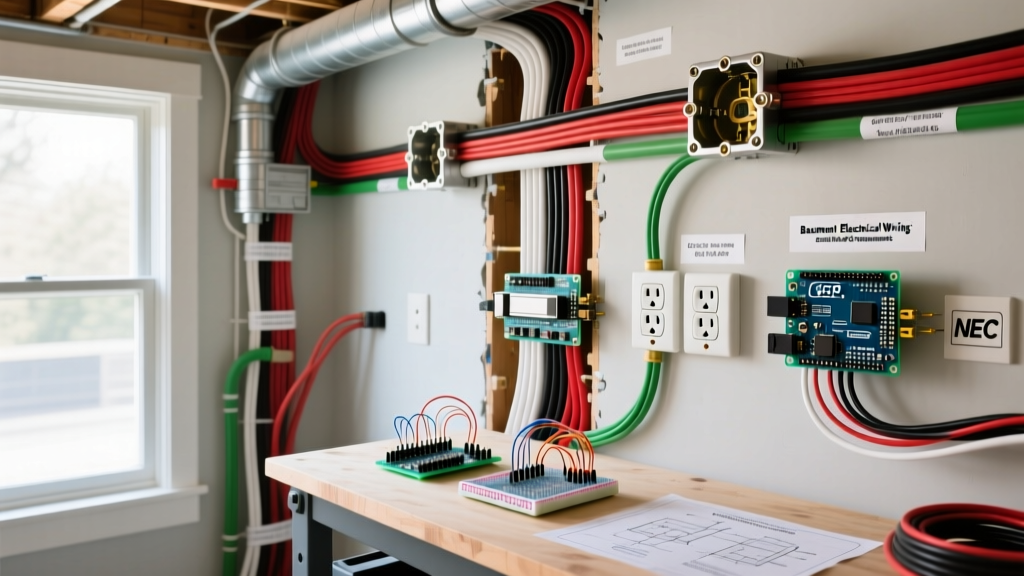
Basement electrical wiring presents a distinct set of challenges not found in the rest of the home. Unlike above-grade floors, basements are inherently prone to moisture ingress, temperature fluctuations, and physical hazards from exposed joists and concrete walls. Because of these factors, the National Electrical Code (NEC) treats basements as a specialized environment, enforcing strict mandates on ground fault protection, cable routing, and arc fault mitigation.
Whether you are finishing a subterranean family room or simply adding dedicated circuits to an unfinished utility space, understanding the intersection of NEC Article 210 (Branch Circuits) and Article 334 (Nonmetallic-Sheathed Cable) is critical. This guide breaks down the exact code requirements, material specifications, and real-world edge cases you need to know to ensure your underground installation is safe, legal, and built to last.
GFCI Mandates: Navigating NEC Article 210.8
The most heavily enforced rule in basement electrical wiring is Ground-Fault Circuit Interrupter (GFCI) protection. According to ESFI guidelines and NEC Article 210.8(A)(5), all 125-volt, single-phase, 15- and 20-ampere receptacles installed in basements must have GFCI protection. This is because concrete floors and masonry walls are highly conductive when damp, creating a severe shock hazard if a tool or appliance faults to ground.
The Sump Pump Dilemma and Code Workarounds
Historically, electricians used a standard receptacle on a dedicated circuit for sump pumps to prevent a nuisance GFCI trip from flooding the basement. However, recent NEC cycles have largely eliminated the GFCI exception for basement sump pump receptacles. If a sump pump is plugged into a standard 120V receptacle, that receptacle must be GFCI protected.
The Expert Solution: To prevent catastrophic flooding from a tripped GFCI, professionals use one of two methods:
- Hardwiring the Pump: By wiring the sump pump directly into a junction box (eliminating the receptacle entirely), you bypass the NEC 210.8 receptacle rule. Note that local AHJs (Authority Having Jurisdiction) may still require motor-specific GFCI protection under NEC Article 430, but this avoids standard receptacle nuisance tripping.
- Alarm-Equipped GFCIs: If a receptacle is required, install a device like the Leviton GFWT2 SmartlockPro. This GFCI receptacle features a built-in audible alarm that sounds if the GFCI trips, alerting the homeowner to the loss of power before the pit overflows. Expect to pay around $35 to $45 per unit for alarm-equipped models.
AFCI Requirements for Finished Basement Spaces
While GFCI protects against shock, Arc-Fault Circuit Interrupter (AFCI) protection prevents electrical fires. Under NEC Article 210.12, AFCI protection is mandatory for all 120V, 15A and 20A branch circuits supplying outlets in finished basement areas designated as family rooms, recreation rooms, bedrooms, or home theaters.
In a finished basement, cables are often routed through metal or wood studs and hidden behind drywall. A drywall screw accidentally nicking the insulation of a 12/2 NM-B cable can create a parallel arc fault—a high-heat plasma discharge that standard breakers will not detect. Dual-function breakers (CAFCI/GFCI) are the standard here. A Square D Homeline 20A Dual Function CAFCI/GFCI breaker typically costs between $48 and $55 and provides both layers of protection at the panel, eliminating the need for expensive dual-function wall receptacles.
Cable Routing and Physical Protection (NEC 334.15)
In unfinished basements, the physical routing of Nonmetallic-Sheathed Cable (NM-B, commonly known as Romex) is a frequent point of failure during municipal inspections. NEC 334.15(C) explicitly dictates how exposed cables must be secured to prevent physical damage from storage items, ladders, or HVAC contractors.
Inspector's Note: Running 12/2 or 14/2 NM-B cable directly across the bottom face of floor joists (stapled to the narrow edge) in an unfinished basement is a direct NEC violation. Cables must be protected from below.
Compliant Routing Methods for Unfinished Joist Bays
- Bored Holes: The safest and most common method. Drill 3/4-inch holes through the center of the joists (maintaining the 1.25-inch nail-plate setback rule from the edges per NEC 300.4) and pull the cable through.
- Running Boards: If you must run cables perpendicular to the joists, you can staple them to the side of a 1x3 or 1x4 wooden running board that is securely fastened across the joists.
- Side-Stapling (Parallel Runs): Cables running parallel to the joists must be stapled to the side of the joist, not the bottom edge. They must be secured at least 1.25 inches back from the face of the framing to prevent drywall or paneling screws from piercing the wire later.
- Conduit Sleeves: For vertical drops down concrete block walls to receptacles, NM-B must be protected by conduit (typically 3/4-inch EMT or PVC) from the ceiling joists down to the receptacle box to prevent physical abrasion against the masonry.
NEC Quick-Reference Matrix for Basement Wiring
| NEC Article | Requirement | Application | Common DIY Pitfall |
|---|---|---|---|
| 210.8(A)(5) | GFCI Protection | All 15A/20A 125V basement receptacles | Omitting GFCI on utility sink or sump pump receptacles. |
| 210.12(B) | AFCI Protection | Finished living spaces, bedrooms, theaters | Using standard breakers for a finished basement rec room. |
| 334.15(C) | Exposed Cable Protection | Unfinished joist bays and ceiling spaces | Stapling 12/2 Romex to the bottom edge of floor joists. |
| 210.70(A)(2) | Stairway Lighting | Basement staircases with 6+ risers | Installing only a single-pole switch at the top of the stairs. |
| 300.4(A)(1) | Nail Plate Protection | Cables bored through wood studs/joists | Failing to install steel nail plates when holes are <1.25" from the edge. |
Lighting, Stairways, and Egress Compliance
Lighting in basements is governed by NEC 210.70, which requires at least one lighting outlet controlled by a wall switch in every habitable room. For basement stairways, the code is highly specific: if the staircase has six or more risers, you must install three-way switches at both the top and bottom of the stairs. Relying on a pull-chain light at the base of the stairs is a severe safety hazard and an automatic inspection failure.
Furthermore, if your basement remodel includes a bedroom or a primary egress path, you must integrate hardwired smoke and carbon monoxide detectors. Per NFPA 72 and NEC Article 760, these devices must be on a dedicated 15A or 20A lighting circuit, interconnected so that if one alarm triggers, they all sound. Battery-only detectors are not code-compliant for new construction or major remodels.
Material Costs and Breaker Selection (2026 Pricing)
When budgeting for a basement wiring project, material costs have stabilized but remain higher than pre-2020 averages. Here is what you should expect to pay for code-compliant materials:
- 12/2 NM-B Cable (250 ft spool): $135 - $160. (Always use 12 AWG for 20A circuits; 14 AWG is increasingly rejected by inspectors for general basement utility circuits due to voltage drop concerns over long runs).
- 3/4-Inch EMT Conduit (10 ft stick): $2.80 - $3.50. Essential for protecting vertical wire drops against block walls.
- Dual Function (CAFCI/GFCI) 20A Breaker: $48 - $58. Brands like Square D (QO or Homeline) and Eaton (BR series) dominate the market.
- Weather-Resistant (WR) Receptacles: If your basement has a walk-out door or a damp utility sink area, NEC 406.9 requires WR-rated receptacles with in-use covers, costing about $8 - $12 each.
For a comprehensive overview of residential electrical safety standards and updates, refer to the NFPA Electrical Safety Hub and the official NFPA 70 (NEC) Code Directory.
Frequently Asked Questions
Can I use UF-B cable instead of NM-B in an unfinished basement?
Yes, Underground Feeder (UF-B) cable is rated for damp and wet locations, making it highly resistant to basement moisture. However, UF-B is significantly more expensive than NM-B, stiffer to work with, and still requires the same physical protection (conduit or bored holes) from physical damage under NEC 339.3. Most electricians reserve UF-B for outdoor burial and stick to NM-B for interior basement joist bays.
Do I need a permit to wire my basement?
Absolutely. In nearly all municipalities, adding new circuits, extending existing ones, or finishing a basement requires an electrical permit and a rough-in/final inspection. Unpermitted basement wiring can result in denied insurance claims in the event of a fire and will severely complicate future real estate transactions.
How many receptacles can I put on a single 20A basement circuit?
The NEC does not specify a hard limit on the number of receptacles on a standard residential 15A or 20A circuit. However, professional electricians follow the rule of thumb of 8 to 10 receptacles per 20A circuit to prevent voltage drop and nuisance tripping. For heavy-draw areas like basement workshops, dedicate individual 20A circuits to specific high-amperage tools.