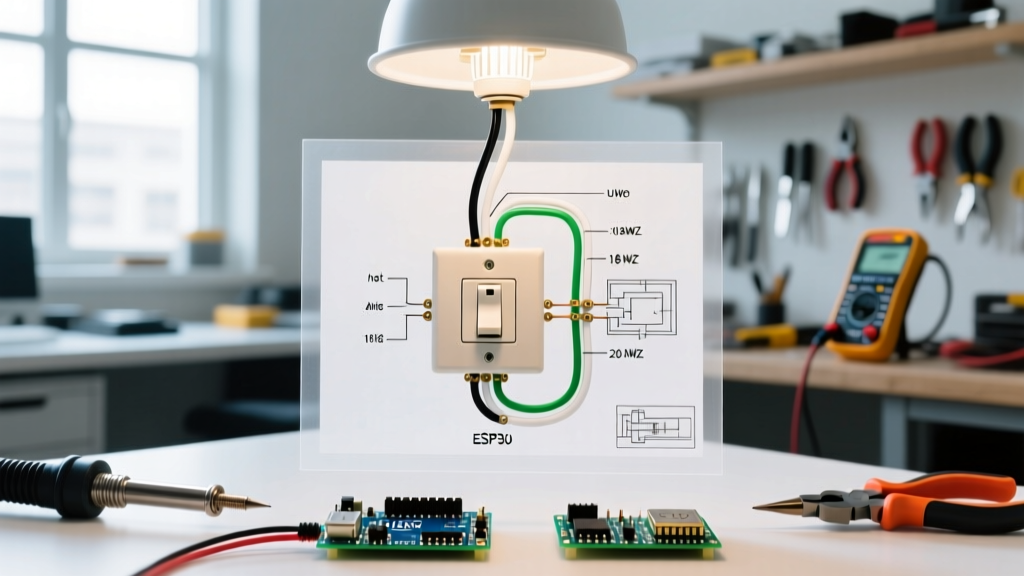

The Great Misconception: Series vs. Parallel Receptacles
When DIYers and homeowners search for a wiring diagram for outlets in series, they are almost always looking for instructions on how to wire multiple receptacles on a single circuit breaker. However, from an electrical engineering and National Electrical Code (NEC) perspective, wiring standard 120V AC residential outlets in a true "series" circuit is a catastrophic misunderstanding of electrical theory. In a true series circuit—like vintage Christmas tree lights—the electrical current must pass through every single device sequentially. If one outlet fails or a single wire disconnects, the entire downstream circuit dies. Furthermore, the voltage would divide across the loads, meaning a 120V circuit with four identical loads would only deliver roughly 30V to each outlet, causing severe malfunction and potential fire hazards.
Expert Warning: True series wiring for branch-circuit receptacles is a direct violation of NEC Article 210 and poses an extreme fire and shock hazard. Residential outlets must always be wired in parallel. The physical routing method you are actually looking for is called daisy-chaining.
What You Actually Need: The Parallel Daisy-Chain Method
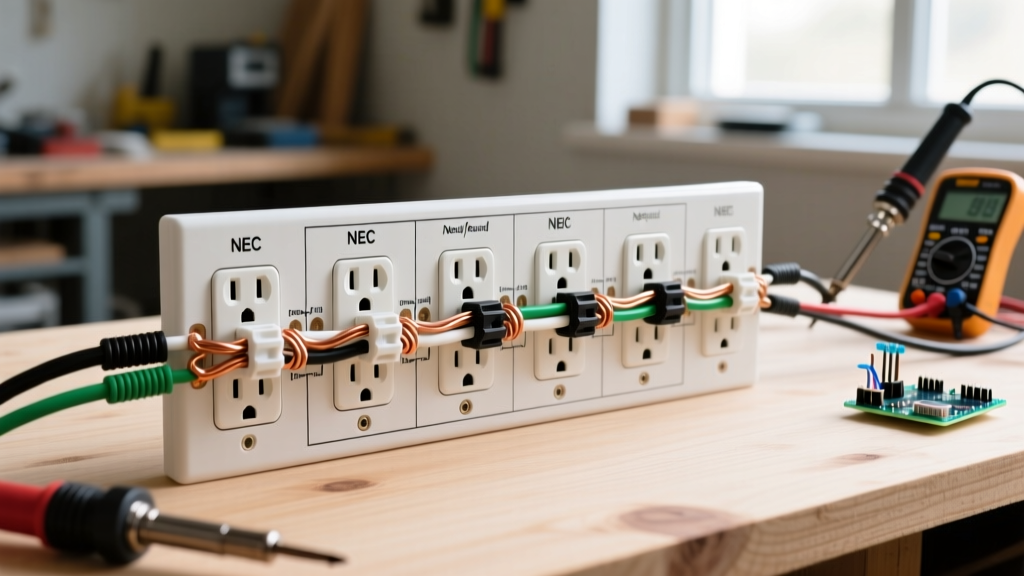
When electricians wire multiple outlets in a single room, they use a parallel daisy-chain topology. Power originates at the electrical panel, travels to the first outlet, and then a second cable carries the parallel power from the first outlet to the second, and so on. Electrically, every hot wire connects to the same 120V potential, and every neutral wire connects to the same 0V return path. This ensures that every receptacle receives a full 120V, regardless of how many devices are plugged in downstream, and if one receptacle is removed, the others can remain operational (provided you use the correct pigtailing technique).
The GFCI Nuance: Series Protection on Parallel Power
There is one specific scenario where a "series" concept applies to modern receptacle wiring: Ground Fault Circuit Interrupter (GFCI) protection. When you wire a GFCI outlet (such as the Leviton GFTA2-W), it features LINE and LOAD terminals. By connecting downstream standard outlets to the LOAD terminals, you create a series monitoring path. The electrical power remains in parallel, but the GFCI's internal sensor monitors the cumulative current imbalance of the entire downstream chain. If a ground fault occurs at the third outlet in the chain, the first GFCI trips, cutting power to all downstream devices. This is a critical safety feature mandated by recent NEC updates for kitchens, bathrooms, and garages.
2026 Material & Component Matrix
Selecting the correct wire gauge and breaker size is the foundation of a safe daisy-chain circuit. As of 2026, copper prices have stabilized, but material selection remains strictly governed by ampacity rules. Below is the definitive matrix for residential outlet circuits.
| Circuit Breaker | Wire Gauge (NM-B) | Receptacle Rating | Max Practical Outlets | Est. 2026 Material Cost |
|---|---|---|---|---|
| 15 Amp | 14 AWG | 15A TR Duplex | 8 to 10 | $0.42 / linear ft |
| 20 Amp | 12 AWG | 15A or 20A TR Duplex | 10 to 13 | $0.58 / linear ft |
Note: The NEC does not specify a hard limit on the number of outlets on a standard residential 15A or 20A breaker. The limits above are based on the standard residential load calculation of 1 Amp per receptacle yoke to prevent nuisance tripping during simultaneous high-draw usage.
Step-by-Step Installation: Pigtailing vs. Pass-Through
There are two ways to physically connect the incoming and outgoing wires at a daisy-chained outlet. While "pass-through" (using the outlet's internal brass bridge) is faster, pigtailing is the professional standard and highly recommended for 2026 DIY builds.
Why Pigtailing is Superior
If you use the receptacle's side screws to connect both the incoming and outgoing wires (pass-through), the entire downstream circuit relies on the internal brass strip of that single $2 outlet. If the outlet melts, fails, or is removed for painting, every outlet downstream loses power—and worse, a loose neutral connection can cause a multi-wire branch circuit to send 240V through 120V appliances, destroying them instantly. Pigtailing bypasses this risk.
- Strip the Cables: Strip 5/8 inch of insulation from the incoming and outgoing black (hot) and white (neutral) wires using a precision wire stripper like the Klein Tools 11063W.
- Prepare the Pigtails: Cut 6-inch lengths of 14 AWG (for 15A) or 12 AWG (for 20A) solid copper wire. Strip 3/4 inch off one end of each pigtail.
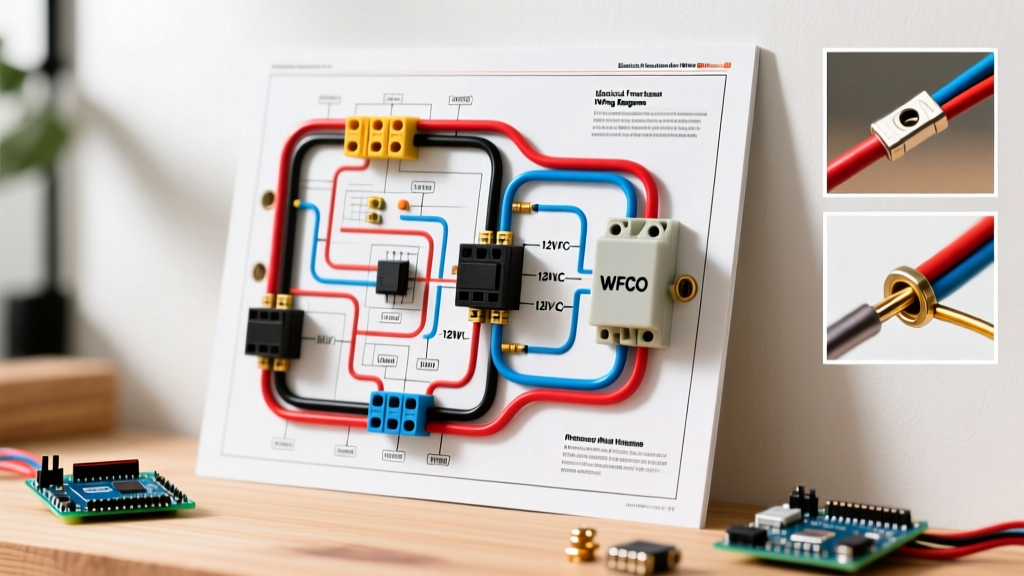
- Join the Wires: Group the incoming hot, outgoing hot, and the black pigtail together. Secure them using a Wago 221 Lever Nut (rated for 20A-40A) or an Ideal Yellow WireNut. Repeat for the white neutral wires.
- Ground the Box and Device: Connect all bare copper grounds, a pigtail to the metal electrical box (if applicable), and a pigtail to the outlet's green ground screw.
- Terminate and Torque: Connect the black pigtail to the brass screw and the white pigtail to the silver screw. NEC Article 110.14(D) requires terminals to be tightened to manufacturer specifications. For a standard Leviton 15A receptacle, this requires roughly 14 in-lbs of torque.
Critical NEC Code Requirements (2023/2026 Editions)
Ignoring the National Electrical Code doesn't just risk a failed inspection; it risks your home's safety. When planning your daisy-chain layout, you must adhere to the following mandates outlined by the National Fire Protection Association (NFPA).
Box Fill Calculations (Article 314)
Every electrical box has a maximum cubic inch capacity. Overcrowding a box with daisy-chain wires causes heat buildup and damaged insulation. According to NEC Article 314.16(B), you must calculate the "box fill." For 14 AWG wire, each conductor counts as 2.0 cubic inches. For 12 AWG, each counts as 2.25 cubic inches. All grounds combined count as a single conductor. A standard single-gang "old work" box holds 18 cubic inches. If you are daisy-chaining 12 AWG wire (incoming hot/neutral/ground + outgoing hot/neutral/ground + device pigtails), you are utilizing roughly 15.75 cubic inches of space, which barely fits an 18 cu. in. box. Expert Tip: Always use 22 cubic inch deep single-gang boxes for daisy-chained 12 AWG circuits to ensure safe heat dissipation and easy wire folding.
AFCI and GFCI Mandates
Under current NEC guidelines, virtually all 15A and 20A 125V receptacles in living areas, bedrooms, and hallways require Arc Fault Circuit Interrupter (AFCI) protection, while wet locations require GFCI. You can achieve this by installing an AFCI/GFCI dual-function breaker at the panel, allowing you to use standard, cheaper TR (Tamper Resistant) receptacles for the entire daisy-chain run.
Troubleshooting Downstream Failures
The most common issue in a daisy-chained circuit is a "dead" downstream outlet. If Outlet 1 works but Outlet 2 does not, the failure is almost never a broken wire inside the wall. According to safety data compiled by the U.S. Consumer Product Safety Commission (CPSC), the vast majority of residential electrical fires and failures stem from loose terminal connections.
- The "Backstab" Failure: If the previous homeowner or DIYer used the push-in "backstab" holes on the back of the receptacle instead of the side screws, the internal spring tension weakens over time due to thermal expansion and contraction. The downstream neutral connection often fails first. Solution: Never use backstabs. Always use side-screw terminals or pigtails.
- Drywall Screw Puncture: If the cable was run too close to the face of the stud, a drywall screw may have pierced the NM-B sheathing, severing the hot or neutral conductor. Use a non-contact voltage tracer to locate the break inside the wall.
- Tripped GFCI Upstream: Always check bathrooms, garages, and exterior walls. A single tripped GFCI outlet at the beginning of the daisy-chain will cut power to all standard outlets wired to its LOAD terminals.
Final Thoughts on Branch Circuit Design
While the terminology "wiring diagram for outlets in series" is technically incorrect for AC branch circuits, understanding the parallel daisy-chain topology is essential for any safe home wiring project. By utilizing pigtails, Wago lever connectors, deep junction boxes, and strict adherence to torque specifications, you ensure your circuit will safely handle modern electrical loads for decades. For further reading on residential electrical safety and load management, consult the U.S. Department of Energy's Home Electrical Systems Guide before beginning any panel or branch circuit modifications.