
Understanding NuTone Multi-Function Electrical Requirements
When upgrading your bathroom ventilation, finding the correct wiring diagram for NuTone bathroom fan units is critical, especially for multi-function models that combine exhaust, lighting, and heating. Unlike basic single-speed exhaust fans that require a simple 14/2 NM-B cable and a 15-amp breaker, NuTone's premium multi-function units—such as the popular QT9093WH (Fan/Light/Heater/Nightlight) or the 744NT (Fan/Light with Humidity Sensor)—demand precise circuit planning, proper wire gauge selection, and dedicated switch legs.
Misinterpreting the manufacturer's schematic is the leading cause of tripped breakers, melted wire insulation, and failed smart switch integrations. Below, we break down the electrical architecture required to safely wire these units in compliance with the latest 2026 National Electrical Code (NEC) standards.
Model-Specific Electrical Specifications
Before pulling any wire through your ceiling joists, you must match your circuit breaker and Romex (NM-B) cable to the specific NuTone model you are installing. The heating element drastically changes the electrical load.
| NuTone Model | Functions | Max Wattage / Amperage | Min. Circuit Breaker | Required Wire Gauge |
|---|---|---|---|---|
| 682NT | Fan Only | 35W / 0.3A | 15 Amp | 14/2 NM-B |
| 744NT | Fan + Light + Humidity Sensor | 120W / 1.0A | 15 Amp | 14/2 NM-B |
| QT9093WH | Fan + Light + Heater + Nightlight | 1580W / 13.2A | 20 Amp (Dedicated Recommended) | 12/2 NM-B (or 12/3 to switch) |
| 9093WH | Fan + Light + Heater | 1530W / 12.8A | 20 Amp | 12/2 NM-B |
Decoding the Wiring Diagram for NuTone Bathroom Fan Units
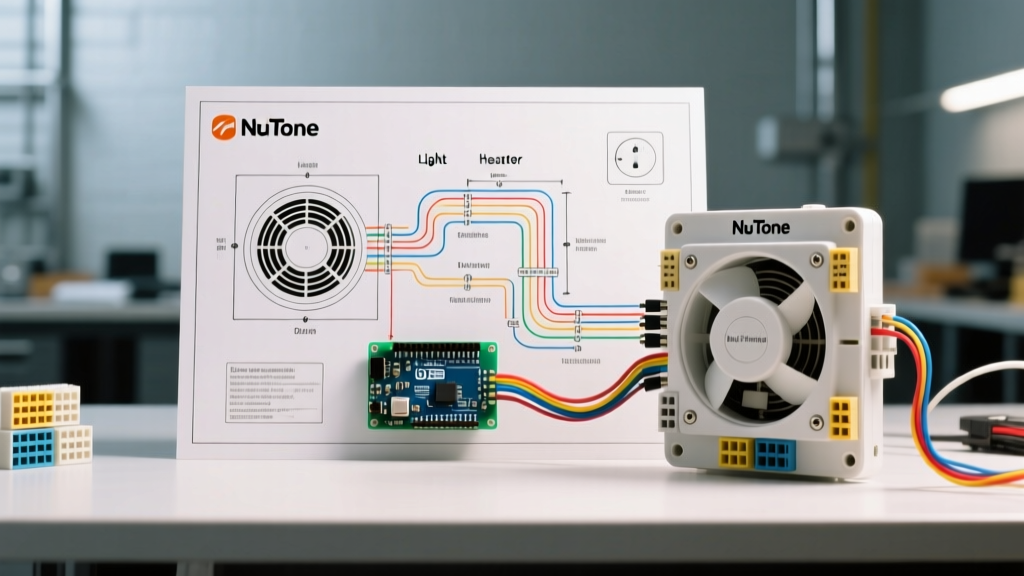
For the purpose of this tutorial, we will focus on the most complex and common scenario: wiring a NuTone QT9093WH heater/fan/light combo. This unit requires a continuous hot feed, a shared neutral, a ground, and three separate switch legs to independently control the fan, the main light, and the heater. The nightlight is typically wired to remain on continuously or tied to the main light circuit.
1. Power Supply and Cable Routing
You have two primary routing options when executing this wiring diagram. The choice depends on whether power enters the wall switch box first or the ceiling fan housing first.
- Power at the Switch (Most Common): A 12/2 NM-B cable brings 120V power from the panel to the wall switch box. From the switch box, you must run a 12/4 NM-B cable (or two separate 12/2 cables) up to the NuTone fan housing. The 12/4 cable contains one continuous hot (black), one shared neutral (white), one ground (bare), and three color-coded switch legs (typically red, blue, and yellow) to carry power back up to the individual fan, light, and heater terminals.
- Power at the Fan Housing: A 12/2 NM-B cable brings power directly to the ceiling unit. You must then run a 12/4 NM-B cable down to the wall switch. In this scenario, the black wire sends constant power down to the switch, and the red, blue, and yellow wires act as 'switch legs' returning power to the respective components in the ceiling.
2. The Wall Switch Configuration (Broan-NuTone 66W vs. Standard)
NuTone highly recommends using their proprietary Broan-NuTone 66W 3-Function Rocker Switch for multi-function units. This switch is designed specifically to fit into a single-gang box while controlling three separate loads.
- Line In: Connect the hot wire from your breaker panel to the black 'LINE' screw on the 66W switch.
- Switch Legs Out: Connect the red, blue, and yellow wires to the three brass 'LOAD' screws. It does not matter which color goes to which brass screw, as long as you map them correctly at the ceiling unit.
- Neutral Bypass: The standard 66W mechanical switch does not require a neutral wire at the switch box. Simply cap the white neutral wire in the switch box and send it straight through to the fan housing.
Expert Tip: If you are using standard single-pole switches in a 3-gang box instead of the 66W, you must pigtail the incoming hot black wire to all three switches. You will still need to run three separate switch legs up to the ceiling housing.
3. Terminating at the NuTone Fan Housing
Inside the QT9093WH housing, you will find a junction box with clearly labeled wire nuts or terminal blocks. Strip exactly 1/2 inch of insulation from your 12 AWG solid copper wires.
- White (Neutral): Connect the incoming white neutral to the bundled white wires from the fan, light, and heater. Use a large red or tan wire nut rated for four or more 12 AWG wires.
- Bare (Ground): Connect the incoming bare copper to the green ground screw on the housing and the bare wire from the unit's internal harness.
- Red/Blue/Yellow (Switch Legs): Connect your incoming switch legs to the corresponding colored wires inside the NuTone harness (e.g., Red to Heater, Blue to Light, Yellow to Fan). Consult the specific schematic taped inside your unit's junction box cover, as color codes can vary slightly by manufacturing year.
Smart Switch Integration: Adjusting the Diagram
As of 2026, many homeowners are replacing mechanical switches with smart relays (like the Lutron Caseta or Leviton Decora Smart). This fundamentally alters the wiring diagram. Smart switches require a neutral wire at the switch box to power their internal Wi-Fi/Zigbee radios.
If you are installing smart switches, you must run a 12/4 NM-B cable (or 14/4 for non-heater models) between the switch box and the fan housing, even if power originates at the switch. The white wire in this cable will serve as the neutral for the smart switch, while the black serves as the Line, and the remaining colors serve as the Load switch legs. Failing to provide a neutral at the switch box will result in smart switches that flicker, fail to connect, or backfeed voltage through the LED light bulbs.
Common Wiring Failures and Edge Cases
Even experienced DIYers make mistakes when interpreting the wiring diagram for NuTone bathroom fan combinations. Here are the most frequent failure modes and how to resolve them:
1. The 'Shared Neutral' GFCI Trip
The Symptom: The bathroom exhaust fan works fine, but the moment you turn on the NuTone heater, the GFCI receptacle on the bathroom wall trips.
The Cause: The installer mistakenly tied the fan/heater's neutral wire into the load-side neutral of the bathroom's GFCI receptacle circuit. According to NEC Article 210.11, bathroom receptacles must be on a 20-amp circuit. However, a 1500W heater draws 12.5 amps. If a hairdryer (12 amps) is running on the GFCI receptacle and the heater kicks on, the combined 24.5 amps will instantly trip the 20-amp GFCI breaker.
The Fix: The NuTone heater/fan must have its own dedicated 20-amp circuit, or at the very least, its neutral must be tied only to the non-GFCI lighting branch circuit neutral, completely isolated from the receptacle's GFCI load terminals.
2. Undersized Wiring on Heater Circuits
The Symptom: The heater works, but the wall switch feels warm to the touch, or the 15-amp breaker trips intermittently.
The Cause: Using 14 AWG wire and a 15-amp breaker for a 1500W heater. While 1500W technically equals 12.5 amps (which is under the 15A limit), the NEC classifies fixed electric heating equipment as a continuous load in some interpretations, and motor startup surges from the fan can push the combined amperage over the 80% continuous load rule (12 amps max on a 15A breaker).
The Fix: Always use 12/2 NM-B and a 20-amp breaker for any NuTone unit containing a heating element. For authoritative guidance on branch circuit sizing for heating equipment, refer to the National Fire Protection Association's NEC guidelines, specifically Article 424.
3. Nightlight Backfeed
The Symptom: The nightlight stays on even when the main light switch is off, or the main light glows dimly when only the nightlight is on.
The Cause: Induced voltage or improper splicing of the blue (main light) and red (nightlight) wires inside the housing. If you are using LED bulbs, they are highly sensitive to micro-voltages. If the nightlight circuit is wired without a proper isolated hot, capacitive coupling between the parallel wires in the 12/4 cable can cause LED ghosting.
The Fix: Ensure the nightlight is wired to a dedicated switch leg or a constant hot, and consider installing an incandescent bulb in the nightlight socket to act as a resistive load sink, or use a smart switch with a built-in bypass resistor.
NEC Code Compliance and Safety Standards
When executing any bathroom wiring project, adherence to the National Electrical Code is non-negotiable for safety and insurance purposes. The U.S. Consumer Product Safety Commission (CPSC) heavily emphasizes the dangers of mixing water and electricity, mandating strict separation of ventilation and receptacle circuits.
- Exhaust Routing (NEC 150.31 & Building Codes): The NuTone fan must exhaust directly to the outdoors via rigid metal or approved flexible ducting. Venting into an attic space is a severe code violation that leads to mold and structural rot.
- Damp Locations (NEC 410.10): If your NuTone fan/light is installed directly over a shower or bathtub enclosure, it must be GFCI protected and explicitly rated for 'Damp Locations' by UL (Underwriters Laboratories). Check the sticker inside your specific NuTone housing; not all models are shower-rated.
- Box Fill Calculations (NEC 314.16): When wiring the wall switch box, ensure the cubic inch capacity of the box can handle the volume of wires. A 3-gang box with a 12/4 cable and multiple pigtails requires a deep-profile box (minimum 24 cubic inches) to prevent crushing the wire insulation when screwing the switches into place.
For the most accurate and model-specific schematics, always cross-reference this guide with the official documentation provided by the manufacturer. You can download exact PDF schematics and replacement part lists from the Broan-NuTone official support portal.
Frequently Asked Questions
Can I wire the NuTone heater and fan to the same switch?
Technically, yes, by splicing the heater and fan switch legs together at the wall switch. However, this is highly discouraged. It forces the heater and fan to turn on simultaneously, preventing you from using the fan independently for ventilation during warmer months, and it concentrates a massive electrical load onto a single switch mechanism, increasing the risk of contact arcing.
Do I need an electrician to install a NuTone QT9093WH?
If you already have a dedicated 20-amp circuit and a 3-gang switch box with a neutral wire, a competent DIYer can handle the wiring. However, if you need to pull a new 20-amp circuit from your main panel or upgrade your switch boxes, hiring a licensed electrician is strongly recommended to ensure compliance with local 2026 permitting and inspection codes.