
The Gap Between Diagram Symbols and Physical Wire
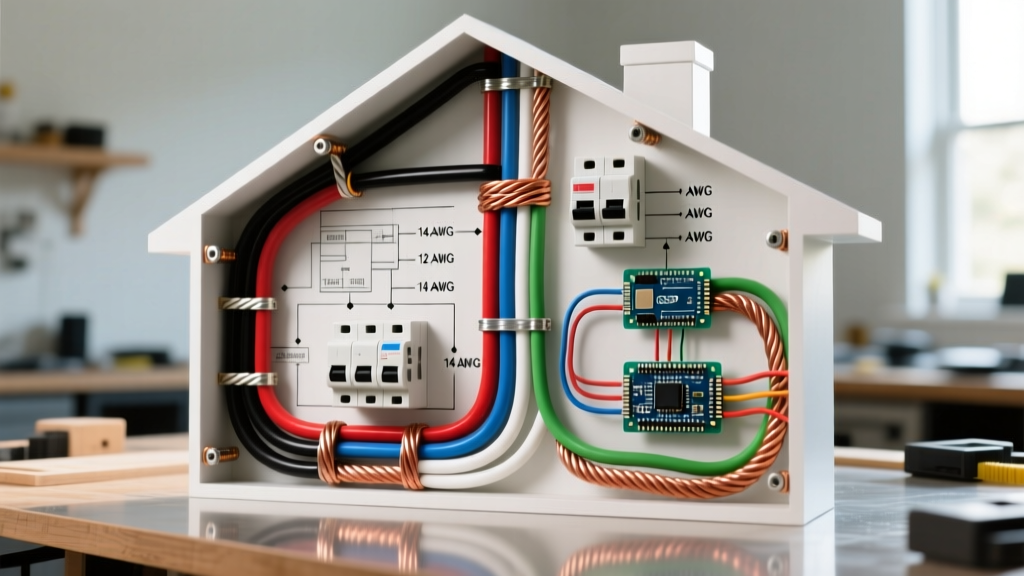
When reviewing electrical house wiring diagrams, it is easy to focus solely on the routing logic—where the hot wire travels from the breaker to the switch, and how the neutral returns to the panel. However, a schematic is only a conceptual map. The physical execution requires a strict translation of those single lines into specific American Wire Gauge (AWG) sizes and National Electrical Code (NEC) compliant color codes. In 2026, with copper prices stabilizing but AFCI/GFCI requirements expanding under the latest NEC cycles, misinterpreting a diagram's implied gauge or misidentifying a wire's insulation color in the field remains a leading cause of failed inspections and thermal hazards.
This reference guide bridges the gap between theoretical electrical house wiring diagrams and the physical realities of residential rough-ins, focusing on exact gauge selections, ampacity limits, and standardized color coding.
Wire Gauge (AWG) and Ampacity Matrix for 2026
Electrical house wiring diagrams rarely specify the exact AWG; instead, they label circuits by their intended amperage (e.g., '20A Small Appliance' or '30A Dryer'). Translating this to physical wire requires understanding the 60°C and 75°C temperature columns in NEC Table 310.16. For standard residential Non-Metallic Sheathed Cable (NM-B), the ampacity is generally limited to the 60°C column, regardless of the wire's actual thermal rating.
| AWG Size | 60°C Ampacity (Copper) | Max Standard Breaker | Typical 2026 Cost (250ft Spool) | Primary Residential Application |
|---|---|---|---|---|
| 14 AWG | 15 Amps | 15A | $75 - $88 | Lighting circuits, bathroom exhaust fans |
| 12 AWG | 20 Amps | 20A | $95 - $118 | Kitchen/dining receptacles, laundry, HVAC |
| 10 AWG | 30 Amps | 30A | $145 - $170 | Electric dryers, window AC units, water heaters |
| 8 AWG | 40 Amps | 40A | $230 - $265 | Electric ranges, large subpanels, hot tubs |
| 6 AWG | 55 Amps | 60A (with 75°C term) | $360 - $425 | Main subpanel feeds, EV Level 2 chargers |
Real-World Failure Modes: Voltage Drop and Thermal Runaway
A common mistake when following electrical house wiring diagrams for detached structures (like sheds or garages) is ignoring voltage drop. The NEC recommends a maximum 3% voltage drop on branch circuits. If your diagram calls for a 20A circuit to a shed 120 feet away, standard 12 AWG copper will experience a voltage drop of roughly 4.1%. Actionable fix: Upsize to 10 AWG for the run, then pigtail to 12 AWG at the receptacle, ensuring the 20A breaker still protects the 10 AWG wire safely.
Expert Insight: Never rely on the 'next size up' breaker rule (NEC 240.4(B)) to compensate for voltage drop. Upsizing the breaker without upsizing the wire creates a severe fire hazard, as the thermal limits of the NM-B insulation will be exceeded before the breaker trips.
NEC-Compliant Wire Color Codes (Insulation Level)
While diagrams use solid lines, dashed lines, or specific alphanumeric labels (like 'W' for white, 'B' for black) to denote conductors, the physical wire must strictly adhere to NEC Article 200 and 250. Miswiring a neutral as a hot, or using a hot wire as a neutral (without proper re-identification) is an immediate inspection failure.
- Black, Red, Blue (Ungrounded/Hot): These carry the current from the source to the load. In a standard 120V diagram, black is the primary hot. In 240V diagrams, black and red represent Line 1 and Line 2.
- White, Gray (Grounded/Neutral): The return path to the panel. NEC Article 200 mandates white or gray for the grounded conductor. Edge Case: If you are using a white wire in a switch loop as a hot feed, NEC 200.7(C) requires you to permanently re-identify it with black tape or paint at both terminations.
- Bare Copper, Green (Equipment Grounding Conductor - EGC): The safety path for fault currents. NEC 250.119 strictly prohibits using green or bare wire for anything other than grounding.
The Multi-Wire Branch Circuit (MWBC) Trap
Electrical house wiring diagrams for kitchens often utilize MWBCs to save conduit and cable space. An MWBC shares a single neutral (white) between two hot wires (black and red) on opposite phases (Line 1 and Line 2). If an electrician mistakenly places both the black and red breakers on the same phase in the panel, the shared neutral will carry the additive current (e.g., 20A + 20A = 40A) on a wire rated for only 20A, leading to insulation meltdown. Modern NEC requires a simultaneous disconnect (handle-tie or 2-pole breaker) for all ungrounded conductors in an MWBC to prevent this exact scenario.
Decoding NM-B Sheath Colors for Quick Identification
When pulling wire based on a diagram, you are rarely dealing with individual THHN conductors in residential retrofits; you are pulling Non-Metallic Sheathed Cable (NM-B), commonly known by the brand name Romex. Manufacturers like Southwire and Cerro Wire use standardized outer sheath colors to allow inspectors and electricians to instantly verify the gauge and ampacity without stripping the jacket. According to Southwire's technical documentation, the industry standard color-coding for NM-B is as follows:
| Sheath Color | Internal Gauge | Max Ampacity | Typical Diagram Label |
|---|---|---|---|
| White | 14/2 or 14/3 | 15A | LTG (Lighting), 15A REC |
| Yellow | 12/2 or 12/3 | 20A | REC (Receptacle), KITCH, BATH |
| Orange | 10/2 or 10/3 | 30A | DRY (Dryer), W/H (Water Heater) |
| Black | 8/2, 6/2, or larger | 40A - 60A | RNG (Range), SUB (Subpanel) |
Expert Tips for Translating Diagrams to the Panel
When you are at the panel executing the final terminations based on your electrical house wiring diagrams, keep these 2026 best practices in mind:
- Torque Specifications: The NEC now strictly requires the use of a calibrated torque screwdriver for all breaker and neutral bar terminations. A 12 AWG copper wire under a standard 15A/20A breaker typically requires 35 to 45 in-lbs of torque. Under-torquing causes arcing; over-torquing shears the copper strands, effectively reducing a 12 AWG wire to the capacity of a 14 AWG wire.
- Strip Length: Use the strip gauge molded into the side of the breaker. Stripping too much insulation leaves exposed copper outside the terminal (a shock hazard), while stripping too little results in the screw biting into the insulation, creating a high-resistance connection that will trigger thermal imaging anomalies during an inspection.
- Neutral and Ground Separation: In the main service panel, neutrals and grounds share the same bus bar (or are bonded). In any subpanel depicted on your diagram, the neutral bus must be isolated from the ground bus and the panel enclosure. Mixing these in a subpanel causes parallel neutral current to flow on the equipment grounding conductors, creating a severe shock hazard.
Frequently Asked Questions (FAQ)
Can I use 12 AWG wire on a 15 Amp breaker?
Yes. The NEC allows you to use a larger wire (lower AWG number) on a smaller breaker. In fact, using 12 AWG (yellow sheath) for 15A lighting circuits is a common professional practice to reduce voltage drop on long runs and future-proof the circuit. However, you cannot physically fit more than one 12 AWG wire under a standard 15A breaker lug; you must use a wire nut to pigtail down to a 14 AWG if making multiple connections.
Why do some diagrams show a white wire connected to a switch?
This indicates a 'switch loop.' In older wiring methods, a 2-wire cable was dropped from the ceiling fixture to the wall switch. The white wire was used to carry the hot feed down to the switch, and the black wire carried the switched hot back up to the light. Modern NEC requires the neutral to be present at the switch box to accommodate smart switches and timers, meaning new diagrams will typically show a 3-wire cable (14/3 or 12/3) dropping to the switch box.
Where can I find the most up-to-date NEC standards for wire ampacity?
The EC&M National Electrical Code resource center and the official NFPA 70 documentation are the definitive sources. Always verify your local jurisdiction's amendments, as some municipalities adopt the NEC with a 3-to-5-year delay or add local amendments regarding AFCI protection and wire gauge minimums.