
The Foundation of Perfect Electrical Panel Wiring
Achieving perfect electrical panel wiring goes far beyond making the interior of a load center look neat for an inspector. True perfection in panel dressing is about thermal management, fault-current withstand ratings, minimizing voltage drop, and strict adherence to the latest National Electrical Code (NEC) standards. Whether you are upgrading a 200A residential service or wiring a 400A commercial subpanel, the intersection of wire gauge selection, insulation type, and color coding dictates the longevity and safety of the entire electrical system.
2026 Code Update Note: With the widespread adoption of the 2023 NEC and early movements toward the 2026 cycle, enforcement of torque verification (110.14(D)) and strict neutral/ground separation in subpanels has intensified. Always verify local AHJ (Authority Having Jurisdiction) amendments before finalizing panel layouts.
Decoding Wire Gauges for Panel Circuits
The most common mistake in panel wiring is sizing the wire based on the 90°C column of the NEC ampacity tables simply because the insulation (like THHN) is rated for 90°C. According to NFPA 70 (National Electrical Code) Section 110.14(C), the ampacity of the wire must be based on the temperature rating of the terminations (the breaker lugs or bus bar stabs). Almost all standard residential and light commercial breakers (e.g., Square D QO, Siemens QP, Eaton BR) are rated for 75°C terminations. Therefore, you must use the 75°C column for final ampacity derating, using the 90°C column only for ambient temperature correction factors.
Standard Copper & Aluminum Ampacity Matrix (75°C Terminations)
Below is the definitive reference for sizing branch circuit and feeder wires in a standard panel environment. Data aligns with Cerro Wire Ampacity Tables and NEC Table 310.16.
| AWG / kcmil | Copper (75°C) | Aluminum (75°C) | Max Standard Breaker | Common Application |
|---|---|---|---|---|
| 14 AWG | 20A* | N/A | 15A | Lighting circuits (NEC 240.4(D) limits to 15A) |
| 12 AWG | 25A* | N/A | 20A | Standard receptacles, small appliances |
| 10 AWG | 35A | N/A | 30A | Dryers, water heaters, A/C disconnects |
| 8 AWG | 50A | 40A | 40A / 50A | Electric ranges, EV Level 2 chargers (40A) |
| 6 AWG | 65A | 50A | 60A | Subpanels, tankless water heaters |
| 4 AWG | 85A | 65A | 70A / 80A | Large subpanels, commercial HVAC |
| 3 AWG | 100A | 75A | 100A | Standard 100A subpanel feeders (Cu) |
| 2 AWG | 115A | 90A | 100A / 125A | 100A feeders (Al), 125A main breakers |
| 1/0 AWG | 150A | 120A | 125A / 150A | 150A residential services |
| 2/0 AWG | 175A | 135A | 150A / 175A | 150A feeders (Al), 200A services (Cu) |
| 4/0 AWG | 230A | 180A | 200A | Standard 200A residential main feeders (Al) |
*Note: While 14 AWG and 12 AWG copper have higher thermal ampacities, NEC 240.4(D) strictly limits their overcurrent protection to 15A and 20A respectively for small conductors.
Standard Color Codes: Beyond Black, White, and Bare
Consistent phase identification prevents catastrophic cross-phasing errors, especially when working with multi-wire branch circuits (MWBCs) or three-phase subpanels. The NEC mandates specific color coding for different voltage systems to ensure any electrician opening the panel in 2036 will instantly understand the circuit topology.
Ungrounded (Hot) Conductors
- 120/240V Single-Phase (Split-Phase): Black and Red. (If a third phase is present for a high-leg delta, the 208V wild leg must be Orange).
- 120/208V Three-Phase (Wye): Black, Red, Blue.
- 277/480V Three-Phase (Wye): Brown, Orange, Yellow. (Do not mix these with 208V systems).
Grounded (Neutral) and Grounding Conductors
- Grounded Neutral: Must be White or Gray. For larger feeders (4 AWG and larger) where re-identifying tape is permitted, white or gray tape must wrap completely around the insulation at every termination point.
- Equipment Grounding Conductor (EGC): Green, Green with Yellow Stripe, or Bare Copper/Aluminum. Never use green tape to re-identify a hot wire.
Insulation Selection: THHN vs. XHHW-2 for Panel Dressing
When pulling individual conductors into a panel, the choice of insulation drastically affects the physical layout and bending radius inside the wire gutters. While THHN/THWN-2 is the default for most branch circuits, XHHW-2 is the superior choice for perfect panel wiring, especially for feeders and large branch circuits.
Material and Physical Comparison
| Feature | THHN / THWN-2 | XHHW-2 |
|---|---|---|
| Insulation Material | PVC with Nylon outer jacket | Cross-Linked Polyethylene (XLPE) |
| Thickness / Diameter | Thicker (Nylon adds bulk) | Thinner (Tighter conduit fill) |
| Bending Radius | Stiffer, nylon resists tight bends | Highly flexible, easier to dress in gutters |
| Wet Location Rating | 75°C (THWN-2) | 90°C |
| 2026 Avg. Cost (500ft, 12 AWG) | $115 - $130 | $140 - $160 |
Pro Tip: The nylon jacket on THHN can be easily nicked when pulling through tight conduit sweeps or crowded panel knockouts, exposing the PVC underneath which degrades in wet environments. XHHW-2 lacks this nylon jacket, making it more resistant to abrasion during pulls and significantly easier to route neatly around breaker stabs.
Torque Specifications: The Hidden Requirement for Perfection
A panel can look flawless but still be a fire hazard if the lugs are not torqued to the manufacturer's specifications. Under-torquing leads to thermal creep (especially with aluminum feeders), where the wire expands and contracts under load, eventually loosening the connection and causing an arc fault. Over-torquing strips the threads on aluminum bus bars or snaps the screw heads off miniature breakers.
NEC 110.14(D) mandates the use of a calibrated torque tool for any termination marked with a torque value on equipment rated over 100A. However, for perfect wiring, professional electricians torque every single connection, including 15A and 20A branch breakers.
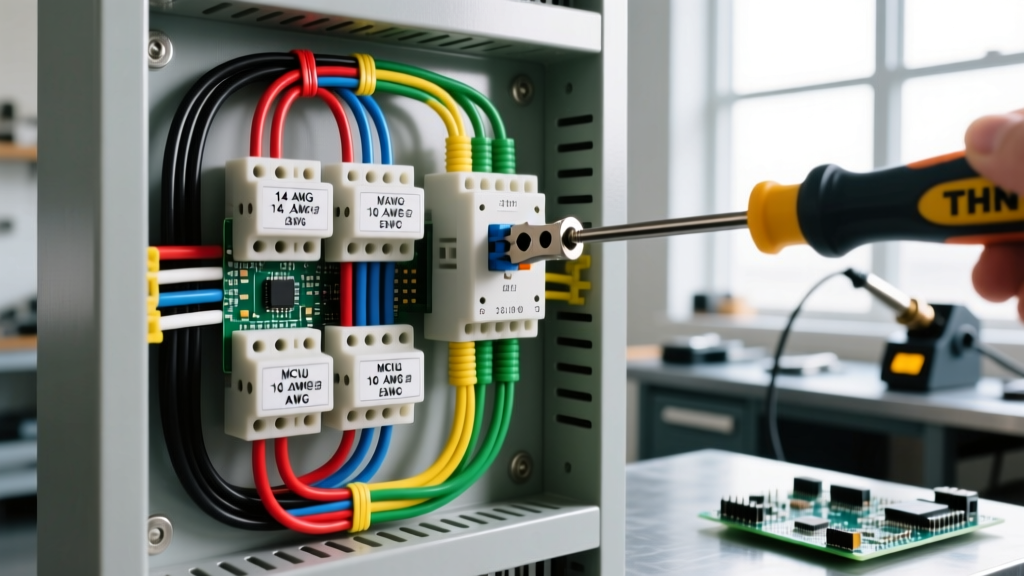
- 15A - 30A Breakers: Typically require 20 to 45 in-lbs. Use a torque screwdriver like the CDI 401SM or Klein Tools 32500 series.
- 40A - 100A Breakers: Typically require 50 to 75 in-lbs.
- Main Panel Lugs (2/0 to 4/0 Aluminum): Typically require 180 to 250 in-lbs. Use a calibrated torque wrench with a 1/4-inch drive adapter.
Always apply an antioxidant compound (like Noalox or Deox) to aluminum conductors before terminating them in the panel lugs to prevent galvanic corrosion and oxidation.
Common Failure Modes & Edge Cases in Panel Wiring
Even with the correct gauge and color code, specific installation errors compromise the system. Avoid these edge cases to ensure long-term reliability and compliance with OSHA Electrical Safety Standards and local fire codes.
1. The Floating Neutral on MWBCs
Multi-Wire Branch Circuits (sharing a neutral between two hot legs) must be tied together with an approved handle tie or a common-trip double-pole breaker. If the neutral is disconnected or loose while the circuits are energized, the 120V loads become a series circuit across 240V. The leg with the higher resistance will experience severe overvoltage, instantly destroying electronics and risking fire.
2. Insulation Scoring During Stripping
Using dull or improperly sized wire strippers (e.g., using the 10 AWG notch on a 12 AWG wire) scores the copper conductor. This creates a microscopic stress fracture that acts as a localized resistor. Under continuous 20A load, this nicked point will generate excessive heat, eventually melting the insulation inside the panel gutter. Always use self-adjusting strippers like the Klein 11055 or Knipex ErgoStrip for clean, unmarred cuts.
3. Violating Wire Bending Space (NEC 312.6)
Cramming too many wires into a single panel knockout or bending them too sharply against the bus bar violates the wire bending space requirements of NEC Table 312.6(A). If a wire is forced into a tight radius, the internal copper strands can separate, or the insulation can crack over time due to mechanical stress. Always use a conduit hub or pulling compound to manage large feeder bends, and leave adequate slack (usually 6 to 8 inches) inside the panel for future troubleshooting.
Frequently Asked Questions
Can I mix copper and aluminum wires in the same panel?
Yes, but they must never be mixed under the same lug or wire nut unless the connector is explicitly rated for CU/AL mixing (like the AlumiConn lug). For main feeders, aluminum (XHHW-2) is standard and cost-effective, while copper is typically used for branch circuits. Ensure the panel bus bar is rated for aluminum if using Al feeders.
Do I need to use colored tape on THHN wires?
For ungrounded (hot) conductors smaller than 4 AWG, the insulation itself must be the correct color (Black, Red, Blue, etc.). You cannot use white tape to re-identify a black wire as a neutral, nor can you use black tape to re-identify a white wire as a hot, except in specific switch loop scenarios outlined in NEC 200.7(C). For wires 4 AWG and larger, re-identifying with phase-colored tape at every termination is perfectly legal and standard practice.