
The 'Panel & Breaker' Approach to High-Current Car Audio
When building a high-output vehicle audio setup, treating the trunk like a residential breaker panel is the hallmark of a professional installation. A standard wiring diagram for car sound system configurations often glosses over overcurrent protection and power distribution. However, when your amplifiers demand 150A to 300A of continuous current, the main power wire essentially becomes a high-capacity feeder line. If unprotected or poorly distributed, it poses a severe fire risk and guarantees voltage drop that starves your amplifiers during heavy bass transients.
In this guide, we apply residential panel and breaker logic to 12V DC automotive environments. We will cover exact wire gauge calculations, magnetic vs. thermal circuit breakers, distribution block topologies, and the specific hardware you need to build a safe, competition-grade audio system in 2026.
High-Current Warning: Any car audio system drawing over 120A requires a dedicated power distribution architecture. Relying on a single inline fuse and daisy-chained amplifier terminals is a primary cause of thermal runaway and vehicle fires.
Core Wiring Diagram Flow: Battery to Amplifier
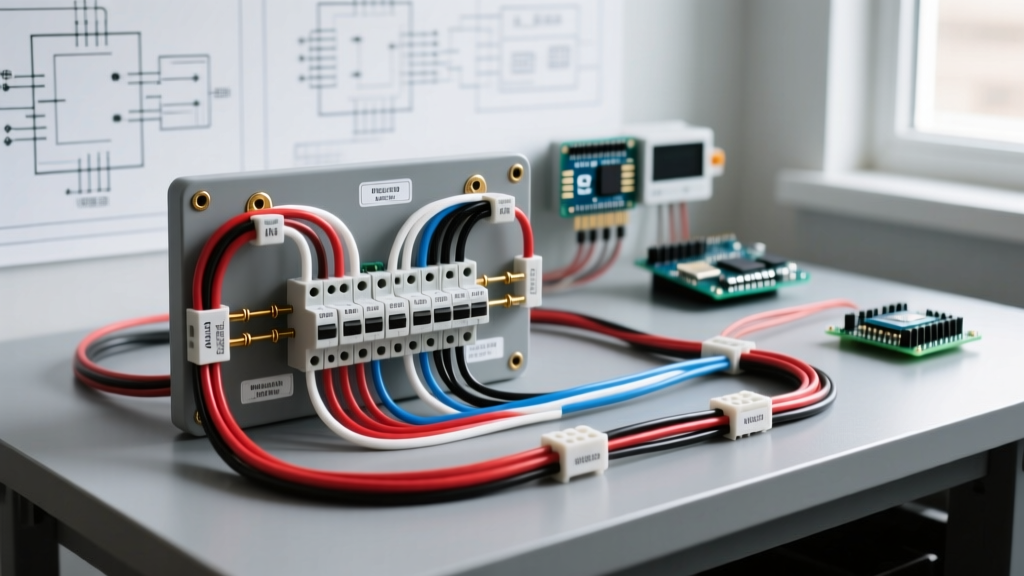
Instead of running multiple wires from the battery to each amplifier, a professional wiring diagram for car sound system utilizes a centralized distribution topology. Think of the battery as your utility drop, the main breaker as your service disconnect, and the distribution block as your sub-panel.
- The Source (Battery): Connect 1/0 AWG OFC (Oxygen-Free Copper) wire to the positive battery terminal using a military-spec lead-acid clamp or a dedicated busbar.
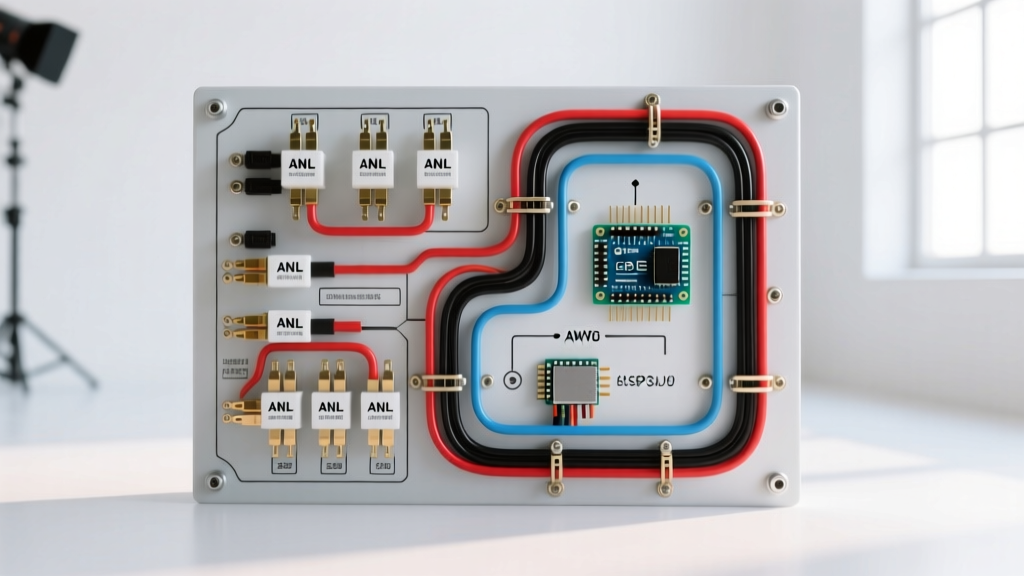
- Main Overcurrent Protection (The Service Disconnect): Within exactly 18 inches of the battery positive terminal, install a 200A Magnetic Hydraulic Circuit Breaker or a 250A ANL Fuse. This protects the main feeder wire in the event of a dead short to the chassis.
- The Firewall Pass-Through: Route the main feeder through an existing factory grommet or use a dedicated 1/0 AWG rubber firewall bulkhead connector. Never let bare wire touch sheet metal.
- The Sub-Panel (Distribution Block): Terminate the main feeder into a high-amperage distribution block (e.g., Stinger SPD52) mounted securely to the trunk floor or subwoofer enclosure.
- Branch Circuit Protection: From the distribution block, run appropriately gauged branch wires (e.g., 4 AWG) to each amplifier. Install secondary blade or AGU fuses within 12 inches of the distribution block output terminals.
- The Grounding Busbar: Instead of daisy-chaining grounds, route all amplifier ground wires to a centralized copper grounding busbar, which is then bolted to the chassis using a single, massive 1/0 AWG ground strap.
Wire Gauge & Overcurrent Protection Matrix
Selecting the correct wire gauge and corresponding fuse size is non-negotiable. According to Crutchfield's car audio learning center, undersized wire causes voltage drop, while oversized fuses defeat the purpose of circuit protection. The matrix below assumes a standard 14.4V system and a maximum acceptable voltage drop of 0.5V.
| Max Current Draw | Wire Gauge (OFC) | Wire Gauge (CCA) | Main Fuse / Breaker Size | Max Run Length (OFC) |
|---|---|---|---|---|
| Up to 60A | 8 AWG | 4 AWG | 70A ANL / Blade | 16 Feet |
| 61A - 100A | 4 AWG | 2 AWG | 120A ANL | 16 Feet |
| 101A - 150A | 2 AWG | 1/0 AWG | 175A ANL | 16 Feet |
| 151A - 200A | 1/0 AWG | 2/0 AWG | 225A ANL / Breaker | 16 Feet |
| 201A - 300A | 2/0 AWG | 4/0 AWG | 350A ANL / Breaker | 14 Feet |
Critical Note on CCA Wire: Copper-Clad Aluminum (CCA) wire has approximately 40% higher electrical resistance than OFC. If you use CCA wire to save money, you must step up one full gauge size to maintain the same current capacity and prevent voltage drop. For systems exceeding 150A, OFC is strictly recommended.
Component Selection: Breakers vs. Fuses in DC Automotive
When designing the 'breaker panel' for your vehicle, you must choose between fuses and circuit breakers for your main overcurrent protection. Both have distinct advantages and failure modes.
ANL Fuses
ANL fuses are the industry standard for high-current car audio. They offer high interrupting capacity (up to 10,000A at 32V DC) and are immune to ambient temperature fluctuations. However, they are single-use. If a dead short occurs, you must replace the fuse.
Circuit Breakers (Magnetic vs. Thermal)
Circuit breakers are resettable, making them ideal for troubleshooting. However, you must select the correct type:
- Thermal Breakers: These rely on a bimetallic strip that bends when heated by current. Avoid these in car audio. Trunks can reach 140°F (60°C) in the summer. This ambient heat causes thermal breakers to trip prematurely (nuisance tripping) even when the amplifier is drawing normal current.
- Magnetic Hydraulic Breakers: These use a fluid-filled dashpot and a magnetic coil to detect overcurrent. They are completely immune to ambient temperature changes. According to Blue Sea Systems support documentation, magnetic hydraulic breakers are the only reliable resettable overcurrent protection for high-amp DC environments.
Recommended 2026 Hardware Stack
To build a reliable distribution panel in your trunk, source these specific components:
- Main Breaker: Blue Sea Systems 185-Series 200A Magnetic Circuit Breaker (Part #7181). Retail: ~$48.00.
- Distribution Block: Stinger SPD52 1/0 AWG Block with removable covers. Retail: ~$65.00.
- Grounding Busbar: Blue Sea 2506 150A BusBar with 10 studs. Retail: ~$32.00.
- Main Feeder Wire: KnuKonceptz Kolossus Flex 1/0 AWG OFC. Retail: ~$14.00/ft.
- Crimping Tool: Titan TIT-TC12 Hex Crimper. Retail: ~$45.00. (Never use hammer crimpers; they deform the wire and create high-resistance hot spots).
Failure Modes & Troubleshooting
Even with a perfect wiring diagram for car sound system layouts, poor execution leads to specific failure modes. Here is how to diagnose them:
1. Thermal Runaway at Distribution Blocks
Symptom: The plastic housing of your distribution block melts, or the system cuts out during heavy bass hits. Cause: Loose set screws on the distribution block. High current flowing through a loose connection creates massive resistance, generating heat (I²R losses). Fix: Use a hex-crimped ring terminal instead of inserting bare wire into set-screw blocks. If using bare wire, torque the set screws to manufacturer specifications and re-torque them after 48 hours of use, as copper strands compress over time.
2. Alternator Whine and Ground Loops
Symptom: A high-pitched whine in the speakers that changes pitch with engine RPM. Cause: Multiple amplifiers grounded to different points on the chassis, creating a ground loop where current flows through the RCA shield cables. Fix: As outlined in JL Audio technical support guidelines, all audio components must share a common ground point. Sand the chassis down to bare metal using 500-grit sandpaper, coat the connection with dielectric grease after tightening, and route all grounds to a single busbar.
3. Amplifier Protection Mode (Voltage Starvation)
Symptom: Amplifiers shut off (protect light illuminates) only during heavy, sustained bass notes. Cause: Voltage drop at the amplifier terminals falling below 10.5V. This is usually caused by undersized CCA wire or a weak alternator. Fix: Measure the voltage at the amplifier terminals using a digital multimeter while playing a 40Hz test tone at 75% volume. If voltage drops below 11.5V, upgrade to a higher-output alternator (e.g., Mechman 320A) and add a lithium-titanate (LTO) battery under the hood.
Frequently Asked Questions
Can I use a residential AC breaker in my car audio setup?
No. Residential breakers are designed for 120V/240V AC systems. DC current does not have a 'zero-crossing' point, meaning DC arcs are continuous and much harder to extinguish. Using an AC breaker in a 12V DC system can result in the breaker failing to interrupt a dead short, leading to a fire. Always use marine or automotive-rated DC breakers.
Where exactly should the main fuse be placed?
The main fuse or breaker must be placed within 18 inches of the positive battery terminal. This protects the entire length of the main power cable. If a short occurs anywhere along the 15-foot run through the cabin, the main fuse will blow. If the fuse is placed 5 feet away from the battery, the first 5 feet of wire remains unprotected and can catch fire in a short-circuit event.
Do I need a capacitor for a 2000W system?
In modern 2026 car audio, stiffening capacitors are largely considered obsolete for systems drawing over 1500W. Capacitors discharge too quickly to sustain heavy bass notes and can actually worsen voltage drop by adding resistance to the charging circuit. Instead, invest in a high-output alternator and a secondary AGM or Lithium battery in the trunk.