
The Metallurgical Divide: Defining the 840°F Threshold
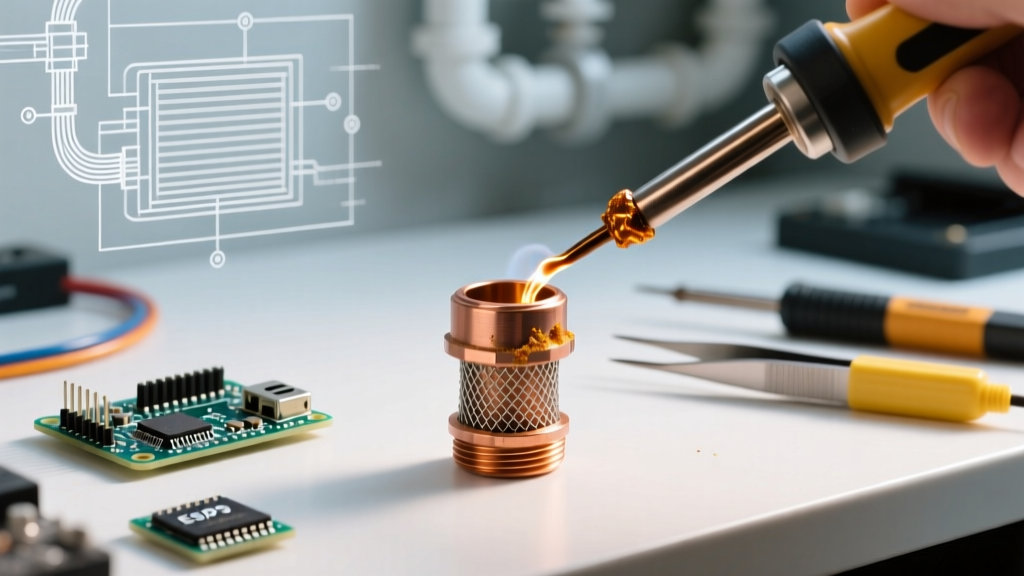
When transitioning from basic residential plumbing to advanced HVAC/R, medical gas lines, or high-pressure hydraulic systems, understanding the fundamental differences between joining methods is critical. The debate of copper pipe brazing vs soldering is not merely about heat; it is a metallurgical distinction defined by the American Welding Society (AWS). According to the AWS Brazing Handbook, the absolute dividing line is 840°F (450°C). Soldering occurs below this threshold, while brazing requires filler metals that melt above it. Neither process melts the base copper (which has a melting point of 1,984°F / 1,085°C); both rely entirely on capillary action to draw the molten alloy into the joint clearance.
For advanced fabricators, choosing the wrong technique can result in catastrophic joint failure under thermal cycling, vibration, or pressures exceeding 400 PSI. This guide bypasses basic DIY advice and dives deep into alloy chemistry, flame dynamics, and forensic failure analysis for high-performance copper joints.
Copper Pipe Brazing vs Soldering: Technical Comparison Matrix
The following matrix breaks down the operational parameters for advanced copper joining, contrasting traditional soft soldering with high-temperature silver brazing.
| Parameter | Advanced Soldering (95/5 & Sn/Ag) | Silver Brazing (BCuP & BAg Alloys) |
|---|---|---|
| Temperature Range | 450°F – 800°F (232°C – 427°C) | 1,100°F – 1,500°F (593°C – 815°C) |
| Capillary Clearance | 0.002" – 0.006" | 0.001" – 0.005" (Tighter tolerance) |
| Joint Tensile Strength | ~6,000 – 8,000 PSI | ~45,000 – 70,000 PSI |
| Flux Requirement | Water-soluble paste (Zinc Chloride) | Self-fluxing on Cu-Cu; White flux on Cu-Brass |
| Primary 2026 Application | Potable water, low-pressure drain lines | HVAC/R, medical gas, high-vibration refrigerant |
| Estimated Filler Cost | $25 - $45 per lb | $95 - $140 per lb (Silver dependent) |
Advanced Soldering: Pushing the Limits of Capillary Joints
While standard 50/50 (Tin/Lead) or 95/5 (Tin/Antimony) solders are ubiquitous in residential plumbing, they fail rapidly in high-vibration environments like compressor discharge lines. For advanced soldering applications where brazing is thermally restricted (e.g., near sensitive TXV valves or electronic sensors), fabricators turn to Stay-Brite 8 or similar tin-silver (Sn/Ag) alloys.
The Stay-Brite 8 Hybrid Approach
Market leaders like Harris produce Sn/Ag alloys that melt around 535°F (280°C). Though technically a solder by AWS definitions, the 8% silver content dramatically increases tensile strength and fatigue resistance. In 2026, a 1/2 lb kit of Stay-Brite 8 with its specialized high-temp flux costs approximately $48. Pro-Tip: Never use standard plumbing paste flux with Sn/Ag alloys; the activation temperature of the flux will burn off before the alloy reaches its liquidus state, resulting in cold, oxidized joints.
Expert Insight: When soldering near existing brazed joints, use a wet rag or specialized heat-blocking paste (like Oatey's Great White) to keep the adjacent braze below 840°F. If a brazed joint exceeds its solidus temperature during a secondary soldering operation, the phosphorus in the braze can oxidize, causing micro-fractures.
Advanced Brazing: BCuP and BAg Alloy Selection
When the Copper Development Association (CDA) Copper Tube Handbook mandates brazing for systems operating above 250 PSI or temperatures exceeding 250°F, alloy selection becomes a precise science.
BCuP Alloys (Copper-Phosphorus-Silver)
For copper-to-copper joints, BCuP-5 (commonly known as Sil-Fos 15 or Dynaflow) is the undisputed industry standard. The phosphorus acts as an internal fluxing agent, breaking down copper oxide at high temperatures without the need for external chemical fluxes.
- BCuP-2 (0% Silver): Highly fluid, brittle. Used only for static, non-vibrating lines. (~$45/lb)
- BCuP-5 (15% Silver): Ductile, handles thermal expansion and compressor vibration. (~$110/lb in 2026)
BAg Alloys (Silver-Copper-Zinc-Cadmium/Indium)
If you are transitioning from copper to brass, bronze, or stainless steel, BCuP alloys will fail. Phosphorus forms brittle phosphides when it contacts iron or nickel. For dissimilar metals, you must use a BAg alloy (like BAg-24 or Easy-Flo 3) paired with a high-temperature white brazing flux. The flux must be manually applied to both the fitting and the filler rod.
The Nitrogen Purge Protocol: Preventing Cuprous Oxide
The most common failure in advanced HVAC/R brazing is internal scaling. When copper is heated to 1,300°F in the presence of atmospheric oxygen, it forms cuprous oxide (Cu2O) scale inside the pipe. This scale eventually flakes off, clogging filter-driers, TXV valves, and compressor oil passages. ASME B31.5 codes for Refrigeration Piping and Heat Transfer strictly require oxygen-free environments during brazing.
- Setup the Regulator: Connect a dry nitrogen cylinder with a precision flowmeter. Do not rely on standard high-pressure regulators.
- Establish Flow: Purge the line at 2 to 3 Cubic Feet per Hour (CFH). Anything higher will create turbulence, drawing ambient air into the joint via the Venturi effect.
- Verify Purity: Advanced techs use an inline oxygen analyzer to ensure O2 levels inside the tubing are below 1% before striking the torch.
- Maintain Flow: Keep the nitrogen flowing until the joint cools below 400°F to prevent post-braze oxidation.
Step-by-Step High-Pressure Brazing Execution
Executing a flawless BCuP-5 braze requires strict adherence to flame chemistry and thermal management.
1. Joint Preparation
Abrasively clean the tube end and fitting cup using 120-grit sanding cloth. Never use a wire wheel. Wire wheels burnish the copper, closing the microscopic pores required for capillary draw. Wipe with anhydrous isopropyl alcohol to remove skin oils.
2. Torch and Flame Dynamics
For 1/2" to 1-1/8" copper, use an Oxy-Acetylene setup with a Victor Journeyman torch and a #3 or #4 swirl-tip. Adjust to a neutral flame.
- Carburizing Flame (Excess Acetylene): Deposits soot, contaminating the filler metal and causing porous joints.
- Oxidizing Flame (Excess Oxygen): Rapidly scales the copper and burns the phosphorus out of the BCuP alloy, destroying its self-fluxing properties.
3. Thermal Equalization
Heat the fitting, not the tube. The fitting has more mass and requires more BTUs. Sweep the flame in a figure-eight pattern. When the copper reaches a dull cherry red (approx. 1,200°F), remove the flame.
4. Filler Application
Touch the BCuP-5 rod to the joint interface. If the temperature is correct, the rod will instantly melt and be drawn into the capillary space. Do not melt the rod with the torch flame. The heat of the base metal must melt the filler. Apply the rod at the 6 o'clock position and watch for a continuous fillet to emerge at the 12 o'clock position, indicating full capillary penetration.
Forensic Failure Analysis: Why Advanced Joints Leak
When high-pressure brazed joints fail in the field, root-cause analysis usually points to one of three specific edge cases:
- Flux Inclusions (Dissimilar Metals): When using BAg alloys with white flux, failing to quench and wire-brush the joint leaves glass-like flux residues. Under thermal cycling, this flux absorbs atmospheric moisture, creating a highly acidic galvanic cell that eats through the copper wall from the outside in.
- Base Metal Erosion: Holding the oxy-acetylene flame too close to the joint pool causes the phosphorus in the BCuP filler to aggressively alloy with the base copper, literally dissolving the pipe wall and creating a microscopic pinhole.
- Improper Clearance: If the tube is forced into a fitting that is out-of-round, the capillary gap exceeds 0.008". At this width, capillary action fails, and the filler metal simply pools at the mouth of the joint, creating a superficial 'ring' braze with zero internal structural integrity.
Frequently Asked Questions (Advanced)
Can I braze copper with MAPP or Propane gas?
For small diameter tubing (1/4" to 3/8"), high-velocity turbo-tips on MAPP/Propane can achieve the 1,100°F required for low-silver BCuP alloys. However, for anything larger than 1/2", the BTU output is insufficient to overcome the thermal mass of the copper before the flux burns off, leading to cold joints. Oxy-Acetylene or Oxy-Propane is mandatory for professional HVAC/R brazing.
Why does my BCuP-5 braze look black and crusty?
A black, crusty appearance indicates an oxidizing flame or a lack of nitrogen purge. The phosphorus is oxidizing before it can penetrate the joint. Adjust your torch to a neutral or very slightly carburizing flame, and verify your nitrogen flow rate.