
The Role of Weller Replacement Soldering Tips in Workspace Ergonomics
Building a professional electronics workbench in 2026 requires more than just a reliable heating element; it demands a strategic approach to thermal transfer. At the very tip of your soldering iron—literally—is the single most critical consumable in your workspace. Selecting the correct Weller replacement soldering tips and organizing them within arm's reach directly impacts your joint reliability, workflow speed, and overall adherence to industry standards like the IPC J-STD-001 standards for soldered electrical assemblies.
Many hobbyists and even seasoned technicians treat soldering tips as an afterthought, buying them only when their current tip turns black and refuses to wet. However, a properly configured workspace treats Weller replacement soldering tips as precision thermal tools. In this guide, we will break down the Weller tip ecosystem, detail exact workspace storage solutions, and provide a rigorous maintenance workflow to maximize the lifespan of your investment.
Decoding the Weller Tip Ecosystem: ET, LT, and RT Series
Weller's product line is segmented by wattage, thermal recovery requirements, and station compatibility. Before you order replacement tips, you must verify which series your station utilizes. Mixing these up is a common procurement error that leads to incompatible hardware and delayed projects.
| Tip Series | Compatible Stations | Wattage / Thermal Mass | Primary Use Case | 2026 Avg. Price |
|---|---|---|---|---|
| ET Series | WES51, WESD51, PES51 | 50W / Medium Mass | General through-hole, basic wire tinning, legacy repairs. | $6.50 - $8.00 |
| LT Series | WE1010NA, PES40 | 70W / High Mass | Heavy ground planes, multi-layer PCBs, large connectors. | $9.00 - $11.50 |
| RT Series | WX1, WX2, WR2000, WMRP | 40W-150W / Low Mass | Micro-SMD (0201 components), precision rework, fine-pitch ICs. | $12.00 - $16.00 |
Understanding the Nomenclature
Once you know your series, you must select the geometry. A standard RT1 features a 0.8mm chisel tip, ideal for 0805 and 0603 surface-mount components. The RT4 offers a 1.6mm chisel, providing higher thermal mass for 1206 components or small through-hole pads. For ultra-fine work, the RTW (Pico) series offers a 0.4mm blade, though it is highly susceptible to bending if lateral pressure is applied. In the LT and ET families, an 'A' suffix (e.g., LTA or ETA) denotes a conical or screwdriver shape, which is generally discouraged for modern SMD work due to poor surface area contact and localized heat concentration.
Strategic Storage: Preventing Oxidation Before Use
The moment a Weller replacement soldering tip leaves its anti-corrosive packaging, it is at war with ambient oxygen and humidity. Your workspace must include a dedicated, climate-controlled storage solution for unused tips.
The Danger of Galvanic Corrosion and Environmental Pitting
Expert Warning: Never store bare copper or iron-plated soldering tips in direct contact with aluminum toolboxes or untreated steel drawers. Galvanic corrosion can initiate micro-pitting on the iron plating before the tip is ever heated, leading to premature non-wetting failure.
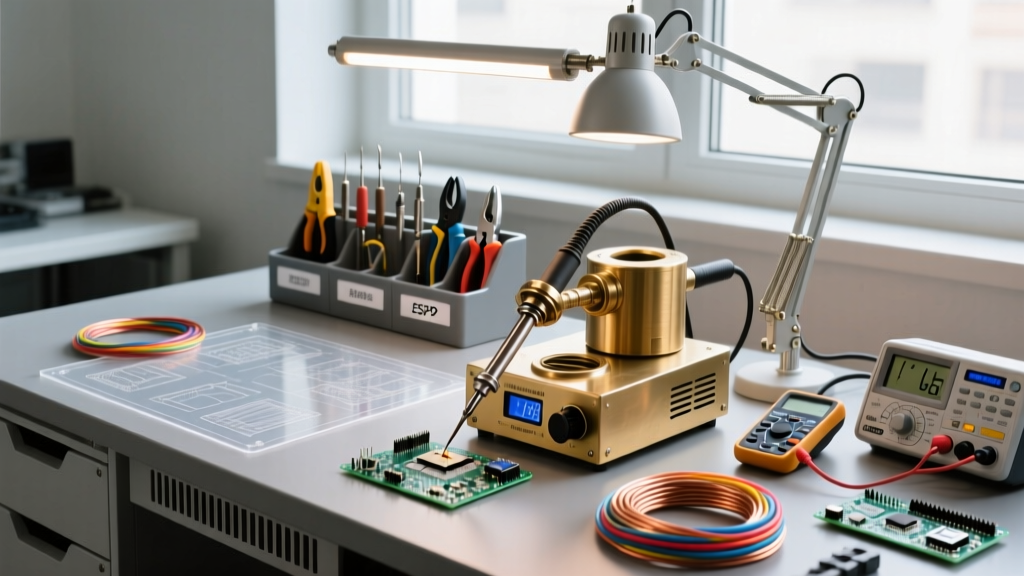
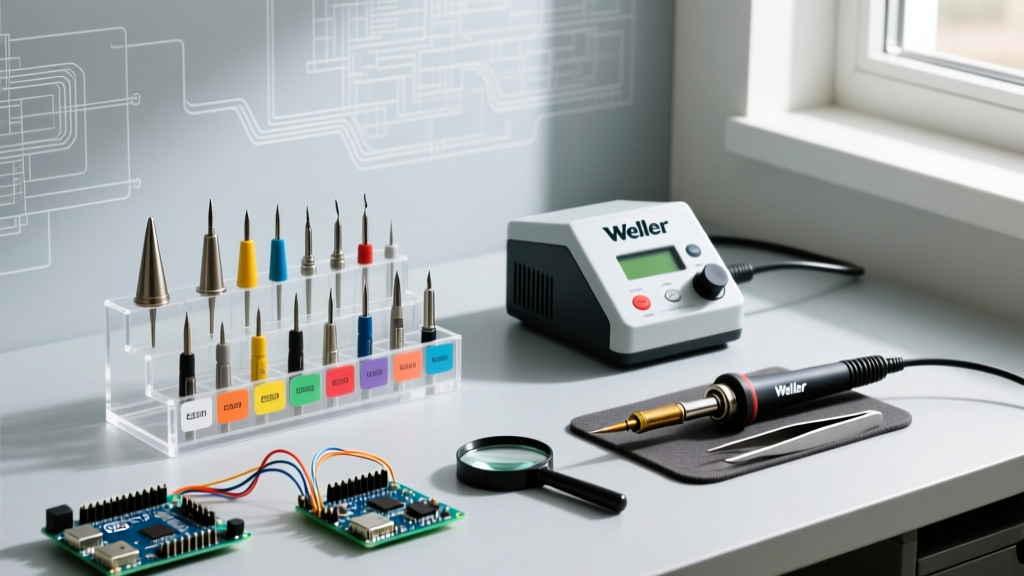
To organize your Weller replacement soldering tips effectively, utilize a silicone-lined, compartmentalized storage tray. Silicone is chemically inert and will not react with the tip's iron plating. Keep the storage tray inside a sealed acrylic or polycarbonate desiccator cabinet with a rechargeable silica gel pack, maintaining relative humidity below 40%. Label each compartment with the tip model (e.g., 'RT1', 'RT4', 'LTA') and its designated geometry using a label maker. This eliminates the 'fumbling' phase during complex rework sessions where every second of thermal exposure counts.
Workspace Tinning and Maintenance Station Layout
Where you place your cleaning and tinning apparatus relative to your soldering station dictates your muscle memory and tip longevity. According to best practices highlighted in SparkFun's through-hole soldering tutorial, proper cleaning technique is just as vital as temperature control.
The Optimal Cleaning Workflow Setup
- The Brass Sponge (Primary Cleaning): Place a heavy-duty brass wire sponge (like the Hakko 599B or Weller WDC2) on the dominant side of your iron stand. Brass is softer than the iron plating of your Weller tip but harder than oxidized solder and carbonized flux. It removes debris without inducing thermal shock.
- The Cellulose Sponge (Secondary Polishing): If you must use a cellulose sponge for final polishing, place it on the non-dominant side. Critical Detail: Only moisten this sponge with distilled or deionized water. Tap water contains calcium and magnesium salts that will bake onto the 400°C tip, creating microscopic craters in the iron plating.
- The Tip Tinner (Rescue Station): Keep a small pot of aggressive tip tinner (such as Kester 185 or MG Chemicals 488) at the back edge of your workspace. This should only be used when a tip exhibits signs of non-wetting. The tinner contains phosphoric acid and solder powder, which chemically strips heavy oxidation and immediately re-coats the tip.
Fume Extraction Airflow Dynamics
A common workspace mistake is placing the fume extractor nozzle too close to the soldering iron rest. If your extraction arm pulls 150 CFM of ambient air directly across the resting Weller tip, it will act as an active heatsink. This forces the station's sensor to overcompensate, continuously pulsing high wattage into the heating element and accelerating the degradation of the internal ceramic heater. Position your fume extractor nozzle at a 45-degree angle, approximately 4 to 6 inches away from the tip rest, capturing the rising smoke plume without aggressively cooling the iron.
Identifying Failure Modes: When to Discard a Tip
Even with a perfect workspace setup, Weller replacement soldering tips are consumables. Knowing exactly when a tip has crossed the threshold from 'dirty' to 'dead' saves you from chasing bad solder joints and blaming your flux or technique.
- Black Crust (Carbonized Flux): This is not a dead tip. It is merely baked rosin or synthetic resin from no-clean or water-soluble fluxes. This can be removed by dipping the hot tip into brass wool, followed immediately by a generous application of fresh, cored solder to re-tin the surface.
- Blue/Purple Discoloration: This indicates severe overheating. If you are running lead-free SAC305 solder at 380°C, leaving the iron in the stand for more than 10 minutes without auto-sleep will cause the iron plating to oxidize deeply. This requires chemical tip tinner to salvage.
- Micro-Pitting and Scaling: If the surface of the tip feels rough to the touch (when cold) or looks like cracked mud, the iron plating has physically eroded, exposing the underlying copper core. Once copper is exposed, the tip will dissolve into the solder pool rapidly. Discard immediately.
- Non-Wetting (Dry Tip): When molten solder beads up and rolls off the tip like water on a hot skillet, the tip is oxidized. Attempt one rescue cycle with Kester 185 tip tinner. If it does not wet within 5 seconds, discard it.
Sourcing and 2026 Pricing Realities
When procuring Weller replacement soldering tips for your workspace, authenticity is paramount. The market is currently flooded with counterfeit tips that feature copper cores with virtually zero iron plating. These clones may cost $2.00 online, but they will dissolve within 4 hours of use and can permanently damage your Weller heating element due to improper thermal expansion coefficients.
Always source from authorized industrial distributors like Digi-Key, Mouser, or Newark, or directly via the Weller Tools official portal. In 2026, expect to pay between $9.00 and $11.50 for genuine LT series tips, and $12.00 to $16.00 for the high-precision RT series. Buying in sealed 5-packs often yields a 10% to 15% discount and ensures your workspace remains stocked for high-volume production runs or extended prototyping sessions.
By treating your Weller replacement soldering tips as calibrated instruments rather than disposable afterthoughts, you elevate your entire workspace. Proper selection, inert storage, and a disciplined maintenance workflow will reduce your annual consumable costs by up to 40% while ensuring every solder joint meets rigorous IPC reliability standards.