
The 2026 Soldering Kit Landscape: Smart Irons vs. Benchtop Classics
Choosing the right soldering kit in 2026 requires navigating a split market. On one side, you have the ultra-portable, USB-C Power Delivery (PD) smart irons that have revolutionized field work and compact benches. On the other, you have the traditional, transformer-isolated benchtop stations that remain the gold standard for sensitive CMOS and RF rework.
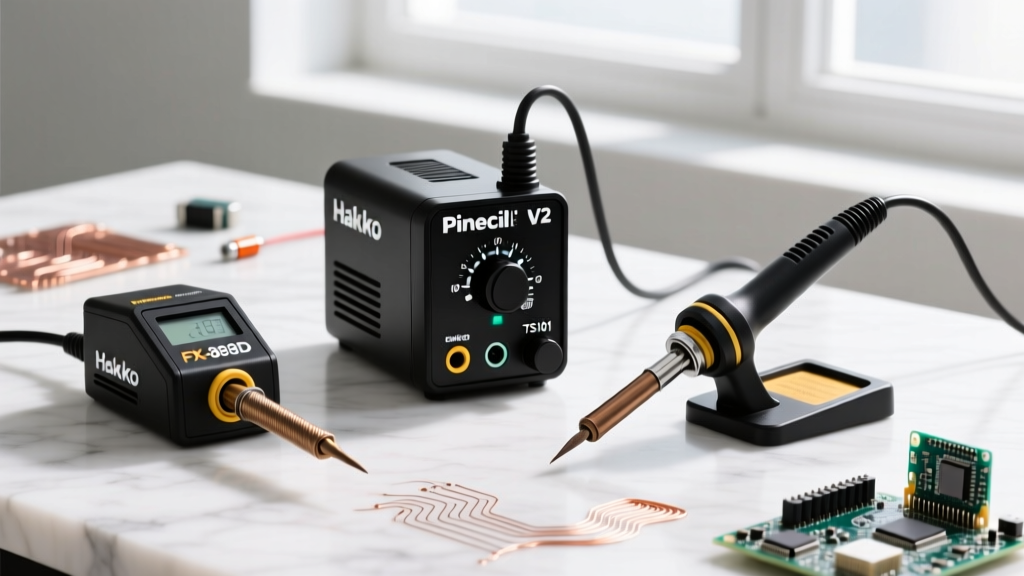
As a senior technician, I have tested dozens of setups. In this comprehensive review, we are putting the three most dominant soldering kits head-to-head: the open-source darling Pinecil V2, the portable powerhouse Miniware TS101, and the undisputed benchtop workhorse, the Hakko FX-888D. We will dissect their thermal recovery, power negotiation edge cases, and tip metallurgy to help you make an informed investment.
Contender 1: Pinecil V2 Smart Soldering Kit
The Pinecil V2, developed by Pine64, represents the pinnacle of open-source hardware in the soldering space. Powered by a 32-bit RISC-V BL706 chip, it supports Bluetooth and Wi-Fi, allowing for wireless firmware updates and telemetry via the PineSAM app.
Performance and Edge Cases
The V2 boasts a blistering heat-up time, reaching 300°C in just 18 seconds when supplied with adequate power. However, the most common failure mode for beginners is USB-C PD negotiation throttling. If you pair the V2 with a generic 65W charger that lacks a 20V/3.25A Power Data Object (PDO), the iron will default to a safe 12W (5V/2.4A or 9V/2A). This results in severe thermal lag when soldering large ground planes.
⚠️ Pro Tip: Power Supply PairingAlways use a GaN charger that explicitly lists 20V/3.25A in its PDO specs (like the PinePower 65W or specific UGREEN Nexode models). According to the official Pinecil Wiki, using a DC 5521 barrel jack with a 24V/3A laptop power supply bypasses PD negotiation entirely, delivering a rock-solid 72W.
- Pros: Unbeatable price-to-performance ratio (~$41 complete), open-source firmware (IronOS), wireless connectivity, rapid thermal recovery.
- Cons: Lacks internal galvanic isolation (requires care on live mains), requires a separate high-quality USB-C PD charger.
Contender 2: Hakko FX-888D Digital Soldering Kit
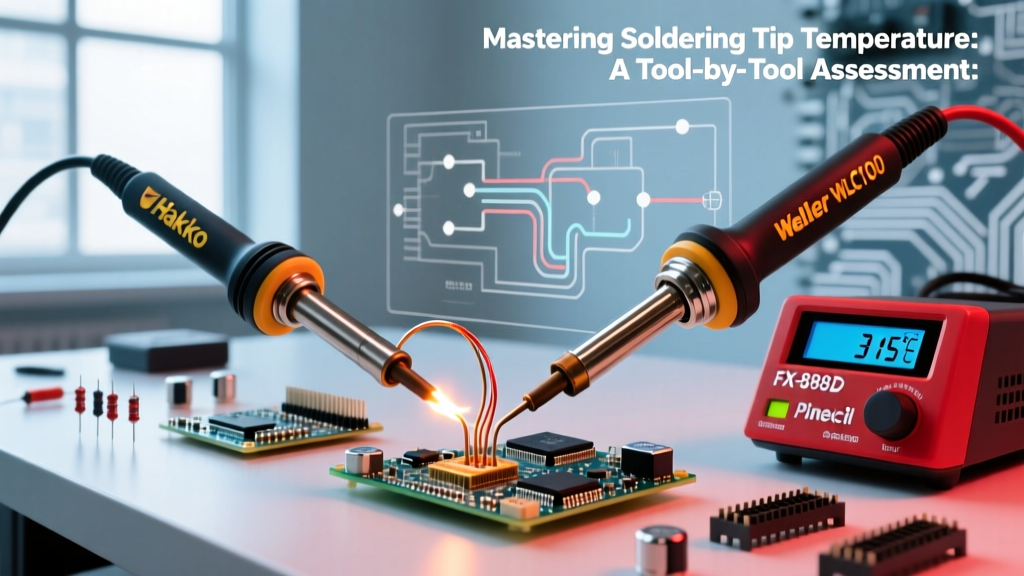
While smart irons grab the headlines, the Hakko FX-888D remains the backbone of professional repair shops and manufacturing floors. This 70W transformer-based station uses a dedicated analog-to-digital control loop and proprietary T18 tip architecture.
Performance and Edge Cases
The FX-888D takes approximately 45 seconds to reach 350°C. Its thermal recovery is steady, though not as aggressive as the TS101 on heavy copper pours. The critical advantage here is galvanic isolation. The step-down transformer physically separates the mains AC from the low-voltage DC heater circuit, eliminating ground loops that can destroy sensitive audio ADCs or unbuffered microcontroller I/O pins.
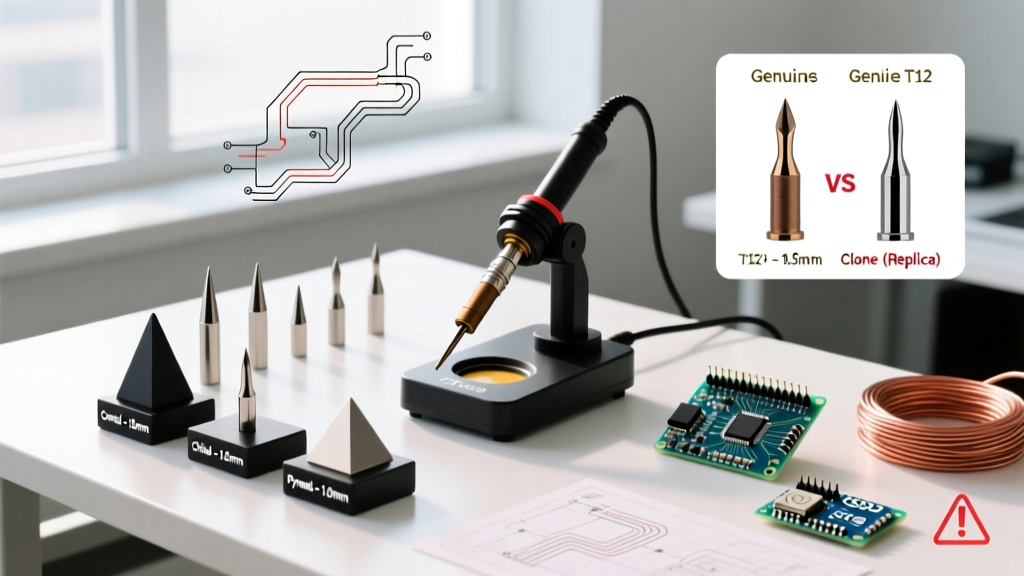
🚨 Warning: The Counterfeit EpidemicThe FX-888D is heavily counterfeited on third-party marketplaces. Fake units use inferior ceramic heaters that fail within 50 hours and lack proper ESD grounding. Always verify the official Hakko product markings and purchase from authorized distributors like Digi-Key or Mouser.
- Pros: True ESD safety, galvanic isolation, massive T18 tip ecosystem, extreme long-term durability, no external brick required.
- Cons: Bulky footprint, fixed 70W ceiling, basic two-button digital interface is tedious to program.
Contender 3: Miniware TS101 Pro Soldering Kit
The TS101 is the spiritual successor to the legendary TS100. Featuring a dual-core ARM processor and an OLED display, it bridges the gap between the raw power of a benchtop station and the portability of the Pinecil.
Performance and Edge Cases
Supporting up to 65W via USB-C PD and a massive 100W via its DC barrel jack, the TS101 handles 10-layer PCB ground planes with ease. The integrated 3-axis accelerometer enables sleep modes and auto-orientation of the OLED screen. However, users performing precision rework on logic boards must be aware of the ground pin routing. Early TS101 batches had the ground pin tied directly to the USB-C shield, which could cause short circuits if plugged into a non-isolated laptop port while touching a grounded chassis. Modern 2026 revisions have largely mitigated this, but using an isolated DC power supply for sensitive work remains best practice.
- Pros: 100W DC capability, brilliant OLED UI, robust build quality, excellent tip compatibility (TS100/Pinecil short tips).
- Cons: Premium pricing (~$75 bare), closed-source firmware, slightly heavier than the Pinecil.
Head-to-Head Comparison Matrix
| Feature | Pinecil V2 | Hakko FX-888D | Miniware TS101 |
|---|---|---|---|
| Max Power (USB-C) | 65W (20V PD) | N/A (AC Mains) | 65W (20V PD) |
| Max Power (DC) | 72W (24V/3A) | 70W (Transformer) | 100W (20V/5A) |
| Heat-Up (to 300°C) | ~18 Seconds | ~45 Seconds | ~15 Seconds |
| Tip Architecture | Short TS100/Pinecil | Hakko T18 | Short TS100/TS101 |
| Galvanic Isolation | No (Use isolated PSU) | Yes (Transformer) | No (Use isolated PSU) |
| Estimated Kit Cost | $41 - $55 | $115 - $130 | $85 - $110 |
Tip Metallurgy and Maintenance: The Hidden Cost
When evaluating a soldering kit, the ongoing cost of consumables is just as important as the upfront price. The IPC J-STD-001 standard emphasizes the importance of proper wetting and thermal transfer, which relies entirely on the iron plating of your tips.
T18 vs. Short-Tips
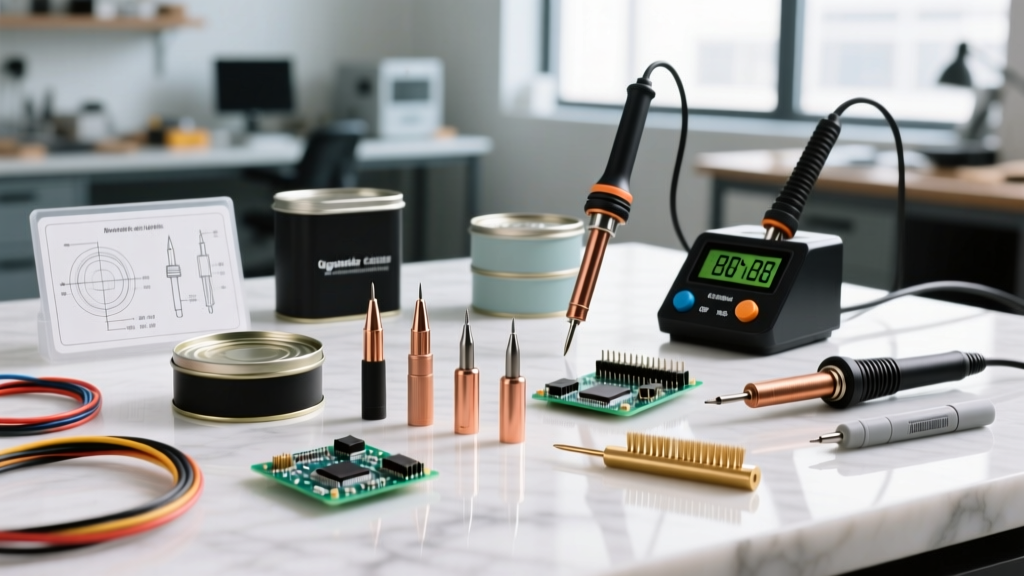
Hakko’s T18 tips feature a thick, high-quality iron plating over a solid copper core. They are exceptionally resistant to flux corrosion and can last for years if properly tinned. The short-tips used by the Pinecil and TS101 prioritize rapid thermal transfer by placing the heating element directly inside the tip cavity. While this yields incredible responsiveness, the thinner plating makes them more susceptible to pitting from aggressive, no-clean, or water-soluble fluxes.
"Never use abrasive sponges or brass wire balls to clean a smart iron tip while it is hot. The sudden thermal shock can micro-fracture the iron plating, allowing molten solder to dissolve the copper core underneath. Always use a damp cellulose sponge or a specialized high-temp silicone tip cleaner."
Final Verdict: Which Kit Fits Your Bench?
- For the Drone Builder, RC Hobbyist, and Field Tech: Choose the Pinecil V2. Its lightweight profile, USB-C compatibility (you can power it off a high-discharge LiPo battery with a PD decoy cable), and open-source nature make it the ultimate portable kit.
- For the Professional Repair Shop and Audio Engineer: Choose the Hakko FX-888D. When you are probing live audio circuits or replacing unbuffered CMOS logic, the transformer isolation and ESD-safe chassis are non-negotiable requirements.
- For the Heavy-Duty Rework and PCB Designer: Choose the Miniware TS101. Paired with a 100W DC power supply, it offers the thermal mass required to solder thick copper pours and large RF shields that would stall the Pinecil or Hakko.
Investing in the right soldering kit is about matching the tool's thermal architecture to your specific failure domains. By understanding the power negotiation quirks of smart irons and the isolation benefits of traditional stations, you can build a 2026 workspace that yields perfect, IPC-compliant joints every time.