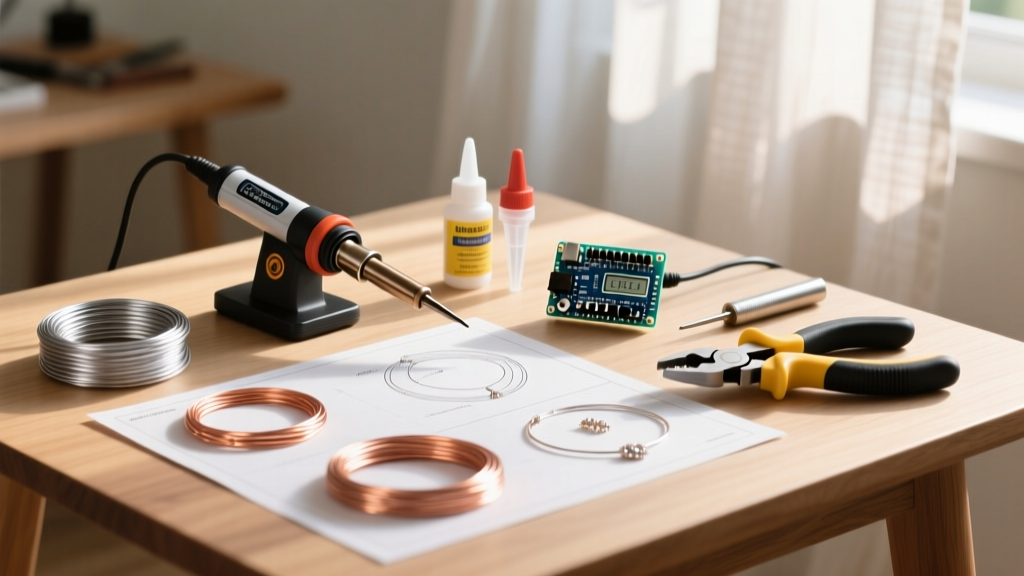

Why Your Electronics Soldering Iron Will Fail at Jewelry Making
If you are transitioning from printed circuit boards and wire splicing into metalsmithing, your first instinct might be to reach for your trusty 60W Weller or Hakko soldering station. Put it down. In the jewelry industry, what we call "soldering" is technically silver brazing. Electronics solder (tin-lead or SAC305) melts around 360°F to 430°F. Jewelry solder, which is a silver-bearing alloy, requires temperatures ranging from 1,325°F to 1,450°F.
Furthermore, jewelry deals with massive thermal mass. A standard soldering iron cannot transfer heat fast enough to bring a 14-gauge sterling silver ring shank up to 1,350°F before the iron's thermal recovery fails. To build a functional jewelry soldering kit, you must abandon the iron and invest in gas torches, specialized hard solders, and chemical pickling solutions. As of 2026, the market offers highly refined micro-torches that make this accessible for home bench jewelers without requiring industrial oxy-acetylene tanks.
The Core of the Kit: Butane vs. Oxy-Fuel Torches
The most critical decision in your beginner jewelry soldering kit is the heat source. Your choice dictates the thickness of the metal you can join and the precision of your work.
1. The Butane Micro-Torch (The Budget Starter)
For jump rings, lightweight bezels, and chain repairs, a high-end butane torch is sufficient. The Blazer Big Shot GT 8000 (typically priced between $60 and $80) is the undisputed king of this category. It features a brass-frame nozzle that resists heat warping and delivers a focused, wind-resistant flame reaching 2,500°F. While it lacks the pinpoint precision of an oxy-fuel setup, it requires zero gas regulators, hoses, or heavy tanks, making it ideal for apartment dwellers.
2. The Oxy-Fuel Micro-Torch (The Professional Standard)
If you plan to solder heavy cuff bracelets, cast settings, or work with gold and platinum, you need the Smith Little Torch (Model 11-101C). Running on oxygen and acetylene (or propane), this system costs between $285 and $350 for the torch and regulator setup, plus tank lease fees. The Smith Little Torch allows you to swap tips (from #00 to #5), giving you a flame size that can range from a microscopic needle for chain links to a broad, sweeping bushy flame for annealing thick metal.
Pro-Tip for 2026: If you choose the Smith Little Torch but live in an area with strict acetylene transport laws, configure your regulators for Oxygen/Propane. You will need to swap the acetylene tip for a propane-specific tip (like the Smith #229), but propane burns cleaner and is much easier to source at local hardware stores.
The Solder & Flux Matrix: Understanding the Metallurgy
Jewelry solder is graded by its melting point and silver content. To solder a complex piece with multiple joints, jewelers use a technique called step soldering. You must buy a kit that includes Hard, Medium, and Easy solders to prevent previously soldered joints from melting while you work on new ones.
| Solder Grade | Melting Point | Silver Content (Approx) | Best Application |
|---|---|---|---|
| Hard | 1,450°F (788°C) | 80% | First joints, ring shanks, structural seams |
| Medium | 1,390°F (754°C) | 70% | Second joints, attaching bezels to backplates |
| Easy | 1,325°F (718°C) | 65% | Final repairs, closing jump rings, catch repairs |
Note: Sterling silver itself melts at 1,640°F (893°C). The 190°F gap between Hard solder melting and sterling melting is your margin of error. Overheat the piece, and the silver will collapse into a molten puddle.
Flux: The Chemical Shield
Silver solder will not flow over oxidized metal. You must coat your piece in flux. For beginners, a Borax Cone and Dish ($12) is the traditional route: you grind the ceramic cone in water to create a milky paste. However, for complex fabrications, liquid fluxes like Stay-Silv White Flux or Prip's Flux offer superior protection against firescale (a deep purple cupric oxide stain that forms when the copper in sterling silver reacts with oxygen).
The Pickle Pot: Chemical Cleaning and the Galvanic Trap
After soldering, your jewelry will be coated in black oxidation and glassy flux residue. You cannot sand this off; you must dissolve it in a warm acid bath called a "pickle." A standard beginner kit should include a small 1.5-quart slow cooker (dedicated solely to the bench, never for food) and Sparex #2 (sodium bisulfate).
The Fatal Beginner Mistake: The Galvanic Reaction
When retrieving your hot silver from the pickle pot, never use steel tweezers. If steel touches the copper-bearing acid solution while silver is also submerged, it triggers a galvanic reaction. Within seconds, a layer of pure copper will electroplate onto your sterling silver, turning it a bright, ugly penny-orange. Always use copper or brass tongs (priced around $8 to $15) to handle jewelry in the pickle.
Common Failure Modes & Troubleshooting
Even with the best jewelry soldering kit, beginners encounter specific metallurgical failures. Here is how to diagnose and fix them:
- The Solder Balls Up and Refuses to Flow: This happens when the metal surface is oxidized or the flux has burned off. Fix: Quench the piece, re-pickle it to clean the surface, reapply fresh flux, and heat the metal, not the solder chip. The solder is drawn to the hottest point via capillary action.
- Melting the Seam (Pitting): You aimed the inner blue cone of the torch directly at the solder chip instead of the surrounding silver. Fix: Use a broader flame and heat the bulk of the metal piece. Let the ambient thermal radiation pull the solder into the joint.
- Severe Firescale: The piece turns dark grey/purple after pickling. Fix: You heated the piece too long in an oxygen-rich environment. Switch to a reducing flame (slightly more gas, less oxygen) and apply Prip's flux as a secondary barrier.
Bench Safety and Ventilation Requirements
Jewelry soldering generates metallic fumes, flux vapors, and acid mists from the pickle pot. According to guidelines on chemical safety and hazard communication from the National Institute for Occupational Safety and Health (NIOSH) and OSHA's Hazard Communication standards, localized exhaust ventilation is mandatory when working with heated fluxes and acidic vapors.
- Fire Safety: Always solder on a ceramic soldering board or charcoal block (which reflects heat back into the metal). Never solder directly on wood or combustible surfaces. Keep a fire extinguisher rated for Class B (flammable gases) and Class C (electrical) within arm's reach.
- Pickle Disposal: Sparex #2 is an acid. Over time, the pickle pot accumulates heavy metal salts (copper and silver). Do not pour spent pickle down the drain. Neutralize it with baking soda until it stops fizzing, and dispose of the sludge according to your local municipal hazardous waste guidelines, as detailed by environmental protection authorities.
- Eye Protection: Didymium glasses are highly recommended. They filter out the harsh yellow sodium flare emitted by hot glass and certain fluxes, allowing you to see the exact moment the silver solder flashes and flows.
Building Your 2026 Starter Kit Checklist
If you are assembling your first kit from industry suppliers like Rio Grande or local lapidary shops, ensure your shopping cart includes these exact items:
- Blazer GT 8000 Butane Torch OR Smith Little Torch Setup
- Silver Solder Wire (Hard, Medium, Easy - 19 gauge)
- Stay-Silv White Flux & Brush
- Borax Cone and Ceramic Dish
- Sparex #2 Pickle Compound (1 lb jar)
- Dedicated Ceramic Slow-Cooker (1.5 Qt)
- Copper Tongs (for pickle) and Steel Tweezers (for bench handling)
- Ceramic Soldering Board (Fordite or Kaowool)
- Third-Hand Tweezers with Cross-Lock
Investing in the correct thermal and chemical tools from day one will save you from the frustration of cold joints, ruined castings, and copper-plated disasters. Respect the metallurgy, manage your heat, and your jewelry soldering kit will serve you for a lifetime at the bench.