
Beyond the Basics: The True Purpose of a Soldering Iron
When beginners search for what is soldering iron for, they are usually met with simplistic answers like 'melting metal to stick wires together.' While functionally accurate for a layperson, this definition completely ignores the complex metallurgical and thermodynamic processes at play. In professional electronics manufacturing, aerospace engineering, and advanced DIY fabrication, a soldering iron is not merely a heating element. It is a precision thermal delivery system designed to facilitate the creation of an intermetallic compound (IMC) between a base metal and a filler alloy, all while managing the chemical activation of flux.
As of 2026, the transition toward lead-free manufacturing and high-density PCB layouts means understanding the exact thermal dynamics of your iron is more critical than ever. This technique guide breaks down the metallurgical purpose of the tool, explores diverse application profiles, and provides a matrix for matching your equipment to the task.
The Metallurgy of the Joint: Intermetallic Compounds
To truly understand the tool's purpose, you must understand the joint. Soldering is not gluing. When you apply a heated iron tip to a copper pad and introduce a tin-based alloy, the tin (Sn) physically diffuses into the copper (Cu) substrate. This diffusion creates an intermetallic compound (IMC), specifically the Cu6Sn5 layer.
- Too Little Heat (Under 300°C for SAC305): The IMC layer fails to form properly, resulting in a 'cold joint.' The solder merely sits on top of the pad like a water droplet on a waxed car, leading to high electrical resistance and mechanical fragility.
- Optimal Heat (340°C - 360°C): A thin, uniform IMC layer forms, creating a continuous metallic lattice that provides both excellent electrical conductivity and high shear strength.
- Excessive Heat (Over 400°C): The IMC layer grows too thick and transitions into Cu3Sn. This thicker layer is highly brittle and prone to micro-fracturing under thermal cycling or mechanical vibration.
Therefore, the primary purpose of a modern soldering station is thermal recovery—maintaining the exact temperature required to form a perfect IMC layer without overshooting and damaging the substrate.
The Chemical Catalyst: Understanding Flux Activation
A soldering iron also serves to activate flux. According to the SparkFun soldering guidelines, flux is a chemical cleaning agent that removes oxidation from the base metals, allowing the molten solder to 'wet' the surface. Different flux chemistries require specific thermal thresholds to activate:
- Rosin (R, RMA, RA): Activates around 180°C to 220°C. Leaves a benign, non-conductive residue.
- Water-Soluble (Organic Acid): Activates at higher temperatures (200°C+). Highly aggressive; must be cleaned post-soldering to prevent dendritic growth and short circuits.
- No-Clean (Synthetic): Designed to leave minimal, safe residue. Requires precise temperature control, as overheating can cause the residue to become conductive or corrosive.
Application Matrix: Matching the Iron to the Task
The versatility of the tool becomes apparent when you map specific applications to their required thermal profiles. The table below outlines the optimal parameters for common tasks.
| Application | Recommended Alloy | Tip Geometry | Target Temp (°C) | Thermal Mass / Wattage |
|---|---|---|---|---|
| Precision SMD (0402/0603) | Sn60/Pb40 or Sn63/Pb37 | Micro-Conical or Fine Chisel (0.4mm) | 315°C - 330°C | Low (15W - 30W) |
| Standard Through-Hole (FR-4) | SAC305 (Lead-Free) | Standard Chisel (1.6mm - 2.4mm) | 350°C - 370°C | Medium (40W - 60W) |
| Heavy Gauge Wire (10-14 AWG) | Sn60/Pb40 (Rosin Core) | Heavy Bevel or Large Chisel (4.0mm+) | 380°C - 400°C | High (80W - 120W) |
| Stained Glass / Copper Foil | Sn60/Pb40 (Solid Wire) | Large Bevel / Smoothing Tip (6.0mm+) | 360°C - 390°C | Very High (100W+) |
| Small Copper Plumbing (1/4'') | Sn95/Ag5 (Silver Bearing) | Specialized Soldering Gun/Iron Tip | 400°C+ | Extreme (Often requires torch) |
Primary Technique Profiles
1. Microelectronics and PCB Rework
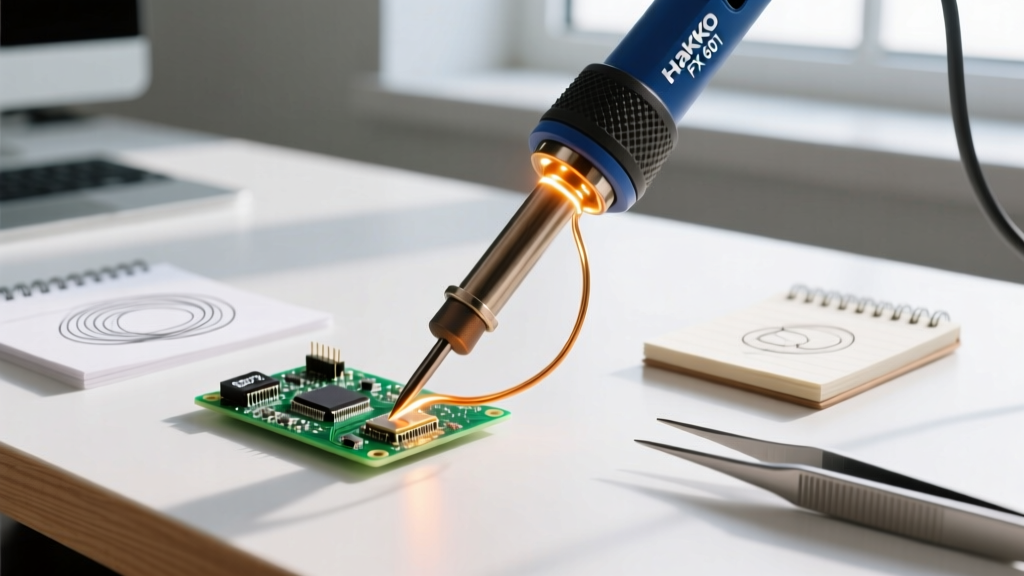
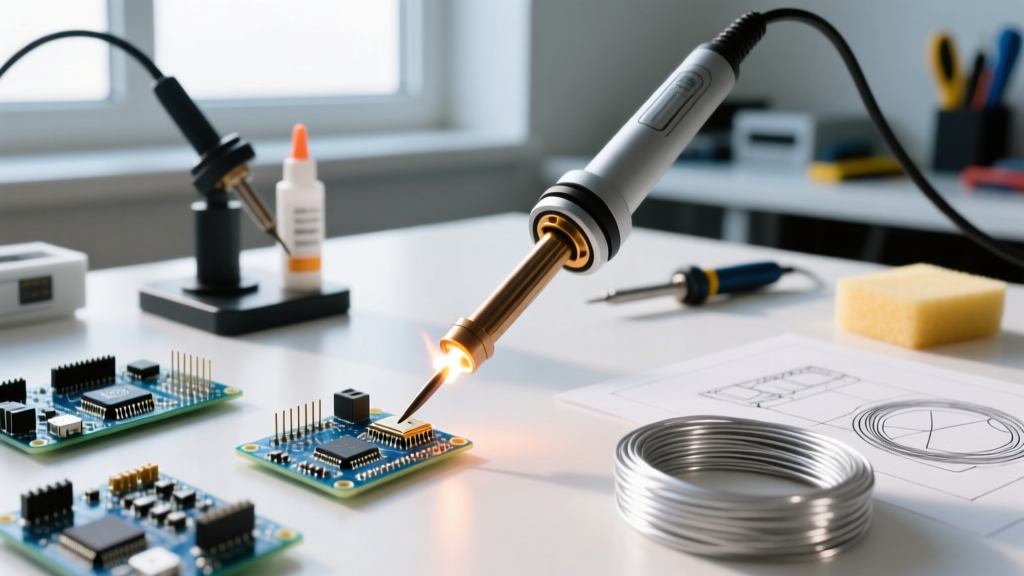
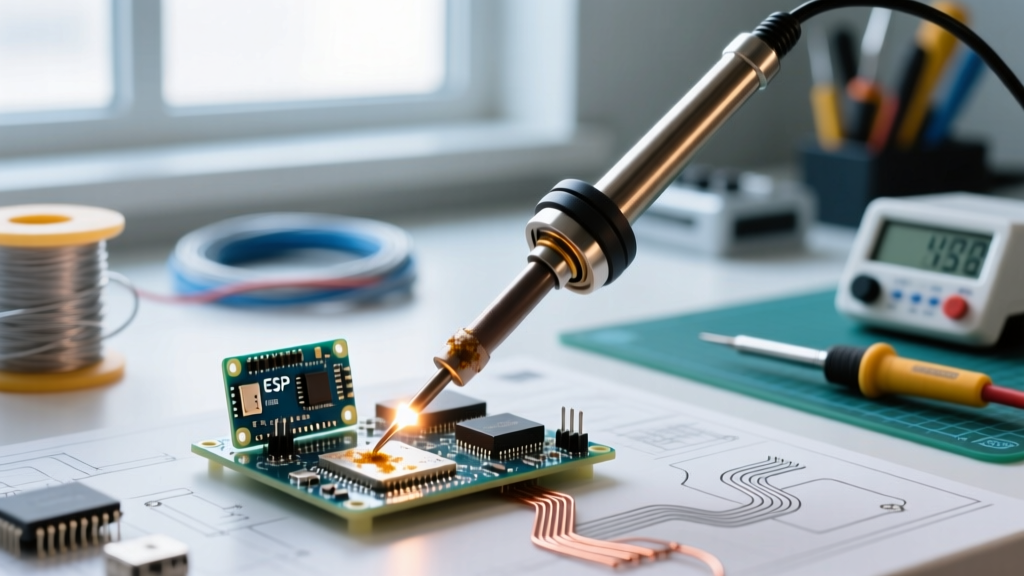
In PCB assembly, the iron's purpose is localized heat transfer. Using a high-quality station like the Hakko FX-951 or Weller WE1010NA, the operator relies on cartridge-style tips. Cartridge tips integrate the heating element directly into the copper tip, reducing thermal lag to milliseconds. When soldering a delicate 0603 resistor, the technique involves simultaneous contact: the tip must touch both the component lead and the PCB pad for exactly 1 to 2 seconds before feeding 0.5mm diameter solder wire. Prolonged contact risks delaminating the FR-4 fiberglass substrate.
2. Heavy-Duty Wiring and Automotive
When soldering 12 AWG silicone wire for drone ESCs or automotive harnesses, the massive copper acts as a heat sink, rapidly drawing thermal energy away from the joint. Here, what the soldering iron is for shifts from 'precision' to 'brute thermal force.' A standard 40W ceramic pencil will fail, resulting in a cold joint. Instead, technicians use high-wattage irons (like the 120W JBC CD-2BQE) or specialized soldering guns. The technique requires pre-tinning both wires separately with ample flux before bringing them together and applying the iron to the combined mass.
3. Stained Glass and Jewelry
Unlike electronics, stained glass soldering uses solid solder wire and liquid or paste flux applied to copper foil. The principles of copper wetting apply here, but the aesthetic goal is a smooth, rounded 'bead' of solder. Artists use heavy, temperature-controlled irons (like the Hakko FX-601) with wide bevel tips. The technique involves 'dragging' the molten bead along the seam, relying on surface tension and gravity to create a uniform convex profile.
Expert Insight: Never use plumbing flux (acid paste) on electronic PCBs. Plumbing flux is highly corrosive and will destroy copper traces and cause short circuits within days. Always use rosin-based or no-clean electronics flux.
Common Thermal Failure Modes & Troubleshooting
Understanding the tool's purpose helps diagnose when a process goes wrong. Here are the most common failure modes encountered in the field:
- Dewetting: The solder initially wets the surface but then pulls back into islands, exposing the base metal. Cause: Flux burnout due to an excessively hot iron or prolonged dwell time. Fix: Lower the temperature by 20°C and apply fresh flux.
- Pad Lift (Delamination): The copper pad peels off the PCB. Cause: Exceeding the glass transition temperature (Tg) of the FR-4 board (usually around 130°C-170°C) for too long. Fix: Use a higher wattage iron with a larger tip to reduce dwell time, rather than turning up the temperature dial.
- Tip Oxidation (Blackening): The tip turns black and solder refuses to stick to it. Cause: Leaving a clean iron at 380°C on a stand without a protective coat of solder. Fix: Always 'tin' the tip with a blob of cheap, leaded solder before placing it in the holder. This sacrificial layer oxidizes instead of the iron plating.
Modern Tooling: Cartridge vs. Ceramic Heaters
The evolution of the soldering iron has largely been driven by the need for better thermal recovery. Older, budget-friendly irons (often under $30) use a ceramic heating element wrapped around a metal sleeve, into which a copper tip is inserted. This creates an air gap and significant thermal resistance.
Modern professional stations utilize cartridge tips, where the heater, sensor, and tip are a single, integrated unit. As noted in Hakko's official soldering training resources, this direct-coupling allows the sensor to detect a temperature drop the millisecond the tip touches a cold copper plane, triggering the heater to compensate instantly. For anyone serious about electronics, upgrading from a ceramic pencil to a cartridge-based station (such as the Pinecil V2 for budget-conscious makers, or the JBC C245 series for professionals) is the single most impactful improvement you can make to your workflow.
Summary
Ultimately, a soldering iron is a highly specialized instrument for managing thermodynamics and metallurgy. Whether you are assembling a microcontroller, repairing a vintage audio amplifier, or crafting stained glass, success depends on matching the tool's thermal mass, tip geometry, and temperature profile to the specific physical demands of the joint. By respecting the chemistry of flux and the physics of intermetallic compounds, you transform a simple heating tool into an instrument of precision engineering.