
The Thermal Dilemma: Is Your Soldering Iron Hot Enough?
As we navigate the electronics landscape in 2026, the transition to strict lead-free manufacturing and high-density interconnect (HDI) PCBs has fundamentally changed how we approach thermal management. A common frustration among both hobbyists and professional technicians is the sensation that their soldering iron is not hot enough to properly flow modern SAC305 (Tin-Silver-Copper) solder, which has a baseline melting point of 217°C (423°F). However, the issue is rarely about the maximum temperature dial setting; it is almost always a matter of thermal recovery and thermal mass.
When comparing a traditional contact soldering iron against a hot air rework station, understanding how heat transfers into the copper pads and component leads is critical. This guide breaks down the physics, tool capabilities, and practical applications to help you decide when to use conductive heat versus convective heat.
Tool Comparison Matrix: Contact Iron vs. Hot Air Station
Before diving into specific failure modes and techniques, let us look at the fundamental differences between these two thermal workhorses.
| Feature | Traditional Soldering Iron | Hot Air Rework Station |
|---|---|---|
| Heat Transfer Method | Conduction (Direct Contact) | Convection (Forced Air) |
| Ideal Component Types | Through-hole, large SMD, wires | QFN, BGA, 0402/0201 SMD, heat-shrink |
| Typical Temp Range | 200°C – 450°C | 100°C – 480°C |
| Thermal Mass Handling | High (with high-wattage/active tips) | Moderate (struggles with heavy ground planes) |
| Airflow Control | N/A | 20 – 120 Liters Per Minute (LPM) |
| 2026 Avg. Price Range | $25 (USB-C) to $350 (Pro Station) | $120 to $600+ |
Understanding "Hot": Thermal Mass vs. Temperature Setting
A frequent mistake is cranking a low-wattage iron to 450°C to compensate for heat sinking on a multi-layer PCB. This does not make the iron "hotter" in a useful way; it simply oxidizes the tip plating instantly, creating a barrier that prevents heat transfer. According to the workmanship standards outlined by IPC, a proper solder joint requires the pad and lead to reach the solder's liquidus temperature simultaneously without exceeding the thermal degradation limits of the PCB laminate (typically around 260°C for short durations).
The Ground Plane Problem
If you are soldering a capacitor to a ground plane on a 4-layer board, the massive copper area acts as a heatsink. A standard 40W iron will lose its thermal energy the moment it touches the pad, dropping the tip temperature to 180°C and resulting in a cold, grainy joint. To solve this, you do not need a hotter iron; you need an iron with higher thermal mass or active thermal recovery.
Pro Tip: Never use a conical (pointed) tip for heavy ground planes. The surface area contact is too small. Switch to a heavy chisel or bevel tip (like the Hakko T18-D24) to maximize conductive surface area.
When to Deploy Hot Air: The Convection Advantage
While a soldering iron relies on physical contact, a hot air rework station uses forced convection. This is indispensable when physical contact is impossible or dangerous to the component.
1. Bottom-Terminated Components (BTCs) and QFNs
Quad Flat No-lead (QFN) packages have their thermal and electrical connections hidden beneath the IC body. A traditional iron cannot reach these pads. A hot air station, set to roughly 380°C with an airflow of 40 LPM, evenly heats the entire package, allowing surface tension to pull the IC into alignment as the solder paste reflows.
2. Multi-Pin Dense Connectors
When desoldering a 60-pin HDMI or USB-C connector, applying a soldering iron to each pin individually will lift the pads due to prolonged, localized thermal stress. Hot air distributes the thermal load evenly across all pins simultaneously, allowing the component to be lifted cleanly with tweezers once the solder reaches its plastic state.
2026 Market Contenders: Specific Tool Recommendations
To achieve the right thermal profile, you need the right hardware. Here is how the top tools stack up this year.
Pine64 Pinecil V2 (The USB-C Disruptor)
Price: ~$28 | Max Temp: 450°C
Powered by a RISC-V chip and capable of running off a 24V USB-C PD power supply, the Pinecil V2 is a marvel of 2026 portable tech. It boasts a 65W theoretical max (when paired with a 100W GaN charger) and exceptional thermal recovery for its size. However, it still struggles with massive ground planes compared to a dedicated AC station.
Hakko FX-951 (The Conduction King)
Price: ~$280 | Max Temp: 450°C
The FX-951 utilizes active tip technology where the heating element and temperature sensor are embedded directly inside the tip cartridge. This eliminates the thermal lag found in older ceramic heater designs. If your primary complaint is that your soldering iron is not hot enough during continuous through-hole work, the FX-951's instant recovery solves the issue without requiring extreme temperature settings. Check out Hakko's official station lineup for cartridge compatibility.
Quick 861DW (The Hot Air Heavyweight)
Price: ~$260 | Max Temp: 480°C
With a 1000W heating element and digitally controlled brushless fans, the Quick 861DW is the industry standard for hot air rework. It provides the stable, high-volume airflow required to reflow large BGA chips without scorching the surrounding FR4 fiberglass.
Real-World Failure Modes: Diagnosing Thermal Issues
- Cold Solder Joints (Grainy/Dull Appearance): Caused by insufficient heat transfer. The solder melted on the iron tip but not on the PCB pad. Fix: Increase tip surface area, apply fresh flux, or increase wattage.
- Delaminated PCB Pads: Caused by dwelling too long with an iron set too low. The prolonged exposure to 300°C+ breaks down the epoxy resin bonding the copper to the fiberglass.
- Scorched Flux Residue: Caused by hot air temperatures exceeding 400°C with low airflow, baking the no-clean flux into a hard, corrosive shell that is difficult to clean with isopropyl alcohol.
Frequently Asked Questions
Why does my soldering iron tip turn black and stop melting solder?
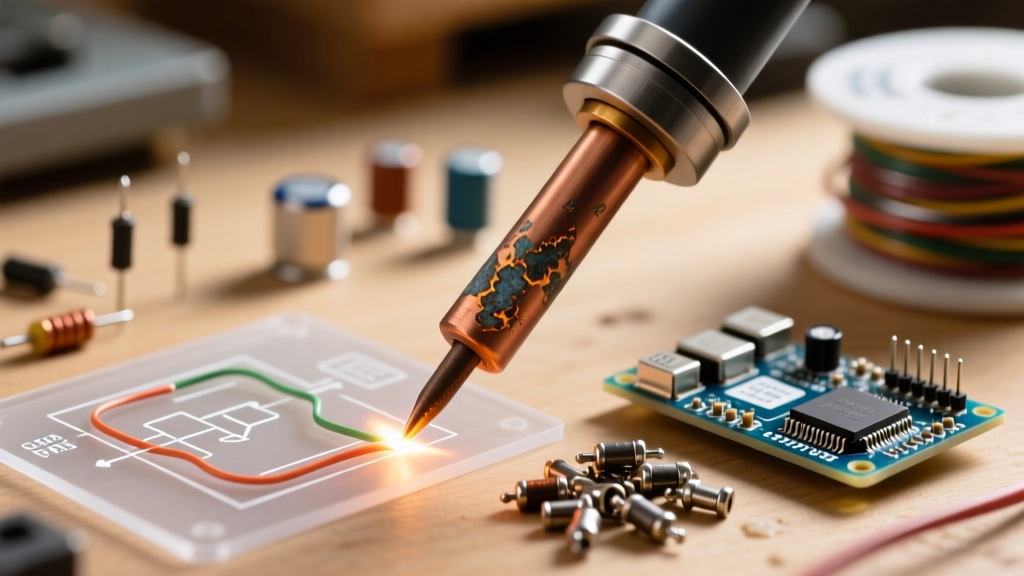
This is tip oxidation, usually caused by leaving the iron at 400°C+ while not in use. The iron is "hot," but the black iron-oxide layer acts as a thermal insulator. Always tin your tip with a thick layer of solder before placing it in the holder, and use a brass wire sponge—not a wet sponge—to clean it, as rapid cooling degrades the iron plating.
Can I use a hot air station for standard through-hole soldering?
While technically possible, it is highly inefficient. Hot air will blow the component out of the hole if the airflow is too high, and it will heat the entire board unnecessarily. Stick to a high-thermal-mass contact iron for through-hole work.
What is the ideal temperature for 63/37 Leaded Solder in 2026?
Even though leaded solder (Sn63/Pb37) melts at a low 183°C, your iron should be set between 300°C and 330°C to ensure rapid heat transfer and proper flux activation. Setting it lower will result in sluggish flow and poor wetting.